Curing Brand Australia Syndrome, Part 2


Part 2 of this mini-series of articles highlighting Australian producers making and promoting wines of quality that sing of their vineyards and regions, looks at a new producer in one of Australia’s younger yet most exciting viticultural areas: Margaret River.
A number of the wineries of Margaret River have been more successful than those in many other regions of Australia at communicating a sense of origin to consumers. The steadfast nature of its top producers to make the best wines that their land can produce as opposed to chasing the latest market research revealed craze that consumers apparently want to drink has developed into some uniquely crafted wines that can’t help but speak of their place.
The planting of Bordeaux varietals in Margaret River (Cabernet Sauvignon, Merlot, Sauvignon Blanc and Semillon) took-off as recently as the late 1960s. This was sparked by a study produced by viticulturalist / plant breeder Dr. John Gladstones in 1965 demonstrating that Margaret River had a similar climate to Bordeaux’s Right Bank. During a warm, sunny, very dry vintage in Pomerol / St Emilion this is probably accurate, though the soils of Margaret River generally have more in common with the freer-draining Medoc soils of the Left Bank.
Nonetheless, forty odd years on and judging from calibre of wines coming out of Margaret River today, Gladstones was obviously onto something. The region’s reds of real distinction are indeed the Cabernet Sauvignons, with producers such as Moss Wood, Cape Mentelle, Cullen and Leeuwin Estate leading the pack. That these Cabernets are never going to be confused with those of Bordeaux, in spite of any climactic similarities, is a great thing. Cabs from Margaret River tend to give positively perfumed wines with very pure fruit expression, though more restrained in intensity than other parts of Australia, often displaying notes of warmed cassis, cloves and a touch of mint. The tendency to blend with a small amount of other Bordeaux varietals or even Shiraz adds depth to the mid-palates, while the flesh is well structured with finely grained, firm yet accessible tannins lending persistence and ageability.
When it comes to Margaret River’s whites, the Bordeaux influenced Sauv / Sem blends can be very good but it’s the Chardonnays that really get me excited. At their best they offer a wonderful combination of intense citric and tropical fruit with a creaminess that can age wonderfully into a nutty complexity. The finest Chards may be full bodied, yet skilfully crafted silken textures and a refreshing backbone of medium to high acid provide a seamless sense of richness without being overblown.
Peccavi, Margaret River, Western Australia
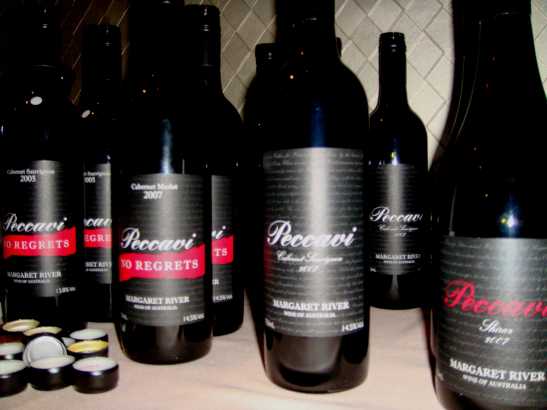
Peccavi, a bit of tongue-in-cheek Latin meaning “I have sinned”, is one of Margaret River’s newest labels owned by Singaporean based Jeremy Muller. He fell in love with Margaret River’s wines whilst living in Tokyo in the early 1990’s. Upon moving to Singapore he realised that Margaret River was only a short flight away and this proximity encouraged his wife and he to visit more and more frequently. “You feel so close to nature there with everything being unspoilt that it really is not hard to want to make it your home,” he confided.
In November 2005 Jeremy set out on a journey to make his own wine, purchasing vineyard land that had previously provided all its fruit to the highly respected Brookland Valley winery. And so despite being established vines, Jeremy has only recently begun producing wines exclusively from this vineyard’s fruit. “With 2006 being such a bad year for reds, I made the decision to sell all the grapes on,” he explained. “This meant that 2007 was then the first year that we were ready to have a red bottled using the Peccavi name, which makes it incredibly difficult to say which will be our flagship wine after such a short period. The idea behind the Peccavi label is to make the best wine achievable in each specific vineyard site.”
In June 2009 I attended a tasting in Singapore of Peccavi’s first releases. He may be a newcomer to the whole winemaking scene, but Jeremy has some clearly defined views about the style of Margaret River and the importance of holding true to the land. “There is a very distinctive style to the wines of Margaret River,” he began by telling me. “The style of the most respected reds closely follows that of its European cousins, but with a slightly more fruit forward approach; a result of delicate flavours and natural balance being able to be achieved at moderate ripeness. When all the elements come together, Margaret River reds are fine, fragrant, medium bodied with deep blackcurrant fruit and fine tannin elements, rendering lovely length and complexity with age. This also means that the tannins can be soft and generous in the warmer years, and somewhat green and stemmy in cooler years; which is why the styling of Peccavi wines is done in the vineyard and refined in the cellar, making vineyard management the key.”
This sought-after styling is apparent Peccavi’s Cabernet Sauvignon 2007, though there’s also a nice touch of spice complimenting the pure cassis fruit. His second label, called “No Regrets”, has so far produced a Cabernet 2005 and a Cab / Merlot 2007, showing a little minty / herbal character in the earlier vintage, developing into to an all around riper and better balanced style in the 2007 blend.
Regarding the white varieties, Jeremy informed me, “We are fortunate that our Chardonnay comes from the Gin Gin clone (aka Mendoza), which is widely accepted as being best suited for the region. It is then about understatement of winemaking, with a measured use of good quality French oak ensuring that the fruit is the statement - it speaks for itself. With Semillon and Sauvignon Blanc I’m not so sure that a Margaret River “style” has yet emerged and winemakers are still experimenting to find the perfect blend, for myself I have crafted a Sauvignon Blanc Semillon in the easier drinking style, focused on early drinking and enjoyment using minimal intervention.”
Jeremy also has a little Shiraz planted. “Our most recent indications are that Shiraz may also have found a home here, especially in the Northern End of the region with a wine almost Northern Rhone in style. It will be interesting to see how this evolves over the next few years.”
Production is looking to be around 4000 cases for the 2009 vintage, split between five labels, with the three Peccavi wines giving a combined total of around 1300 cases and the balance will be made up of the two No Regrets labels. An importer has been nominated in Singapore and Malaysia and Jeremy informed me that he is about to sign with people in Germany, Hong Kong, Spain, Thailand and the UK.
Jeremy concluded by saying, “The words “Margaret River” on my labels are imperative to me. For those who know the region most, expectations are extremely high, with many of Australia’s most respected wineries calling it home. For those less familiar, the name carries a tacit endorsement and implied promise of quality. This comes from the wineries of Margaret River knowing how outstanding and advantageous the region is and over the years investing significant amounts of money, time and energy to promote and preserve the image that Margaret River rightly deserves.”
Jeremy’s 2007 reds are just beginning to reveal the potential of this special piece of Margaret River. Inherent in these wines is his land’s ability to produce fruit with an impressive combination of Margaret River concentration and elegant expression. To ensure the diligent manifestation of his sites in the wines, Jeremy has secured the services of three locally experienced and respected winemakers, Brian Fletcher, Amanda Kramer and Bruce Dukes, who have used judicious means of coaxing the terroir out of the fruit for these 2007s. That Peccavi’s first Cabernet Sauvignon and Shiraz taste this polished so early-on, I eagerly await the development of these wines in the vintages to come!
Peccavi is imported in Singapore by:
J & D Burleigh Pte Ltd
Importer & Distributor of Fine Estate-Bottled Wines
3 Clementi Loop, Level 3
Singapore 129815
Tel. +65 6744 2765
Fax. +65 6744 2715
Contact. Josephine Chua
Email. josephine@jdburleigh.com
Tasting Notes
No Regrets Sauvignon Semillon 2008
87 points
Intensely scented nose with tropical aromas of pineapple, mango and lemongrass. The medium+ bodied palate provides a nice backbone of crisp acidity, balancing the concentrated tropical flavours. Long finish. Drink now. Tasted June 2009.
Peccavi Chardonnay 2006
87 points
Fragrant nose with intense aromas of melon, warm apricot and guava plus a fair bit of cedary oak. The palate it full, viscous and rich with medium to high acidity. Oak is still somewhat dominate. Long finish. Drink now to 2012. Tasted June 2009.
No Regrets Cabernet Sauvignon 2005
85 points
Medium garnet colour. Pronounced cassis and fresh blackberry notes with a touch of mint and dried herbs. The full bodied palate is slightly lacking in acidity with a moderately low level, yet has a nice core of rich, dark berry fruit flavours. Medium level of fine-grained tannins and a medium to long, minty finish. Drink now to 2012. Tasted June 2009.
No Regrets Cabernet Merlot 2007
87 points
Medium garnet-purple colour. Perfumed nose of warm blackberry, dried plums cinnamon and the faintest waft of menthol. The palate is concentrated, full bodied and nicely balanced by refreshing medium to high acidity and a medium level of velvety tannins. There’s just a suggestion of smokiness in the long finish. Drink now to 2015. Tasted June 2009.
Peccavi Cabernet Sauvignon 2007
89 points
Medium to deep garnet-purple colour. The nose is a little subdued to begin, yet vigorous swirling unearths very pretty aromas of fresh blackcurrant, crushed blackberries, cloves, cardamom and a touch of espresso. The palate gives good support to the ripe, concentrated fruit with a medium to high level of fine tannins and a medium to high level of acid. Long spicy finish. Drink now to 2016. Tasted June 2009.
Peccavi Shiraz 2007
90 points
Medium garnet-purple colour. Perfumed blackberry, violets, cumin and star anise aromas. Medium to high acidity and a medium+ level of soft, satiny tannins supports the rich dark fruit and spice flavours. Great balance. Long finish with lingering notes of black pepper and liquorice. Drink now to 2016. Tasted June 2009.