The Riesling exception


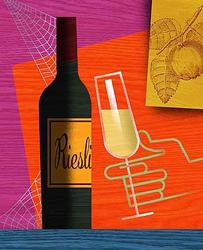
DAVID COWLES illustrator
Most people would never think to age a white wine. It’s bottles of red — and a few dessert wines — that fill up people’s wine cellars, aging patiently to perfection.
But Riesling is another story. It can actually age better than some reds out there. And nobody really knows why.
Generally, reds age much better than whites, because of the tannins in red wine, which you don’t find in whites. All Finger Lakes white wines are laced with age-worthy acidity, yet after asking around, most experts agreed that if stored well in its bottle, Riesling ages much better than other whites. I heard many theories why this is so, but no one really offered a good scientific explanation. It just is that way.
In their youth, Finger Lakes Rieslings are fruit forward and aromatic, with hints of peaches, apricots, tangerines (or melons if the grapes are grown in certain spots on Seneca Lake’s east shore). On the palate, their acidity can be quite forward too, even bracing, and there’s often a mineral-like backbone running through the wine.
Over time, Riesling’s aromatics subdue. In their place, many take on something akin to a petroleum aroma (much more appealing than it sounds; in fact, quite a few Riesling lovers look forward to the aroma). At the same time, the acidity sensation softens considerably, opening up layers of complexity and lushness. The mineral notes often becoming stronger and more intriguing.
Last May, I got a true experience of how Rieslings can age when I attended a special tasting from Konstantin Frank’s Vinifera Wine Cellars’ wine library. The collection included 11 wines — from dry to sweet — spanning 24 years: from 2008, ‘07, ‘05, ‘01, ‘95, ‘91, ‘88, ‘87 and ‘85.
As expected, the earlier brightness and forwardness of each wine slowly morphed from year to year into evolving layers of nuance and complexity. Even the wine from 1985, which had been oxidized by a bad cork that allowed air to seep in and wine to leak out, still offered a complex and compelling structure that spoke to the wine’s power and grace.
There’s no doubt that many of us drink Finger Lakes Rieslings well before they have had a chance to show their real stuff, which is why it’s extremely difficult to find older ones on store shelves. Your best bet is to stay in touch with one or more winemakers and hope that you can one day secure an invitation to a library tasting at the winery.
If you’re patient, the next best thing is to age some Rieslings at home. Consider buying two cases each of your favorite new Riesling release. Drink from one of the cases as you desire, and make notes if you want to keep a serious comparison. Put the other case in storage at a constant temperature of about 60 to 65 degrees. Each year, open a bottle from that case, and make more notes. After 12 years, you’ll have completed an interesting aging experiment — and likely enjoyed some great new flavors.
I guarantee your tastings will go as well as the 24-year one that I recently experienced, provided that you choose your Riesling wisely. Recently, the Finger Lakes region has been graced with back-to-back good vintages for age-worthy Riesling. Belhurst Winery winning Best of Show at the 2009 New York State Fair Wine Competition for its 2008 Semi-Dry Riesling illustrates this fact beautifully. But so, too, do other Rieslings.
Enjoy —and drop me a line in 12 years to let me know how you did with your Riesling choices.