Finger Lakes Grape Prices Lower


Excess unsold wine stocks force prices down despite smaller harvest
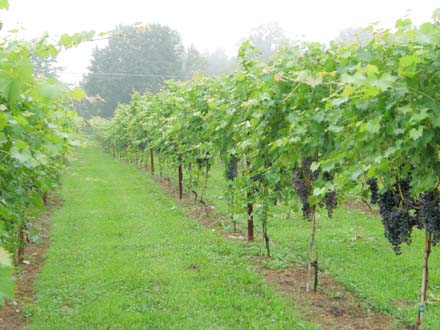
Grapes in the rain: Even though unusually wet weather reduced the Northeast's winegrape crop this year, many varieties remain in surplus, and their prices have dropped.
Penn Yan, N.Y. -- It's been a tough year to grow grapes in New York state. A May 18-19 frost in the Lake Erie region brought leaf damage and killed primary buds. Poor fruit set, delayed ripening and disease problems occurred because of the cool temperatures and rainy conditions across the entire state. As a consequence, grape production is expected to drop from 172,000 tons in 2008 to 140,000 tons this year.
Even though a decrease in production is predicted statewide, most grape prices in New York's Finger Lakes in 2009 also are down from those paid in 2008. Hans Walter-Peterson, viticulture extension specialist with the Finger Lakes Grape Program, attributed the price weakness to a surplus of grapes.
A major factor affecting prices is the higher-than-normal inventory of wine from previous years that many state wineries now have. The economy has definitely had an impact on both tourism and wine sales in the Finger Lakes region.
The extent to which prices were lowered by different buyers was quite variable, Walter-Peterson said, with prices for Riesling, for example, ranging from no change to one-third less than in 2008.
The biggest price change from 2008 to 2009 was for Gewürztraminer, where the average price per ton dropped $198, from $1,638 to $1,440. Two other losses exceeding 11% were Riesling, down $167, from $1,584 to $1,417; and Cabernet Franc, which lost $154, from $1,396 to $1,242. Prices for most hybrid and native American varieties also declined.
A list of grape prices is available below, courtesy of the Finger Lakes Grape Program in Penn Yan. Of the eight vinifera varieties with seven or more wineries posting prices, all were down. In addition to the three varieties listed above that had the sharpest losses, Lemberger dropped $131 per ton; Pinot Noir, $128; Cabernet Sauvignon, $90; Pinot Gris, $85 and Chardonnay, $74.
Six wineries posted prices for hybrid varieties. Five of the six dropped in price: Traminette, $57 per ton; Vignoles, $44; Seyval and Cayuga White, $33; and Vidal, $7. One variety, Rougeon, was $3 higher.
Four other varieties showed strength: GR7, $549 to $579 a ton; Chelois, $725 to $775; Chancellor, from $680 to $700; and Aurore, $381 to $393. Three of the four varieties in the native American category showed small losses, Niagara, $9; Concord, $5 and Catawba, $4. Delaware gained $12, from $387 to $399.
New York state wineries that purchase more than 5 tons of any grape variety are required to publish the prices they will pay by Aug. 15 each year. According to Walter-Peterson, some of the prices reported are prices paid by wineries for their own fruit. Others may be contracted prices between growers and wineries.