Riesling in Asia


Riesling sales in Asia are lamentable. For a start, most of the markets of Asia are dominated by red wines. The majority of whites consumed in the Far East are Chardonnay. And Riesling has a lousy reputation over here, still shackled to its former association with cheap, poor quality Liebfraumilch and the like. Even in the more mature, urban markets of Tokyo, Hong Kong and Singapore, you can sometimes be hard-pressed to track down anything remotely racier than a revamped label of Blue Nun.
Like many living in Asia I’ve become slightly more of a red wine drinker, but when I do drink white nowadays I’ll overwhelmingly opt for a good Riesling. While I appreciate the lighter body and crisper style that this grape produces what I really love is its incredible spectrum of aromas and flavours not to mention its potential for terroir expression, aging and exceptional quality. Most occasions I’ll head for the drier styles though a touch of sweetness can be welcome, according to what I’m eating. At the end of meals often in lieu of dessert I’ll choose a late harvest or botrytised Riesling, which tends to be a little crisper, lighter and less alcoholic than other sweet wines.
Ah but if only I had a drop of Clos Saint Hune for every time that a Riesling producer has bemoaned to me that their Asian sales should be better because Riesling is so compatible with Asian food, I could retire to my desert island by now subsisting purely on that exquisite nectar. That Riesling is the ideal food partner for Asian cuisines is a whopping generalisation. It’s a bit like saying Cabernet Sauvignon goes with Western food. Yes, but. There are a number of Asian foods and Riesling styles that work beautifully. Yet there are just too many styles of Asian cuisines not to mention Rieslings to make such a broad claim.
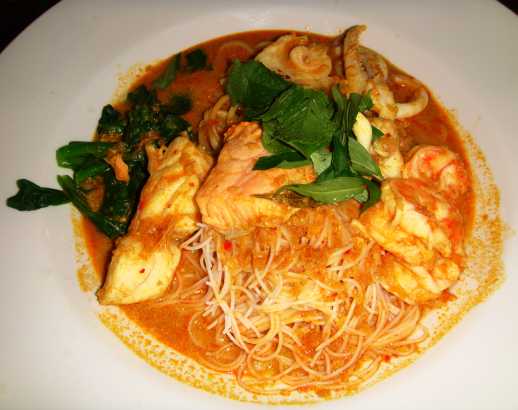
That said, the residents of Asia are missing out on some extraordinary wine experiences by snubbing Riesling. Particularly in South East Asia where the heat and the spice levels are turned up a few notches, a chilled, tangy, boldly-flavoured Riesling with a touch of sweetness can really hit the spot, with or without food. Here in Singapore one of my favourite local combos is Hokkien hae mee (fried noodles with prawns) and New Zealand Riesling. With Hainanese chicken rice, a dry Alsace or Austrian Riesling can be superb. And Thai green curry made with fish, chicken or prawn is delicious with a German Riesling Kabinett or Spatlese.
So it’s perhaps been a rather selfish endeavour that over the last few months I’ve been sniffing out opportunities to taste and acquire good Rieslings in Asia. My quest began with a bang last December when I attended an amazing tasting of 2007 German Auction Rieslings in Jakarta hosted by the Singapore based wine merchant, Artisan Cellars. For many of the ardent Indonesian collectors attending this tasting, this was their very first taste of Riesling at this pinnacle. And though the wines were criminally young and relatively mute, such was their calibre that they could not fail to impress. Once again you have to hand-it to Artisan Cellars, not just for their incredible selection of Rieslings from Schloss Lieser, Willi Schaefer, Dönnhoff and Egon Müller, but for busting free of the SE Asian Bordeaux rut and breaking new and exciting ground with this event!
Back in Singapore in April 2009 I had the privilege to meet with the family members of two top German estates, both with a long history for producing Rieslings going back many generations: Heymann-Löwenstein and Robert Weil.
 Reinhard Löwenstein of Weingut Heymann-Löwenstein
Reinhard Löwenstein, of Heymann-Löwenstein in the Mosel-Saar-Ruwer, began our conversation by pointing out, “I have five hundred years of tradition in my bones.” For him the Riesling grape is exclusively a means for expressing his terroir. “I don’t want to make Riesling; I want to show the taste of the soil.” I sampled a mini-vertical of his Riesling Uhlen Roth Lay, a unique style of Mosel Riesling that he started producing experimentally from 1980 and commercially from 1995. Uhlen Roth Lay is bone dry with more alcohol and weight than the standard for German wines of this quality. “This is actually the new old style,” he informed me. In fact, the first sweet wine made by his family was not until 1961, so with this style he is harking back to his original heritage. Harvested at the equivalent of an Auslese level (resulting in around 13% alcohol), this truly special Grand Cru Riesling is produced with long skin contact of 12-48 hours followed by wild yeast ferments and 18-20 months on fine lees – extraordinary.

“People will discover Riesling, it’s just a matter of time,” Wilhelm Weil remarked with a confident smile. “We need to understand how to make our wines easier for consumers to understand without losing the character.” Wilhelm is the great grandson of the original Robert Weil that established the eponymous winery in 1875 in the Rheingau. He made his first anticipated visit to Singapore in April as part of the World Gourmet Summit, featuring him and his Rieslings as the superstar compliments for a feast of Foie Gras. “Asian markets feel more and more that wine is part of culture as is food,” he commented, encouraged by the progress in sales of his wines since he entered the SE Asian market seven years ago. Though his wines are so sought-after they could easily be sold just within his domestic market, his goal is to even the balance of sales between the North American, EU and Asian markets. “Export is very important to us in terms of reputation and tradition. One hundred years ago there were four great wines in the world: Bordeaux, White Burgundy, Red Burgundy and German Riesling.”
Fast-forward to June 2009 - I was treated by my good pal and fellow journalist Curtis Marsh to a fantastic home-cooked Malaysian lunch, prepared by his very talented wife and her mother. The luncheon was in honour of visiting producer Stephanie O’Toole, owner / winemaker of Mount Horrocks, Clare Valley, South Australia. Malaysian salt-cooked chicken stuffed with don quay chased by a mild Penang-style seafood curry were triumphant matches with the dry, intensely fruited, brazen flavours from this Riesling hot-spot down-under. Lunch was served with a vertical of Mount Horrocks Watervale Rieslings, 2005-2008. This was followed by three vintages of Stephanie’s Cordon Cut Riesling perfectly paired with lemon tart. Her cordon cut method of producing sweet Riesling from grapes raisined on the vine has been perfected over the years by Stephanie to produce her signature sweet, unctuously textured, candied-fruit style.
More recently my Riesling quest continued in Tokyo in July 2009 when I organised a tasting of what little some of the Japanese importers had to offer from this grape. The response to my request for importer suggestions of their Rieslings from around the world was sluggish and the ensuing lists were lacklustre. The very mention of an article dedicated to Riesling seemed to bewilder the Japanese. Clearly some myth dispelling is in order here, not least of all because Riesling in its many guises can make an excellent accompaniment with so many Japanese dishes: sashimi, tempura, uni, crab, yakitori, udon, unagi and shabu shabu – just to name a few!
To follow are the tasting notes of around fifty wines that were sampled during my (on-going) quest to find good Rieslings in Asia.