Virginia's emerging grape and wine industry benefits from university's expertise


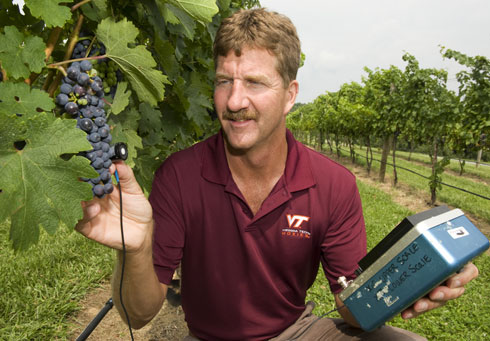
Tony Wolf measures sunlight interception at the level of the grape cluster to quantify fruit cluster exposure.
Tony Wolf, professor of horticulture, and Bruce Zoecklein, professor of food science and technology both in the College of Agriculture and Life Sciences, are recognized around the world for their research and outreach in the areas of viticulture and enology. Through their work with Virginia Cooperative Extension, Wolf and Zoecklein are directly impacting the growth of the commonwealth’s grape and wine industry.
Nearly 200 years after Thomas Jefferson planted more than 30 European grape varieties in Virginia, the challenging and very unique “terroir,” or the soil and climate of an area, has produced some of the most prominent wines in the United States.
“Winemakers and growers are interested in a broad range of topics related to grape growing, so we’ve been able to provide the industry with knowledge on what it costs to grow grapes, what the vineyard site limitations are, what varieties should be grown in specific sites, and then how to grow those varieties,” said Wolf.
Wolf is involved with a number of projects to improve grape quality and increase grape-cropping efficiency. Some of this work entails modified training and canopy management practices, while other work is aimed at intentionally limiting the amount of canopy development on overly vigorous grapevines. The canopy is the vine’s assemblage of foliage, fruit, stems, and leaves.
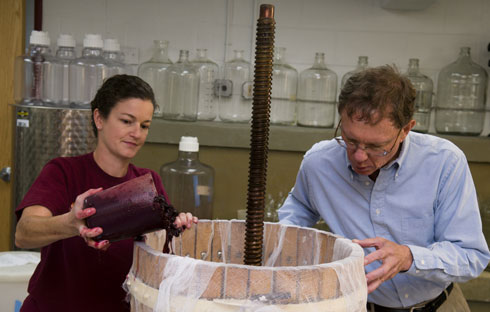 Bruce Zoecklein and Lisa Pelanne, a research associate in the Department of Food Science and Technology, prepare a sample of wine in the Virginia Tech Wine Lab.
On the other side of the industry, Zoecklein leads the Wine/Enology Grape Chemistry Group at Virginia Tech to support the growth and development of the wine industry. Along with a team of researchers from the Department of Biological Systems Engineering, he has developed an electronic nose that can determine grape maturity and can dictate the best time to harvest the grapes.
“We are using this new technology to be able to go into a vineyard and nondestructively measure the volatiles while the fruit is still on the vine,” said Zoecklein, who oversees the Enology Service Lab, an analytical laboratory service that conducts chemical, physical, microbiological, and sensory analysis on grapes and wines for the industry. “This will lower the cost of production and increase wine quality.”
According to Zoecklein, by analyzing nitrogen components in the grape itself, he and his team can predict the desirability of the wine. In doing this, they are able to make recommendations to grape growers on how to maximize the aroma and flavor of their grapes. He is also working with wine producers to ensure that they select the best grape cultivars for the region’s soil quality and climate.
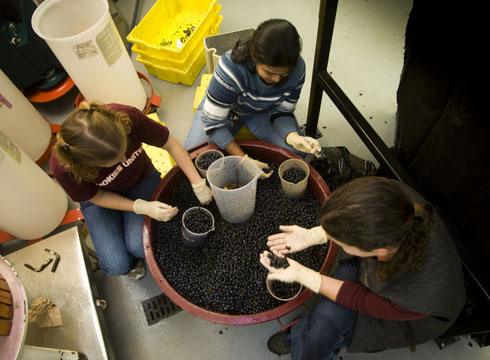 Graduate students in the Department of Food Science and Technology sort through grapes for wine research.
“In addition to our research programs in viticulture and enology, we have a tremendous Extension force that is also helping us here on campus, at some of the off-campus AREC facilities, and also out at the unit offices,” Wolf said. “Our goals are to provide educational resources and to research problems or constraints to further development and profitability of the Virginia wine industry.” He added that Extension specialists and agents offer assistance on everything from winery design and vineyard site evaluation to research-based solutions to specific grape and wine production issues.
Wolf and Zoecklein said they are optimistic about the growth of Virginia’s wine industry. While Zoecklein hints at a growing trend in the importance of regionalism, Wolf cites the opportunities of a young industry to gain recognition with unique varieties and the industry’s popular ties to agritourism.
“We have to be adaptable. We have to be willing to take some risks in terms of new varieties. Virginia is already a leader in the mid-Atlantic region, and I think the outlook for the future is very bright and very positive,” said Wolf.