GUEST OPINION: Sonoma County water decision was not made in haste, Kelley says


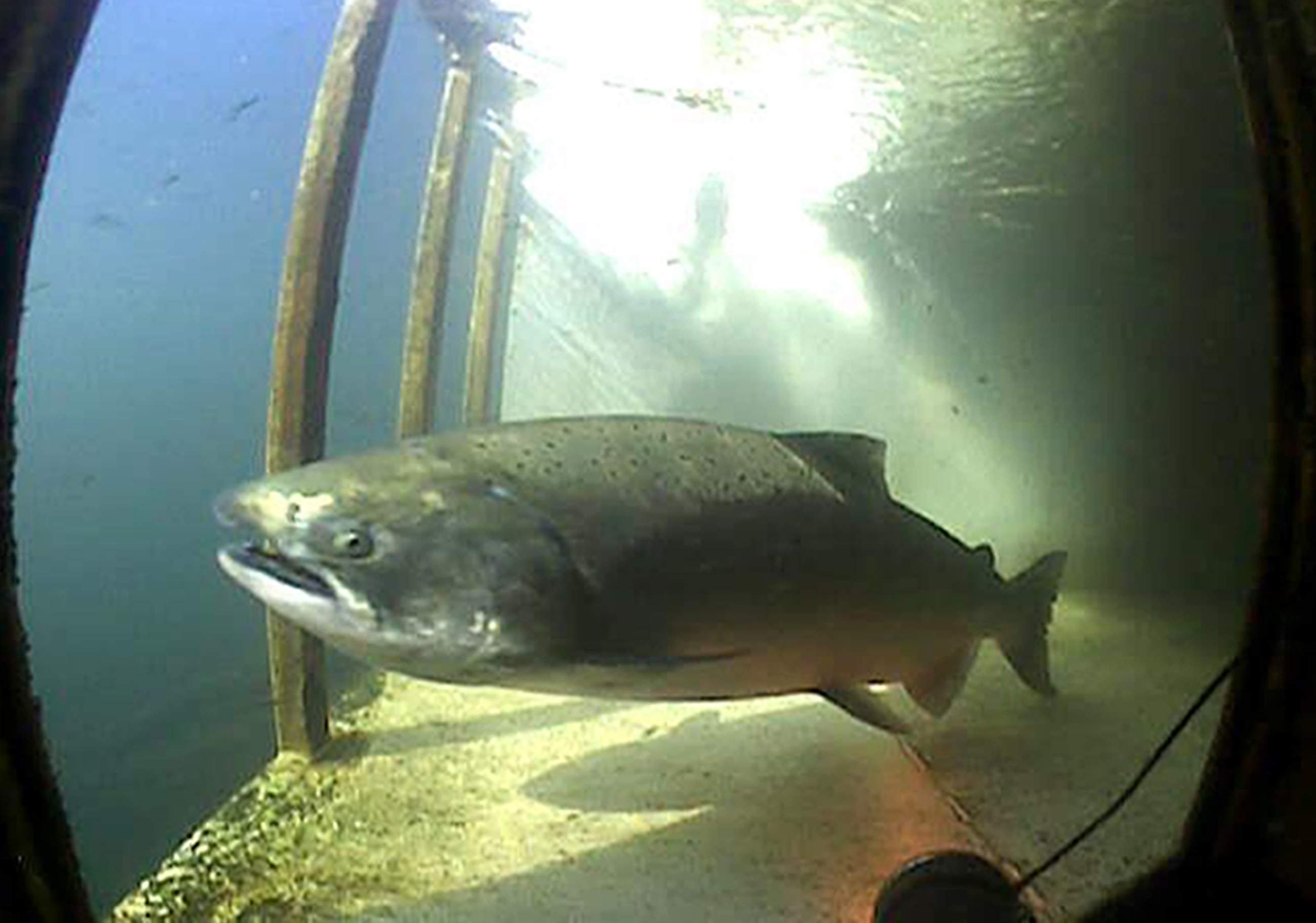
Courtesy Sonoma County Water Agency, 2007 A chinook salmon swimming up the fish ladder on the Russian River at the Mirabel Dam, near Forestville.
As chairman of the Sonoma County Water Agency board of directors, I’ve heard some criticism of the Sept. 15 unanimous decision by the board to set aside a long-standing water project. Comments from respondents to a recent Press Democrat survey on the decision also indicated a lack of understanding about some of the facts. I’d like to clarify a few key points.
The water project is outdated. For nearly two decades, the Water Agency has pursued a water supply plan (known as the “water project”) that includes taking an additional 26,000 acre-feet of water from Lake Sonoma (via Dry Creek and the Russian River) and building the infrastructure to deliver this water. This 20-year-old plan is no longer feasible.
One year ago, on Sept. 24, 2008, the Russian River Biological Opinion was released by the National Marine Fisheries Service. This document requires the agency to spend more than $100 million on activities to help steelhead, chinook salmon and coho salmon over 15 years. It also mandated that the Water Agency ask the state Water Resources Control Board for less water in the river during the summer in order to improve conditions for threatened fish.
The water project, meanwhile, required asking the state board for more water and an increase in summer flows. These two requests are in conflict.
The Water Agency’s customers tout a Dry Creek pipeline as a magic solution to this problem. But in these lean economic times, it is clear that ratepayers cannot afford the costs of complying with the biological opinion, building a Dry Creek pipeline and building the rest of the water project facilities.
Given these inconsistencies and financial constraints, for the board, it came down to a simple question of priorities: Should we focus on securing our current water supply by delaying a request for more, or should we focus on pursuing additional water for the future, risking what we have today?
Since failure to comply with the biological opinion would put our existing water supply system at risk, we chose the prudent course of protecting what we have by setting aside the water project.
There will be enough water to go around. None of our customers (which include seven cities and two water districts) will be left high and dry. Last year, the Water Agency delivered about 55,000 acre-feet of water to these communities. Our current state permit allows us to deliver up to 75,000 acre-feet.
With careful conservation, retrofit programs (like the one just launched in many areas of the county for high-efficiency toilets and appliances), increased use of recycled water and other measures, we will have plenty of water to meet local needs for many years.
As Santa Rosa Mayor Susan Gorin and Rohnert Park City Councilman Jake Mackenzie pointed out in Tuesday’s Close to Home (“Water planning requires everyone’s input”), our local residents and businesses have done a tremendous job conserving water. Our board expects that with new technologies and ongoing education, these conservation levels will continue to increase into the future.
We continue to develop future options. On Sept. 15, the board committed significant financial resources to studying and pursuing 12 strategic options to ensure water for our children and grandchildren. Some of these strategies, such as developing additional opportunities for conservation and reuse, are well-known and proven locally. Other strategies, such as storing plentiful winter water in aquifers for use in the summer, have been used successfully in many communities. The plan that emerges will ensure water for the future and will be economically and environmentally sustainable.
We won’t lose our water rights. The Water Agency has rights to store and use, in the future, about 200,000 acre feet of water in Lake Sonoma. We are absolutely not giving up the rights to that water — and will fight to keep every drop for future needs.
This decision wasn’t made hastily. Since the Biological Opinion was issued, it's become increasingly clear to the board that the Water Agency needed to rethink its long-term water supply plans. For this reason, the board held a water supply workshop in early April to discuss strategic options and directed staff to meet with all water contractors and the public to get feedback. All the contractors and several community groups have seen the presentation. (To date, the contractors have failed to provide feedback to the Water Agency.)
At hearings before the state Water Resources Control Board, the agency has been very clear that the biological opinion was going to require a change in tactics and approach. Given these events, the Sept. 15 decision was anything but hasty.
That being said, the Water Agency should have done a better job in notifying its contractors and the community about the recommended action to set aside the Water Project. As a board, we’re committed to better, clearer communications from the agency to contractors and stakeholders.
Anything having to do with water elicits passionate responses from Californians. Our board understands and appreciates these strong emotions. But we also want to be clear that as public stewards of the water system, we take our responsibilities seriously. We are committed to ensuring and protecting our community’s current and future water supply.