The White Horse Temple


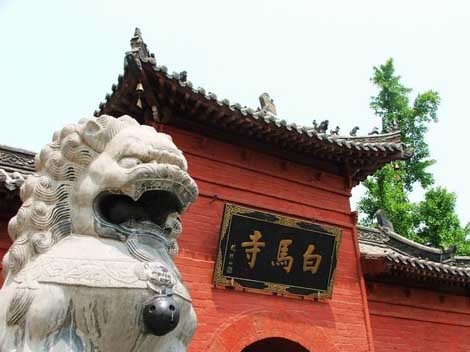
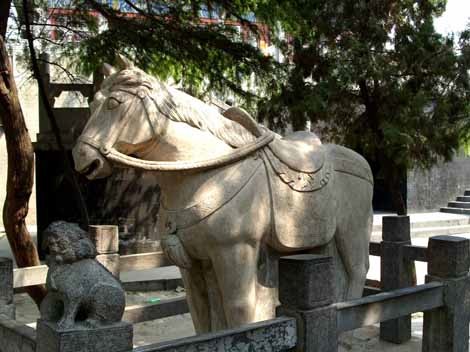
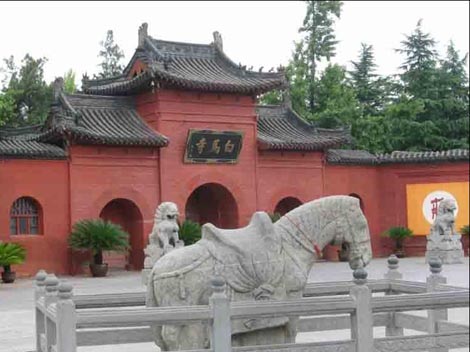
The White Horse Temple, crowned as “the First Ancient Temple of China”, is located 12 kilometers east to Luoyang City, Henan Province. It was the first temple established in mainland China after Buddhism was spread in the country. First built in 68 A.D. in the Eastern Han Dynasty, the temple was named after the white horse for carrying back Buddhist statues and sutras from Tianzhu (today’s India) along with two imperial envoys. It takes an important position in the history of China’s Buddhism.
Facing the south, the White Horse Temple, with a rectangular court covering about 40,000 square meters, consists of 5 principal halls, four big courtyards and east and west wing rooms. The five principal halls are the Heavenly Guardian Hall, the Hall of Grand Buddha, the Hall of Mahavira (Great Hero), the Jieyin Hall and the Pilu Hall from south to north, each of which enshrined Buddhist figures carved in the Yuan, Ming and Qing Dynasties. In addition, over 40 stele inscriptions are preserved, which are invaluable for the study of the history of the temple. There’s a 13-storey Qiyun Pagoda that was rebuilt in the Jin Dynasty (1115-1234), 30 meters eastward to the gate of the temple, with a history of over 800 years.
At present, the White Horse Temple is designated one of the national cultural relics protection units and national 4A certificate scenic spots. The monk priests of the temple have frequently visited other Asian countries and greeted friends from afar, conducting friendly exchanges to disseminate Buddhist culture.