Turn Winery Wastewater Into Hydrogen


Microbial electrolysis demonstrated by Penn State at Napa Wine Co.
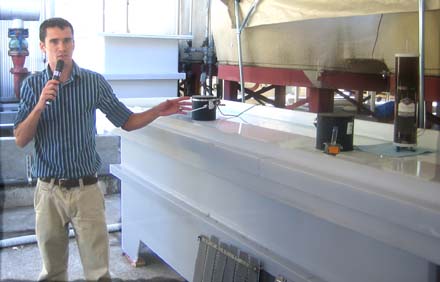
The demonstration microbial electrolysis wastewater processor will convert about 1,000 liters of wastewater daily.
Oakville, Calif. -- A new process using a microbial electrolysis system developed at Pennsylvania State University might someday allow wineries to convert their wastewater into hydrogen gas for use in vehicles and generating electricity. An expanded version also could convert municipal wastewater into energy -- and even desalinate seawater.
Winery and other waste already can produce energy, primarily in the form of methane, which can be burned but gives off carbon dioxide, an undesirable waste product that contributes to global climate change. When hydrogen is burned in a car engine or used in a fuel cell, the only waste product is water vapor, which can be cooled to pure water.
The first demonstration of a renewable method for hydrogen production from wastewater is underway at the Napa Wine Co. in Oakville. The refrigerator-sized hydrogen generator processes winery wastewater with bacteria and a small amount of electrical energy to convert the organic material leftover from winemaking into hydrogen, according to Bruce Logan, Kappe professor of environmental engineering at Penn State, who developed the process.
Logan said, "This is a demonstration to prove we can continuously generate renewable hydrogen and to study the engineering factors affecting the system performance."
The amount of hydrogen generated is too small for energy use at present. The hydrogen produced will be vented, except for a small amount that will be used in a hydrogen fuel cell. Eventually, Napa Wine Co. would like to use the hydrogen to run vehicles and power systems.
Napa Wine Co.'s wastewater comes from winemaking, cleaning equipment, grape disposal and other processes. Andy Hoxsey, managing partner of Napa Wine Co., is an ardent environmentalist who also farms 600 acres of vines organically. The company already has on-site wastewater treatment and recycling.
Hoxsey said he learned about the Penn State work, which up until now has been done in teacup-sized equipment, by Googling around the Internet. He invited the university to use his winery as a demonstration site. "Our wastewater is ideal, because we don't use chemicals or solvents, so the wastewater isn't contaminated with metals and other toxic compounds. "
Logan added, "We chose a winery because it is a natural tourist attraction. People go there all the time to experience winemaking and wine, and now they can also see a demonstration of how to make clean hydrogen gas from agricultural wastes."
The demonstration microbial electrolysis plant is a continuous flow system that will process about 1,000 liters of wastewater per day.
Microbial electrolysis cells consist of two electrodes immersed in liquid. Logan's system uses electrode pairs of one carbon anode and one stainless steel cathode, rather than an electrode coated with a precious metal like platinum or gold. Replacing the precious metals reduces cost. Because the solution isn't very conductive, the electrodes have to be very closely spaced.
Wastewater enters the cell, where naturally occurring bacteria convert the organic material into electrical current. If a slightly higher voltage is added to that produced by the bacteria, the process produces hydrogen gas electrochemically on the stainless steel cathode. The natural voltage for water electrolysis is 1.2 volt, but with the added microbial activity, it drops as low as 0.114 volt.
The demonstration plant is made up of 24 modules. Each module has six pairs of electrodes.
Technically, the cell utilizes an electrochemical process in which exo-electrogenic bacteria oxidize the biodegradable material and produce electrons and protons at the anode. When bacteria oxidize a chemical, they capture the electrons and transfer them to a series of respiratory enzymes used to store energy (in the form of ATP) within the cell. The electrons are then released to an electron receptor such as iron, nitrate, sulfate or oxygen.
The same bacteria that can respire using iron have recently been found to be able to transfer electrons to an electrode. In a microbial electrolysis cell (MEC), hydrogen gas is evolved at the cathode through the recombination of electrons with protons, assisted by additional voltage supplied by an external power source.
The cells have demonstrated high efficiency in the laboratory, but so far, the large-scale demonstration is getting up to speed slowly. "It's a 1,000-time increase in scale," Logan said.
Hoxsey added, "You have to build up the activity. It's not working up to expectations yet. "
To prime the process, the operators got some sludge from a municipal water treatment plant; output has been rising steadily. The plant is now producing about 0.2 ampere of electricity to fuel the hydrogen generation, and expects that to rise 200-fold. It is also producing some methane and sulfur products. The ideal level of BOD (bacterial oxygen demand) is 1,000 to 1,500, but the winery water varies between 500 and 4,000.
The bacteria are naturally occurring, not engineered or cultured.
The partially treated water from the microbial electrolysis system will join other water for further treatment and use in irrigation. "The composition of the wastewater will change throughout the year, " Logan said. "Now it is likely to be rather sugary, but later it may shift more toward the remnants of the fermentation process." The bacteria that work in the electrolysis cells will consume either of these organic materials.
The project is supported by Air Products & Chemical s Inc., the Water Environmental Research Foundation Paul L. Busch Award and other donors. Brown & Caldwell, an environmental engineering consulting firm, was contracted to build the demonstration plant. The Napa Wine Co. is donating its facilities and wastewater for the demonstration.