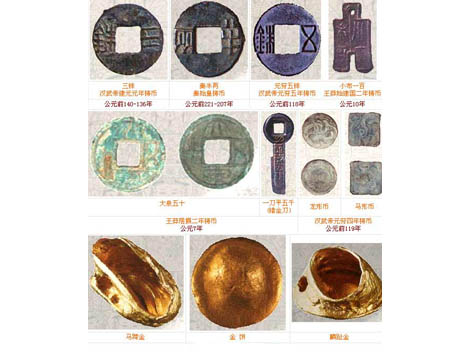
Currency in the Qin and Han Dynasties


Currency was unified by Emperor Qin Shi Huang after he unified China. Gold was considered as high-grade currency, and "banliang", the round copper coin with a square hole in the middle, was regarded as low-grade currency; they were circulated nationwide.
During the reign of Emperor Wudi of the Han Dynasty, "wuzhu" was the currency circulated nationwide, and old currency was forbidden to be used. Gold was the high-grade currency, measured by jin (half a kilogram) as the unit; copper coin was the second-grade currency, used for exchange by the commoners. The "wuzhu" coin, medium-sized and neither too light nor too heavy, was a kind of casting coin developed relatively successfully in the history of Chinese currency. It kept being used until the late Sui Dynasty, lasting for 700-odd years.
For the convenience of collection and usage, gold was cast into square, round, hoof shape or gold-ingot shape and generally used for block trade in the Han Dynasty.
When new dynasty was founded by Wang Mang, he abrogated the currency in the Western Han Dynasty and cast "Xiaoquan Zhiyi" to replace "wuzhu" coins. In addition, he reformed the currency system for three times, but was unable to solve the social conflicts, and aggravated the financial confusion instead. The currency used by Wang Mang regime was elaborately made, and the characters were beautifully written, some even gilded; it was a fine art of ancient coins.