Jackson Family Wines opens huge Napa warehouse


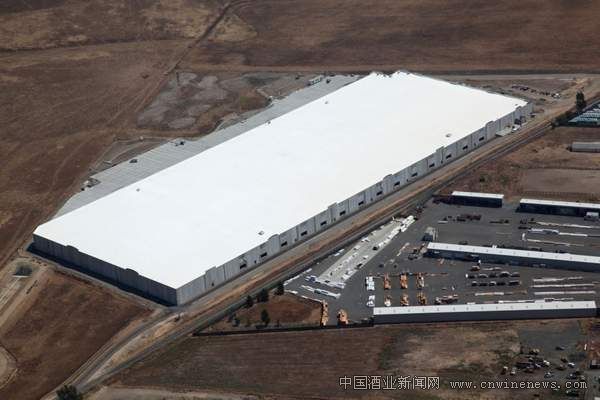
Jackson Family Wines Jackson Family Wines' new 650,000-square-foot refrigerated facility — bigger than 10 football fields — is nearing completion in American Canyon.
Jackson Family Wines, Sonoma County’s largest wine company, is consolidating its warehouse operations into one massive, $29 million distribution facility south of Napa.
The 650,000-square-foot refrigerated facility — bigger than 10 football fields — is nearing completion in American Canyon. Designed with energy-saving features, it fits in with the company’s conservation strategies, an official said. In a 15-month period ending in December, Jackson Family Wines projects it will have saved from all its operations enough energy to power 1,000 homes for one year.
“It’s a comprehensive and costly approach, but it does result in great benefits to operational costs in the long run,” said Robert Boller, vice president of sustainability for the Santa Rosa wine company.
Jackson Family Wines is the largest wine group in Sonoma County, marketing wine under its flagship Kendall-Jackson label and about 30 different wine brands. It sold an estimated 5.6 million cases of wine last year made from 14,000 acres of vineyards around the state.
The company will share the distribution facility with Biagi Bros., a Napa-based transportation and warehouse company started by two brothers born in Santa Rosa. Biagi Bros., begun by Fred and Greg Biagi, will use 27 percent of the facility’s space for its business and will operate the remainder for Jackson Family Wines.
The wine company now leases 10 warehouses in Sonoma, Napa and Solano counties. But by February all the wine storage and shipment will take place at the American Canyon facility, which is capable of handling up to 5 million cases of wine a year.
The distribution center, developed by Scannell Properties of Indianapolis and built by Sierra View Company of Granite Bay, features a 1,900-foot railroad spur. Jackson Family Wines selected the location because of the existing rail line and because of the land’s proximity to Interstate 80 and other highways, Boller said. The facility will keep wines at a temperature of 54 to 60 degrees. And the wine’s quality will be better protected by reducing the number of times it is moved, Boller said.
The developer is seeking a silver certification for the building under the Leadership in Energy and Environmental Design program. The facility is projected to use 60 percent less energy than a similarly sized building using standard construction, Boller said.