Taklamakan Desert


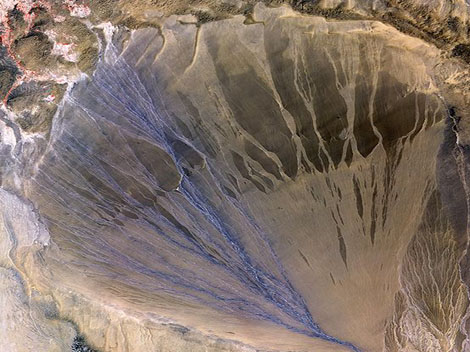
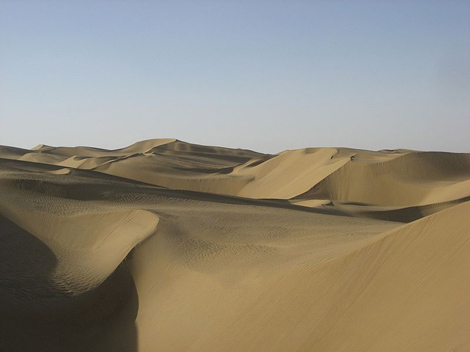
The Taklamakan Desert (塔克拉玛干沙漠), also known as Taklimakan, is a desert in Central Asia, in the Xinjiang Uyghur Autonomous Region of the People's Republic of China. It is bounded by the Kunlun Mountains to the south, and the Pamir Mountains and Tian Shan (ancient Mount Imeon) to the west and north. The name is a Uyghur borrowing of Arabic tark, "to leave alone/out/behind, relinquish, abandon" + makan, "place". Popular accounts claim that Takla Makan means "go in and you will never come out".
Taklamakan is one of the largest sandy deserts in the world, ranking 15th in size in a ranking of the world's largest non-polar deserts. It covers an area of 270,000 km2 (100,000 sq mi) of the Tarim Basin, 1,000 kilometres (620 mi) long and 400 kilometres (250 mi) wide. It is crossed at its northern and at its southern edge by two branches of the Silk Road as travelers sought to avoid the arid wasteland. In recent years, the People's Republic of China has constructed a cross-desert highway that links the cities of Hotan (on the southern edge) and Luntai (on the northern edge).
There is no water on the desert, and it is hazardous to cross. Merchant caravans on the Silk Road would stop for relief at the thriving oasis towns.
The key oasis towns, watered by rainfall from the mountains, were Kashgar, Marin, Niya, Yarkand, and Khotan (Hetian) to the south, Kuqa and Turpan in the north, and Loulan and Dunhuang in the east. Now many, such as Marin and Gaochang, are ruined cities in sparsely inhabited areas in the Xinjiang Autonomous Region of the People's Republic of China.
The archeological treasures found in its sand-buried ruins point to Tocharian, early Hellenistic, Indian, and Buddhist influences. Its treasures and dangers have been vividly described by Aurel Stein, Sven Hedin, Albert von Le Coq, and Paul Pelliot. Mummies, some 4000 years old, have been found in the region. They show the wide range of peoples who have passed through. Some of the mummies appear European. Later, the Taklamakan was inhabited by Turkic peoples. Starting with the Tang Dynasty, the Chinese periodically extended their control to the oasis cities of the Taklamakan in order to control the important silk route trade across Central Asia. Periods of Chinese rule were interspersed with rule by Turkic, Mongol and Tibetan peoples. The present population consists largely of Turkic Uyghur people.