Sustainable Ag Expo Promotes Healthy Farms, Environments, Communities


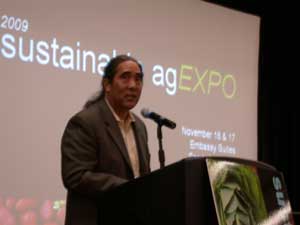
A.G. Kawamura, secretary of the
California Department of Food and Agriculture.
The 2009 Sustainable Ag Expo, presented by the Central Coast Vineyard Team on November 16 and 17, promoted “healthy farms, healthy environments and healthy communities.” The fifth annual gathering was held at the Embassy Suites and Conference Center in San Luis Obispo, California.
While the focus of the meeting was mostly oriented toward California and the central agricultural regions, the issues discussed and hot-button topics were relevant to growers anywhere in the country. Concerns for agricultural sustainability are universal and this year’s agenda touched on many: social equity and economics, tools for long-term viability, workers' compensation, tightening labor laws, continuing water issues, regulation, urban buffers and the critical need for community educational programs.
The vital interaction between grower perspective and community awareness is becoming increasingly important and is expected to be more demanding in 2010. As a result, there is an emerging ethic within the agricultural community for wise stewardship: to protect working lands, habitat and watersheds as they face growing urban expansion and rural residential development.
During the last 20 years in California alone, more than one-half million acres of productive farmland has been converted to non-agricultural uses. It is important now, more than ever, to interact with communities to educate people about the importance of agriculture sustainability. This was part of the message delivered by A.G. Kawamura, secretary of the California Department of Food and Agriculture, this year’s keynote speaker.
To document how few people are responsible for the country’s food resources, Kawamura cited “that only 2 percent of the people in our country supply the remaining 98 percent with food. Unfortunately the vast majority of people have little or no interaction with farming.
“In addition, in most third world countries, where large percentages of the population may engage in agriculture, only about 50 percent of production actually makes it to the plate. In the United States we throw away 35 percent after it gets to the plate,” Kawamura said.
This disconnect between production and consumption is the root of the problem for the ag industry. Kawamura added, “People with agendas also begin to sway public opinion, which soon becomes political and begins to drive policy.
“People still cling to bad issues like DDT or E.Coli outbreaks,” he said. “We need to convince people of the inherent importance and viability of the agricultural community.
“Unfortunately we do not have a collective voice and this is a result of agriculture being so divided among itself,” Kawamura concluded.
L. George Daniels, vice-president of the Farm Employers Labor Service, addressed additional issues facing agriculture in 2010. Daniels reviewed problems from the “no-match social security letter” saga and suggested homeland security would become more visible than ever. Daniels said Form I-9, which now requires all employers with new hires to verify their identity and authorization to work in the United States, would become even more important.
“Be prepared for visitations of inspectors from Cal-OSHA and the Ag Commissioners office,” he said, adding, “The best thing is to be proactive and be sustainable. Document absolutely everything, be sure to understand the rules and communicate with your employees.”
On a more positive note, successive presentations moved beyond regulations and discussed the many proactive things growers can do to attain sustainability. Speakers addressed designing better irrigation systems for money and water savings, organic and biodynamic farming, energy efficiency opportunities and how ‘going green’ has changed the rules of business.
The event’s tradeshow showcased a wide selection of sustainable options for growers. Sixty-five exhibits provided information and products for everything from grapes to row crops, orchards and olives. There were representatives from companies offering organic fertilizers and alternative nutrition, pest control, renewable energy, weather stations, improved technology for irrigation scheduling, frost protection, liability insurance consulting, farm implements and more.
Next year’s conference will be held in Monterey, California. For additional information, go to www.sustainableagexpo.org or www.vineyardteam.org. Central Coast Vineyard Team executive director Kris O’Connor can be reached at 805-369-2288.