Wine Warehouse Uses Green Tech


Napa's Bin to Bottle expansion chose innovative construction, efficient wastewater treatment
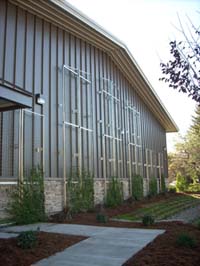
The exterior of Bin to Bottle's new barrel storage facility will eventually be softened when vines climb its trellis.
Napa, Calif. -- Custom-crush winery Bin to Bottle quickly ran out of barrel storage space, so it built a new warehouse, vowing to make it as green as practical.
The result is a new 24,500-square-foot structure, adjacent to the existing 27,500-square-foot winery, with a sophisticated cooling system that uses computer-controlled night-air cooling plus solar power for running its daytime air conditioning.
Bin to Bottle started with an efficient construction method. Instead of the usual tilt-up concrete panels, which absorb heat during the day and release it at night, the building is metal with thick foam insulation. “It’s built like a big refrigerator,” says general manager John Wilkinson. Which is really what it is.
The roof is also well insulated, and it’s painted white to reflect sunlight. The solar array also prevents solar radiation from reaching part of the roof, as well as generating electricity to run the air conditioning and fans.
The building also uses a night-air cooling system to save energy. Bin to Bottle is in the cooler, southern part of Napa County. Wilkinson estimates the temperature averages about 10ºF less than, say, St. Helena, which reduces cooling needs.
Multiple thermostats monitor inside and outside temperatures. When the outside temperature drops below the chosen level, typically 59ºF, the computerized system automatically opens nine louvered 4x4-foot vents on the side of the building and four openings on the roof, each with a turbine to move air through the facility. They’re balanced for minimal energy consumption, says Wilkinson, who adds that they generate a 12- to 15-knot breeze at full power.
Solar arrays don’t generate electricity at night. Then, Bin to Bottle uses excess power that it’s fed to Pacific Gas and Electric Co., which acts as a virtual battery to power the fans. The result is neutral consumption of electricity and no electric bills. PG&E will happily take excess power, but doesn’t pay for it, so the system was engineered to be only as large as needed.
The company also “borrows” systems from next door, including hot water, nitrogen and compressed air.
The structure includes an advanced humidification system called Smart Fog that maintains 75% humidity. It includes only 16 emitters, which generate such small droplets of water (4 microns) that they can’t be seen 10 feet away.
To prevent clogging the emitters, water for this system is filtered four times -- through 10- and 5-micron filters, then reverse osmosis and de-ionization. Engineer Rob Main designed the cooling system.
Wilkinson says that the timing was perfect to build the business and install its systems. “We probably saved $500,000,” by doing it now, when financing costs are low.

The building's sun-exposed south side is windowless,and features a high spread roll
up door to further reduce incoming heat.Saving money disposing of wastewater
In addition, Bin to Bottle installed a sophisticated wastewater treatment facility, instead of either having the water hauled away and paying excess fees to Napa Sanitation or building its own septic system, which wasn’t practical on the industrial site. As a result, it can discharge cleaned wastewater into the normal sewer system, although there are restrictions on the amount that can be sent each day.
Discharging dirty water can be very expensive -- as much as $6,000 per equivalent dwelling units, depending on the level. Hauling wastewater away can cost 15 cents per gallon, which adds up fast, and also discharges carbon into the atmosphere, which may become a cost in the future.
Bin to Bottle’s system is called Advantic. It consists of a series of settling tanks for solids, combined with the introduction of oxygen plus aqueous ammonia to provide a neutral pH, which encourages bacteria that dispose of the biological component of the wastewater. “It looks like a hot tub,” Wilkinson says. The water is then sprayed over a grid of tiles to further oxide impurities.
A computer controls and monitors the system; Wilkinson and his staff can access it over the Internet.
The system can store 37,000 gallons, far more than Bin to Bottle’s typical 2,000 to 3,000 gallons of daily use, allowing it to hold back water and avoid fees for discharging more than 150% of its allowed flow.
Mike Muelrath of Applied Civil Engineering engineered the system. The treatment tanks are from Orenco Systems and cost about $16,000 each, while the five, 5,000-gallon storage tanks cost about $20,000 each. Without stating a total, Wilkinson says the whole system cost “hundreds of thousands of dollars,” though it will pay for itself.