U.S. Wineries See Hope in Hong Kong


Wine & Spirits Fair presents opportunities, but Asia still presents tough challenges
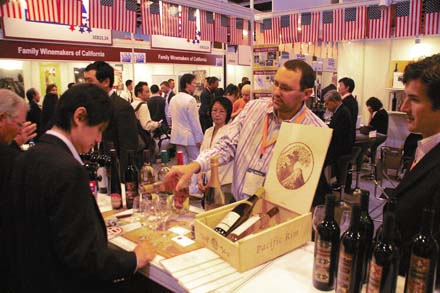
Nicolas Quillé (left), general manager of Pacific Rim Winemakers, and adviser J.B Moresco acknowledged that establishing a wine market in Asia requires a long-term commitment, and solid relationships.
Hong Kong, China -- Hong Kong is fast becoming a major wine trading and distribution hub, and many North American wineries seek to expand into the Asian wine market. The second annual Hong Kong International Wine and Spirits Fair, held Nov. 4-6, drew 520 exhibitors from 34 countries and six continents -- more than double the attendance at the 2008 show. With the promise of a burgeoning Asian wine market, many growers made the trip expecting to find distributors anxious for their business: They quickly learned that patience and hard work are necessary to crack the Asian market.
Hong Kong’s position as a major wine center has increasingly solidified during the past few years. The Chinese government has taken an active role in making Hong Kong a wine-friendly region -- first by eliminating wine duties in early 2008, and also permitting wine to be transferred to storage prior to clearing customs (rather than sitting on the tarmac). Hong Kong cooperates with major wine-producing nations, already is the main distribution center for Asia and is set to become a wine auction center second only to London.
Understanding the Asian palate
As the wine industry in Hong Kong grows, so does the sophistication of the Hong Kong palate. Ross Chan of California Grapes International Inc., a Hong Kong-based distributorship specializing in California wines, described Hong Kong as having a taste for “premium red wines.” Conversely, he said, “less educated areas like the mainland want lower prices and sweeter wines.”
Korbin Ming, the marketing and sales director for Glen Ellen, Calif.-based Korbin Kameron Wines, noted that the Chinese “like to drink more” at a single sitting but “prefer less robust wines.” Ming’s display included a Best of Class medal won at the fair's associated wine contest, as well as a silver for its Cabernet, but he said that while the medals made potential distributors more likely to stop at the booth, in general competitions aren't that important to the local distributors. And though his family is originally from Hong Kong (Ming lived there until he was 5 years old and grew up speaking Chinese), Ming said, “Hong Kong is a confusing market. We came here to learn it, but it raised more questions than answers.”
Daniel Choy is the sourcing officer for San Castle Wines, a leading importer into the mainland, with offices in Guandong, China, and San Gabriel, Calif. San Castle has several U.S. clients and represents wineries from Europe and South America. Choy said it is looking for winemakers who believe in “taste, packaging and have a seriousness about the quality of the wine.” Equally important, Choy said, the wines must be competitively priced.
Distributors are key
Finding the right distributor was the goal of most exhibitors -- a goal that requires patience and hard work. At the show, “There are a lot of start-up distributors,” explained Nicolas Quillé, general manager of Pacific Rim Winemakers, but, “very few with a track record. Nobody’s been selling for more than five years.”
American wineries have a reputation among Hong Kong distributors for pulling out of the international market when domestic demand is up. Selling into Asia is “very labor intensive” explained J.B. Moresco, managing director of Alexander Benjamin Wine Group, who was at the show in an advisory capacity to Pacific Rim Winemakers.
Pacific Rim made a sale in September 2008, and was only just getting the wine onto the market 14 months later. “They like to buy brand,” Moresco said, from “someone they know and can relate to.” To achieve this, he said, “You need a vision, you need to want to be a player in 15 years.”
American wineries have a reputation for using Asia as a dumping ground for unwanted wines, leaving many distributors wary; many attendees found that although there seemed to be some interest, few came away with signed contracts.
But some wineries reported great success at the show. James Judd and Eric Alvarez, principals in Judd Family Wines of San Miguel, Calif., were delighted with the contacts they were making. With assistance from the Los Angeles office of the Hong Kong Trade Development Council (HKTDC), Judd said he got a “great offer for exhibiting” and help with shipping and getting through customs. Judd got offers from distributors and described the show and the process as “a great experience and very easy.”
Best of all, Judd said, the “HKTDC will help with the vetting (of distributors) for a fee, and will call on their offices and check letter of credit” to help improve the distributor selection process.
To observers, it appeared that wineries that worked independently through the HKTDC to get their own booths attracted more attention than those at the larger American Pavilion, where several wineries displayed their wares side by side.
Olivia Lizotte of the San Francisco-based consultancy Brix 22, who came to the show to meet with Hong Kong distributors on behalf of her winery clients, got more interest from the mainland. Judd also mentioned that the “vast majority of distributors were representing mainland China.”
Pelee Island Winery, Kingsville, Ontario, has been selling across the Pacific since 1994, with most of its Asian business in Japan and Taiwan. Everett de Jong, the winery’s export coordinator, said Pelee Island has been working China for three years. He said finding the right distributor is his main objective to help crack the market.
Once in the mainland, de Jong said, “There are almost two markets -- the shops and the underground market.” Many consumer sales are made in restaurants, but often, restaurateurs buy either directly from retailers or “friend of a friend of a friend.” Distributors that know how to play all segments of the market are the key to success.
For those who were successful in f inding the right distributor, selling into mainland China poses additional problems. It is a time-consuming process bogged down by bureaucracy. The mainland is “very structured,” Quillé explained, and there is “no one to say ‘yes’ or ‘no’ just like that.”
Label counterfeiting is another problem for many American brands. Pacific Rim Winemakers experienced a lot of back and forth regarding labeling, and Lizotte said the Chinese have been known to “duplicate labels and put their own wine” in the bottles. For her, copyrighting labels is necessary, despite a $2,000 fee. Some Chinese wine-sellers will counterfeit labels by copying them off the Internet. Unlike Hong Kong, mainland China has retained its import duties on wine and, while looking to grow as a wine market, it is not taking steps to make itself a wine-friendly region.
Damien Shaw of Australia’s Koomooloo Vineyard stressed that being in the Asian market requires hard work but offers great rewards. “You have to find the (right distributor); they won't find you.” But if you're willing to start small, build your business over time, and commit the time to maintain markets and grow new ones, Asia represents great potential.