Australian Wine Makers Push to Renew Sales in U.S.


Wine drinkers thinking of French wines conjure the country's famous winemaking regions: Bordeaux, Burgundy, Champagne.
Now Australia's wine industry wants drinkers to think "Coonawarra" and "Barossa Valley" when they're considering buying a glass or bottle that comes from Down Under.
After years of seeing their wines lumped into the "Australia" category on menus and store shelves, marketers there are pushing to counteract a sharp recent decline in the value of Australian wine exports to the U.S. Their strategy: expose Americans to a broader array of styles and brands, expecially those that command higher prices than the Yellow Tail and Lindemans brands familiar to Americans.
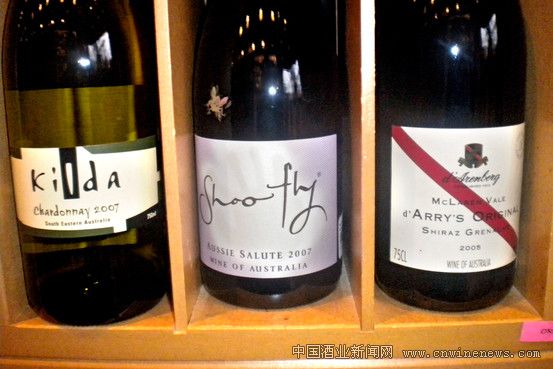
David Kesmodel/The Wall Street Journal
Australia hopes to expose Americans to a wider array of wine brands.
Wine Australia, a branch of a government agency called Australian Wine and Brandy Corp., is exclusively sponsoring events such as September's Chicago Jazz Festival, allowing it to show off its wines without competition. The group also has begun a series of seminars in eight U.S. cities, including San Francisco and Seattle, to teach sommeliers and other wine-industry professionals the nuances of Australian wines.
Years of torrid growth made Australia's wines the second-largest wine import category in the U.S. by volume after Italy's. But dollar sales have stumbled. The value of wine exported to the U.S. fell 23% to A$741 million (US$667 million) in the 12-month period through June, compared with the same period two years earlier, according to the Australian Wine and Brandy Corp.
Wine marketers and retailers say Australia has partly been a victim of its own success. For instance, they say, the popularity of Yellow Tail, a low-priced brand known for the wallaby on its label, inspired scores of imitation "critter" brands. That has led many Americans to think of Australian wine as pretty good, yet cheap and generic. Yellow Tail, the top-selling Australian brand in the U.S., sells for $6 to $7 a bottle.
Meanwhile, at the higher end—$15 or more per bottle—the industry for years trumpeted its bold-tasting Shiraz wines, which eventually lost their luster amid competition from Chilean, Spanish and Argentinian wines.
"In California, we know the difference between Napa and Sonoma, but Australia is seen as one place and one grape, Shiraz," says Chuck Hayward, a wine buyer at J.J. Buckley, an Oakland, Calif., wine retailer. "It was a perfect storm of laziness...people making so much money they didn't feel they needed to do any work."
Now Australia needs to promote its diversity to revive the category and make it more durable in economic downturns, Mr. Hayward and others say.
The tactic is part of an attempt to mend an industry crisis in Australia. There, wineries for months have grappled with excess supplies of grapes and wine, sluggish international sales and the rising Australian dollar, which weakens the value of exported wines. Publicly traded Foster's Group Ltd. of Australia and Constellation Brands Inc. of Victor, N.Y., have been restructuring their Australian wine operations, including selling vineyards and cutting jobs. Constellation said Sunday that it is in talks to merge part of its Australian and U.K. operations with smaller rival Australian Vintage Ltd.
Wine Australia receives funding from winemakers to pay for marketing programs. Backers include Constellation Brands, the world's largest winemaker by sales; Pernod Ricard SA, the world's second-largest distilled-spirits producer, which has Australian operations; and Casella Wines Pty. Ltd., the family-owned maker of Yellow Tail.
Wine Australia divided its wines into four categories: "brand champions," "generation next," "regional heroes" and "landmark Australia." Regional heroes include wines less familiar to Americans, such as Cooralook Pinot Noir from the Mornington Peninsula region, which sells for about $16 a bottle, and d'Arenberg Stump Jump White, a white blend from McLaren Vale that goes for about $12.
"The Australian wine industry is far better suited for long-term growth by promoting higher-value wines, which better support our cost of production," says James Gosper, Wine Australia's director for North America. "We need to get our diversity and regionality story out there."
Wine Australia has introduced consumers to such wines by sponsoring events like a series of summer music concerts in Brooklyn, N.Y., October's Vancouver International Film Festival and the Chicago Jazz Festival. Visitors typically can buy samples of the wines or full glasses.
Some wine drinkers have found the events eye-opening. "I didn't even know I could get a Pinot Noir from Australia," said Ben Morris, a 24-year-old from San Francisco, who bought wine at the Chicago Jazz Festival. His girlfriend, Kate Kordek, a 24-year-old consultant in Chicago, said she liked the event because it made it easier "to take a little risk" to try new wines, rather than buying an unfamiliar bottle off the shelf.
Mr. Gosper and others involved in the marketing effort say it could take years to pay off, but that it is necessary to move Australia's wines in a new direction.
Jake Wheatley, director of marketing in the U.S. for Jacob's Creek, an Australian wine brand owned by Pernod Ricard, says he is "very optimistic" that the campaign will work. But, he says, "nothing happens overnight...Everyone is going to have to have some patience."