Rabbit and oysters — feasts of Christmas past


Waitrose has launched a Christmas pudding- flavour sausage. Advent calendars have Lego bits or chocolates behind the doors. A restaurant in the City is making customers sign a release form, promising not to sue if they choke on the coins in the Christmas pud. People love to moan about the contamination of the traditional festival by the commercial and modern. But, while our ancestors’ Christmas may not have been purchased at Tesco, commercial has long been traditional.
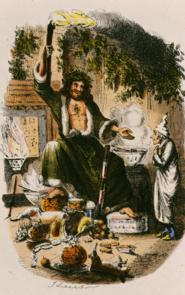
It is said that the Victorians invented today’s Christmas, the country loyally taking a lead from the rituals that the Queen’s consort, Prince Albert, brought from his native Germany: decorated trees, Yule logs, St Nicholas and so on. But the British were enjoying Bean Feasts and Twelfth Night parties in the early Middle Ages and before. With the help of Oxfam’s bookshops, I’ve been looking for further tips from Christmases of the past.
Now my desk is piled with manuals and histories of how to do Christmas. They are fascinating. Two things stand out: while we may consume more today, we certainly eat less. And the other is that nowdays we don’t spend nearly as much time on a classic Christmas duty, making sure the poor have fun. Take the diaries of James Woodforde, the parson of Weston Longville in Norfolk in the late 18th century. On Christmas Day 1788, he entertained seven poor bachelors of the parish to dinner and gave them “rost Beef and plumb Puddings — and after dinner a Pint of strong beer”.
But with his friends the Parson rolled out the barrel. On January 1, 1790, dinner for eight was: “Skaite and oyster sauce, Peas soup, Ham and Chicken, a boiled leg of Mutton with Capers, a rost Turkey, fryed Rabbit, Brawn, Tarts, Mince pies and etc.” Then the Woodfordes and friends danced a quadrille and played whist. Mince pies then had real minced meat in them, mixed with dried fruits and spices. There’s a contemporary recipe in a fascinating British Museum book, Festive Feasts by Michelle Berriedale-Johnson.
Of course, the modern Christmas dinner was born in 1843, with Dickens’s A Christmas Carol, the tale of the miser Ebenezer Scrooge. The dinner was actually a poor Londoner’s feast, that of Tiny Tim and the rest of the family of Bob Cratchit, Scrooge’s clerk. It was a goose (cooked as a favour by the neighbourhood baker in his oven) with sage and onion stuffing, apple sauce and mashed potatoes. Afterwards there were roast chestnuts, oranges, lemons and of course the pudding “like a speckled cannon-ball, so hard and firm, blazing in half of half-a-quartern of ignited brandy, and belight with Christmas holly stuck into the top”. At the end of the book the reformed Scrooge gives the Cratchits a Christmas bonus: a prize turkey. In a book called Drinking with Dickens I found a recipe for the fruity hot port and red wine that Bob Cratchit and his newly-mellowed boss drink on Christmas morning: the wonderfully named Smoking Bishop.
Christmas gradually got more complex, especially among the wealthy. A gloriously pompous book from 1960, entitled To Set Before a King, announces: “After a good dinner one can forgive anybody, even one’s own relations,” quoting Oscar Wilde. It’s a useful motto for the season of goodwill, though after this Christmas dinner you might have to take them all off to A&E. Here is the menu: Cornets of Saumon Fumé, Celery Stuffed with Roquefort Cheese, Dungeness Crab-Avocado Cocktail with Thousand Island Dressing, Roast Turkey (“pack completely in aluminium foil”) with stuffing, Franconia Potatoes, Spinach Timbales, and “an enchanted centrepiece for your Christmas table” a Tomato Salad Ring. To follow there is a Cranberry sherbert, Hazelnut Torte with Christmas Frosting, a Harlequinade, Confits Joyeux — which you’ll have made previously by filling prunes with fondant and so on, and coffee. “If you decide on strong Italian coffee, rub the edges of the demitasse cups with lemon, then dip in sugar and allow to crystallise.” She suggests magnums of Chevalier- Montrachet, 1951.
Tempting though it is to recreate this entire menu (given a few kitchen maids) the only thing I will try is the book’s recipe for the turkey stuffing, the ingredients of which begin with “1 ½ lb of chestnuts, 1 dozen oysters”. ( If you e-mail me I will send you it). She also advises that, in the season of comfort and joy, you should “beware of physical discomfort and misery through gluttony ... temper your table with wit and gaiety”. It is a good tip.
This was always a time of games, plays and jokes — January 1 is the Feast of Fools and in Scotland the time between Christmas and New Year was the Daft Days. And in Nichola Fletcher’s history of feasting, Charlemagne’s Tablecloth, I found a 16th-century Christmas game definitely worth reviving: Snapdragon, where a bowl of raisins was covered in brandy and set alight so that people could risk dipping their fingers in the flames to reach the fruit. In some versions you eat them while still burning (closing your mouth will put out the flames), and whoever eats the most wins. To health and safety, you can say — bah, humbug!
Thanks to the Oxfam bookshops at Thame, Wantage, Bloomsbury and Henley. Oxfam now has 130 bookshops selling one million books a month, and an online shop at www.oxfam.org.uk/shop