Survey Says 'Cellared in Canada' Confuses


Study of regular wine drinkers shows a majority believe the label terminology is inappropriate
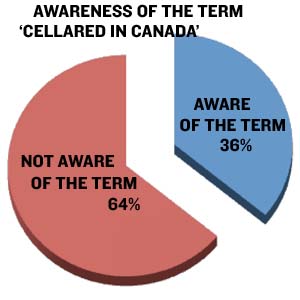
Wine Intelligence asked 1,033 Canadians who are regular wine
drinkers whether they were aware of the "Cellared in Canada" designation.
London, England -- When Canadian national Erika Neudorf joined London-based market researcher Wine Intelligence as senior project manager in May, she brought with her a healthy interest in the Canadian wine industry. So when the “Cellared in Canada” debate started making international news, Neudorf knew the topic should be addressed in the British agency’s survey of 1,000 Canadian wine drinkers.
This October and November, Wine Intelligence used the Vinitrac global survey platform to interview 1,033 Canadians who drink wine at least once per month. Among other topics, they answered questions about Cellared in Canada labeling practices.
Awareness
When asked whether they were aware of the term “Cellared in Canada” (CIC) as it applied to wine, 64% of the regular wine-drinking respondents said they were not aware of the term. Of those who did recognize the CIC designation, less than half correctly stated that CIC wines are made partially or entirely from imported grapes that are blended and bottled in Canada.
Appropriateness
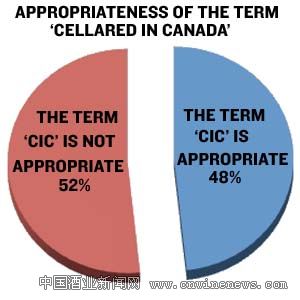
Armed with the definition, survey respondents then decided whether “Cellared in Canada” was an accurate description.
After all respondents were advised of the true meaning of the CIC designation, they were asked, “Do you think the words ‘Cellared in Canada’ are an appropriate way to label this type of wine?” More than half (52%) answered no, the term was not appropriate.
Neudorf, who served as marketing and research coordinator at the consumer laboratory at Brock University’s Cool-Climate Oenology and Viticulture Institute prior to joining Wine Intelligence, said, “A lot of issues are coming from placement in the stores,” because ‘Cellared in Canada’ wines are shelved with traditional Canadian wines. I don’t think the consumers pay attention, and they thought they were Canadian wines.”
What’s the alternative?
Survey respondents who didn’t think “Cellared in Canada” was an appropriate designation then were asked what would be an appropriate way to label wines that are blended and bottled in Canada, but not made from 100% Canadian grapes.
Sixty-five percent of respondents said that labels should state the percentage of grapes that aren’t from Canada, and list the country where they are from. Other respondents suggested putting “Cellared in Canada” bottles in a different section of the liquor store, rather than shelving such wines with 100% Canadian wines. “It goes back to the idea of shelf placement,” Neudorf told Wines & Vines.
Another 49% of respondents said that the term “Cellared in Canada” should be changed to something different. Respondents’ suggestions included “Blended in Canada” or “Grown in XYZ, Cellared in Canada.” Fewer than 20% of respondents indicated that creating a new “Cellared in Canada” logo to put on CIC wines would be a suitable alternative, and just 9% said increasing the font size would remedy the situation.
“I think the bottom line is that the consumers want transparency,” Neudorf said. “They want to know what they’re buying, and I think that’s the same argument coming from the trade.”
Indeed, some winegrape growers and their organizations from Ontario and British Columbia (where wines containing as much as 100% foreign grapes may be labeled “Cellared in Canada”) have spoken out against the term, saying it is misleading.
“I think it’s fair to say that the term Cellared in Canada is currently not helping Canadian wine drinkers make a very informed choice,” Richard Halstead, COO of Wine Intelligence, said in a statement. “The sooner we see some clarification and reform in this area, the better off consumers will be.”