Grape expectations for uniquely Canadian vine


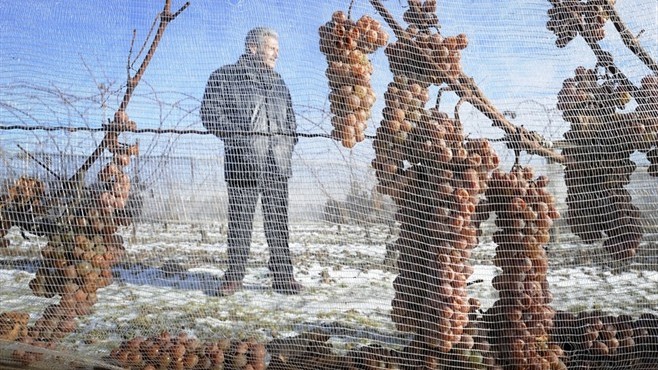
NIAGARA-ON-THE-LAKE, ONT. - In the search for the next great grape, a swath of 270 acres in Niagara-on-the-Lake is carrying the torch, so to speak.
At Château des Charmes, a mid-sized, family-run winery that looks no different than most of its neighbours, an ambitious project to create and assess thousands of new varieties of grapes is under way. From the many, these vino-scientists hope to cull a few wholly Canadian-born seeds and create new, distinctive wines.
Paul Bosc, 74, who immigrated to Canada from Algeria via France in the early 1960s, and his son Paul Bosc Jr., 49, now also the chairman of the Canadian Vintners Association, launched their breeding strategy a decade ago, gambling that Canadians were eager for wines that would stand apart from traditional fare.
When the family arrived in Canada, their major fight was against apathy. Ontarians didn't seem to care much about the minutia of winemaking, the Boscs say, and many thought "good Canadian wine" something of an oxymoron.
Now the wine market is growing rapidly - by 4 to 5 per cent a year across North America - and its customers are ever younger. Most importantly, long before the Olympic torch relay came through the region Sunday on its way to Niagara Falls, many Canadians began taking palpable pride in having good wines that are authentically Canadian.
By the early 1990s, the Boscs were dabbling in genetic engineering as a way to mitigate the potentially crippling effects of especially harsh Ontario winters on their mostly European-bred stock, infusing the grapes with genes they hoped would make them stronger.
"But that didn't go very well. We came to a wall. The science wasn't available," Paul Sr. explains from the winery yesterday, rows of spindly vines stretching into the distance behind him.
They installed dozens of 13-metre-tall wind turbines that warm the air over the vineyards. They turned their attention instead to trying to breed better-tasting, hardier grapes, that still had good acidity levels, sugar content and resistance to fungi.
They first crossed a cabernet franc and a pinot noir, two full red grapes. Astonishingly, the first progeny was a white grape, suggesting both parent grapes had once had white parents themselves, but that "all their genes haven't been expressed," Paul Sr. says.
Soon they tried two more reds, cabernet sauvignon and pinot noir, "the two best names in grapes." The first progeny was also white - "huge, beautiful" - the second a full red, and the third white again. In breeding, the same pair of grapes can produce several very different offspring, creating huge possibilities.
If a grape doesn't pan out, you don't propagate it. It dies in its infancy, naturally selected for extinction by the wine grower's eye.
"We're doing with great precision what nature sometimes takes hundreds of years to achieve," Paul Jr. says.
After a decade's labour, Château des Charmes has more than 1,000 crossed grapes. "We crossed everything," Paul Sr. says.
The practice of cross-breeding has been taking place for millennia, but it has dwindled worldwide, and Château des Charmes has the lone Canadian breeding venture. Its costs are beginning to rise precipitously as the new grapes expand from a single vine each to blocks of eight and then 27 vines, but the Boscs are hoping to get government grants to lighten the burden.
Eventually, the new grapes that prove better adapted to the climate and pass the taste test will be patented, christened with "truly Canadian names" and could hit the market within a decade, Paul Jr. says, adding that the process can't be rushed.
At his age, Paul Sr. doesn't know how long he'll have to enjoy the fruits of his labour, but he preaches patience.
"If you don't start somewhere, you never get anywhere," he says.