Grapes for good


Christopher Chung / The Press Democrat
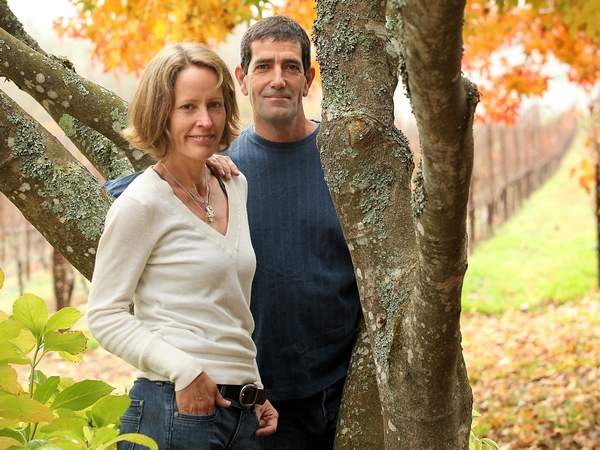
Chris and John Mason use the profits from their Emtu Estate Wines to support their global nonprofit efforts. The Masons also volunteer during the offseason in areas of need overseas.
John and Chris Mason spend the bulk of the year farming grapes at their serene 3-acre vineyard in Forestville.
But during the winter, when the vines are dormant and the rains have begun, the couple leaves the tranquillity of the farmhouse and heads straight for trouble.
They travel to some of the world's most devastated areas to help people who've lost their homes in earthquakes or whose villages have been ravaged by AIDS.
For funding, they have received support from friends and family. But the great hope of the two winemakers is that their tiny organic label, Emtu Estate Wines, will become a primary source of revenue for their philanthropy.
They started the winery in 2003 and since then have spent 11 months of the year committed to the demanding work of establishing it. When winter comes, they pack their bags and head out for the truly difficult work. Their dedication to philanthropy takes them from the halcyon world of Wine Country to places plagued by hellish conditions.
Next Wednesday, they depart for a small Indonesian village on the island of Sumatra where a 7.6-magnitude earthquake in September left 1.25 million people with partial or total loss of their homes. They will spend a month in the largely Muslim country, working with the aid organization Hands On Disaster Response to help people clean out and salvage usable material from their homes.
Their departure next week is the latest in a long sequence of disaster-relief efforts. After the United States began bombing Afghanistan in late 2001, the couple headed to the Afghan-Pakistan border to work with the aid group Mercy Corps, where they helped establish medical clinics for refugees fleeing the war.
“We were in Pakistan's version of the Wild West,” said John Mason, a retired paramedic who spent decades working for fire departments in the Bay Area.
“I spent 20 years running into burning buildings when everyone else was running out,” he said.
He embarked on his first disaster-relief project in July 1999 when, on impulse, he headed to Kosovo to offer his paramedic skills for six weeks in refugee camps. He ended up staying a year, using his skills as a former general contractor to help restore more than 100 homes and rebuild and operate six refugee shelters.
Mason's arrival was a godsend, said Karen Johnson Elshazly, former director of the American Refugee Committee, headquartered in Minneapolis.
“John was a gem. We called him the ‘Open-Air Home Depot.' He would commandeer supplies from wherever and go to the areas of need and set up shop,” Elshazly told The Press Democrat in 2001.
The experience left Mason dedicated to helping people re-establish their homes. “Without a stable home, it makes everything else in life hard,” he said.
Chris Mason joined him for the first time in 2002 when they headed to Pakistan. A nutritionist, she had worked in Sonoma County AIDS clinics for most of her career. But in Pakistan, she found herself surrounded by AK-47 assault rifles and strict Islamic law. When they arrived in the conservative southwest of the country, she was wearing a head scarf, a thick sweater and pants.
“I might as well have been naked,” she recalled. She immediately sought the help of a local woman, who loaned her a traditional garb called a dupatta.
In the rapidly growing refugee camp near the Pakistan border town of Chaman, the medical clinic consisted of one tent and much chaos. About 1,000 people a day were arriving as bombs continued to drop on Afghanistan.
The couple was tasked with running the clinic and turning the chaos into order. While they labored to erect new tents and establish new rules, ailing people kept pouring in.
Two brothers brought their dying father in on a wheelbarrow, they said. A boy arrived whose leg bone was literally rotting. And Chris Mason rushed to tents to provide care to expectant mothers. The refugee tents housed whole families who cooked, slept and delivered babies all within an 80-square-foot area.
“It was other-worldly,” Chris Mason said.
By the time they left, they had hired local doctors and nurses, erected more tents and created a work flow to the operation. Although they were only on the border for about a month, the model of their clinic was replicated at other refugee camps.
When they returned to the United States, they took a deep breath and slowly began hatching the idea of starting a winery that would partially fund a nonprofit effort.
In 2008, Emtu Estate Wines broke even for the first time. All the profits from the winery now go to their nonprofit organization, The Labyrinth Foundation.
The couple lives frugally, subsisting on retirement income. They do not pay themselves for their winery work and have no employees, they said.
Since 2005, the ultra-small winery has produced between 300 and 500 cases a year. The hope is that in 2010, the winery will turn a solid profit for the first time.
“Right now most of our support comes from family and friends,” John Mason said. “But at the winery, we're at the cusp of critical mass.”
If the winery can succeed in helping support the Masons' philanthropic endeavors, that will be good news for people like Alan Manski, who is head of the emergency teams at the International Rescue Committee in New York.
John Mason and Manski worked together in 2005 in Pakistan, where a 7.6-magnitude earthquake killed 79,000 people and left millions homeless. Mason traveled to remote parts of Pakistan to help establish medical and housing services.
“John is very relaxed. He doesn't stress out in situations,” Manski said. “He knows what he is doing.”
The couple has purchased two brick-making machines that they hope to deliver to remote villages outside Oaxaca, Mexico, in 2010. The machines, which they purchased for about $1,250 each, will enable villagers to cheaply build sturdy homes, Mason said.
In really poor areas, it is amazing how far a little money can go, he said. In the Afghan-Pakistan border refugee camp, he recalled the emotional impact of 9-cent kites. He had purchased 1,000 kites to distribute to camp children.
“That night, instead of swirling dust, the sky was full of kites,” Mason said. “Even in the midst of it all, there are these moments of beauty.”