Too much 'green' wine befuddles consumers


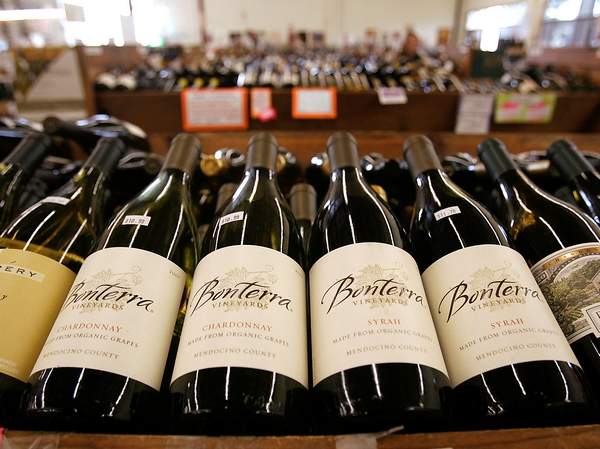
JOHN BURGESS/The Press Democrat Mendocino County’s Bonterra is the nation’s largest organic wine brand.
Too much green wine is giving consumers a headache.
The proliferation of wineries making various environmental claims — from “organic” to “sustainable” to “fish friendly” wines — threatens to leave the average wine buyer befuddled.
“There is no question that consumers are confused, totally confused,” said Peter Granoff, a partner in Ferry Plaza Wine Merchants in San Francisco. “And so, for that matter, are many of the experts they are listening to.”
The wine industry is so awash in “green” claims by wineries that it risks overwhelming and alienating the very wine drinkers it is trying to woo, Granoff said Wednesday at the second annual Green Wine Summit in Santa Rosa.
“If we don’t get our heads around this terminology, it is very soon going to degenerate into meaningless hype and will have no meaning at all,” he said.
Paul Dolan, co-owner of the Parducci Wine Company in Ukiah, told more than 300 wine industry executives that their industry has done wonders in recent years to reduce its impact on the land, from the way it farms grapes to the way it uses water to its embrace of solar power.
Wineries like Mendocino County’s Bonterra, the nation’s largest organic wine brand, Benziger Family Winery in Glen Ellen, which promotes biodynamic farming, and Rodney Strong Vineyards in Healdsburg, which recently became the nation’s second carbon neutral winery, are all examples of wineries taking leadership roles in the sustainability effort, Dolan said.
“I think we can feel proud of what we’ve done in this industry,” Dolan said.
But he cautioned wineries against making claims that “aren’t complete truths,” urging them to follow “authenticity and transparency.”
One of the reasons for the rush toward “green” wine is that consumers are buying it.
“Organic” wines enjoyed strong growth this year, up 12 percent versus 3 percent for general table wine, according to Brian Lechner, director of client services for The Neilsen Company.
“That’s an outstanding performance, especially given this economy,” Lechner said.
But within even that category there is significant confusion. Organic wines fall into two groups, organic wines and wines made from organically grown grapes.
Wines that claim to be made from organically grown grapes can contain sulfites, and must note it on the label. For a wine to call itself “organic” it cannot use sulfites, specifically the preservative sulphur dioxide, during the winemaking process.
There are about 55 wineries making wines from organically grown grapes, 13 making organic wines, Dolan said.
In Europe, however, sulfites are allowed and don’t need to be listed on the wine label, further confusing the issue, Dolan said.
“The U.S. is totally out of step with the rest of the world on this issue,” he said.
The increase in the use of such terms, plus others like “sustainably farmed,” “carbon neutral,” and “biodynamic,” are actually making consumers less clear about the methods used to produce such wines, said Christian Miller, president of Full Glass Research.
“Green washing is big and it’s a growing issue and it seems to be getting worse,” Miller said.
A recent survey among 900 consumers who drink at least a glass of wine a week showed they are more confused than ever by such terms, and feel like they are being manipulated by marketers, Miller said.
Forty-eight percent of those surveyed agreed with the statement “I can never sort out which is better for me or the environment between green, natural, organic and sustainable,” while 81 percent agreed that “a lot of products claim to be green or sustainable without it really meaning much.”
“There’s a lot of suspicion out there,” Miller said.
He called for the wine industry to address the problem “in broad terms at a high level” in order to prevent further consumer cynicism.
“If individual brands all go their own ways, it’s just going to add to the cacophony,” Miller said.
Despite the current confusion, Mike Hall, president of Hall Winery in St. Helena, said he’s convinced the shift toward “green” wines will continue.
“I think the conversation in a few years will not be ‘Are you organic?’ It will be ‘Why aren’t you?’” Hall said.