China- a study of the very old... and new


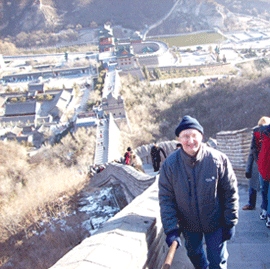
Jim Busta on his way up the Great Wall of China.
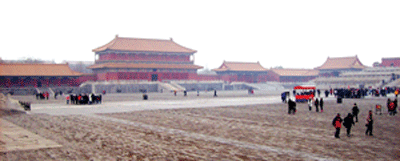
The Forbidden City in Beijing is an expansive place where once only the emperor, his family, and government officials were allowed.
China is a country much older than the United States and thus has an extensive history. Spring Grove School superintendent, Jim Busta, recently toured part of China as a member of the American delegation to the 2009 Chinese Bridge Delegation: Taking the Next Step.
In a press release, Gaston Caperton, president of the College Board, stated that taking U.S. educators to China helps them "experience firsthand the culture of a country that is rapidly changing and growing on the global stage. We also now have 138 Chinese guest teachers currently in the U.S. teaching our students Chinese language and culture."
The 400 American delegates spent time touring elementary and high schools in China as well as taking in many of the historic sites that the country is rich in.
Sub-groups of the delegation visited schools in different provinces; Busta's group visited Shanghai. However, most of his stay was in Beijing where they stayed at the Beijing Hotel.
Points of interest enjoyed
The Beijing Hotel, a five-star hotel, was in the heart of the city and was where the top 2008 Olympic officials and special guests stayed. It was only a few blocks from Tiananmen Square, the Forbidden City, the China Museum and many government buildings.
Within a 20-minute walk, Busta reached the Forbidden City. This "city" is a huge complex that is surrounded by a large wall and parts of it also still have a mote bordering it.
Until recently, only the emperor, his family, and high-ranking government officials were allowed in. Busta described the city as many city blocks long and wide composed of 12 to 15 large buildings and many gardens.
Across the busy street from the Forbidden City is Tiananmen Square, a large museum and many government buildings. This museum as well as others that he visited in Shanghai, had many ancient artifacts on display - some dated back to the 18th - 20th centuries B.C.
Part of Busta's itinerary included going to the Great Wall of China. This huge structure runs the entire northern border of China. Busta remarked that about one-fourth of China's population helped build the wall.
After an hour of walking up stairs that were steep and not always equal in height, Busta said they reached the top. It took approximately the same amount of time to walk back down to the base.
The 2008 Olympics was held in Beijing. Busta and the rest of the American delegation also got to visit the Olympic Village and the Olympic Stadium, also known as the "Birds Nest" due to its architectural structure.
"It [the Birds Nest] was a very impressive structure. It seats over 100,000 people. It was interesting to be able to actually go into the structure," Busta commented.
Another landmark that the group visited was the Oriental Pearl TV Tower. This is one of the tallest towers in the world standing over 325 meters tall, which translates to almost four football fields end-to-end. They were served lunch in the revolving restaurant and observatory at the top.
"It was an amazing place. I looked up from the tower and saw skyscrapers that were taller yet!" Busta remarked.
In China, it is a status symbol to own a vehicle. There are electric busses, cars, motorcycles, and regular busses all sharing the roadway. Off to the side of the road in a sort of fenced off area is a lane for bicycles, walkers, and carts carrying large stacks of items.
At intersections, however, all of these lanes converge. "It was a sight to behold! I am surprised there are not more accidents," Busta said.
"It was very congested and I read that it is only going to get worse. In Beijing alone, about 1,300 cars are purchased/sold every day!"
Food - an interesting experience
"We ate at many fine restaurants while we were in China," Busta said. "It was an interesting experience. I didn't always know what I was eating," he added with a laugh.
Every meal, except for breakfast, was eaten with chopsticks. Eight to 10 people sat around a table that had a large lazy-susan type piece in the middle. Different dishes were brought out and placed in the center. As the centerpiece rotated, those sitting there would take some of each. There were usually 10-12 entrees to try.
"Typically in America we eat rice along with the meal. In China, the rice came out last and was more of a "filler' meaning that if you were still hungry after the entrees, you would then eat the rice."
Beverages were always bottled including the water. Busta and the delegation members he was with never drank tap water. At meals, beverages offered often-included water, tea, soda, wine, or beer.
Final remarks
"China is definitely a Communist state. There were many visible uniformed police in military officials in many places. After seeing the amazing construction going on and seeing right next to it a poor little shanty-type building, I believe China is a country of 'have and have-nots.'"
"Visiting China was a very memorable experience. I found the Chinese people to be great hosts. State and education leaders really strive to have increased relations with the West - particularly with America.
"I did remind myself, as did others in our delegation, that we only were exposed to a limited segment of the Chinese world and culture. I would have welcomed the opportunity to visit some of the countryside and its people."
"Our Chinese guides were wonderful. I enjoyed visiting with the few education leaders that I was able to meet. I was very fortunate to be chosen to be a part of the American Delegation."