Wineries Urged: Go Mobile


Mobile marketing is top trend at Direct-to-Consumer Symposium
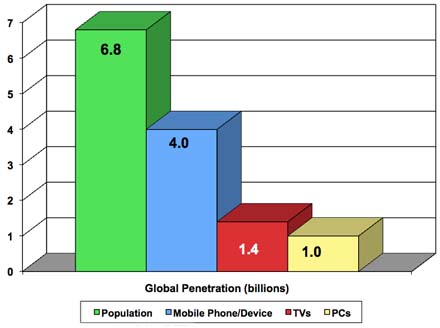
Keynote speaker Michael Becker explained that mobile devices are now by far the most popular digital devices in the world, so it's worth the effort to incorporate mobile marketing in your winery's mix.
Santa Rosa, Calif. -- A keynote address and a breakout session at the 2010 Direct to Consumer Symposium emphasized that winery marketers must include mobile communications as a key element in their promotion and sales plans. Yesterday’s event, in a new location at the Hyatt Vineyard Square in Santa Rosa, drew an overflow audience of about 300, mostly representing California wineries large and small, plus another 100 staffing the well-attended trade show.
Mobile marketing was barely a footnote of last year’s DTC Symposium in Napa: This year, it was the main event. The phenomenon, which has surpassed mere cell phones to encompass every type of voice-, text- and Internet-enabled mobile communications device, does not include the ability legally to sell wine. But as texting, tweeting and social media such as Facebook have come to dominate communications worldwide, these channels cannot be ignored by marketers hoping to build their consumer communities.
During just a scant few years of the past decade, “Mobile phones have eclipsed all other channels” of communications, said keynote speaker Michael Becker, vice president of mobile strategy at iLoop Mobile Inc. The United States now has 235 million unique cell phone users, he said. On the average, each makes some 200 calls per month and sends 586 text messages, he said. That figure exceeds 4 billion texts daily in the U.S. alone: The medium is even more popular in other nations. Approximately 60% of the U.S. population uses text messaging to communicate; some demographics show the number reaching as high 90%.
Learning to use texting and the mobile media for marketing requires a steep learning curve, however, and it is not something to jump into unprepared. “If you want to start a great mobile campaign,” Becker warned, “don’t start there.”
Marketers should ensure that mobile plays a role in all aspects of their brand message. “Think multi-channel; make sure your message is integrated across your customer’s lifestyle, including point-of-sale, radio, TV and print promotions.”
Because mobile devices cannot be used to promote consumption of alcohol, this medium is the place to start building communities, Becker stressed. In order for marketers to access consumers via mobile devices, each consumer must opt-in by agreeing to accept communication from a particular company. Once you are assured a consumer wants to hear from you (and is qualified by age and location to do so), then you may contact them strategically to keep and build their interest.
Becker demonstrated a simple call-to-action promotion: He asked the audience to dial 47201 on their cell phones, then enter the text DCTS to win a bottle of fine wine. Many did so -- one of them entering 400-plus times -- before a winner was announced.
Texting is, of course, limited to 160 characters, but by embedding a link within your text, you can direct recipients to more elaborate, multi-media messages. Some cell phones already can scan two-dimensional barcodes in print or POS ads. Scanning the codes will take users directly to your website. “This is a means of initiating interactive engagement with your customers,” Becker pointed out.
Understanding the technology, your audience and your brand message are essential for any of this to matter in a material way. “My key take-away,” Becker concluded, would be, “Start today, because it will take about five months” to get an effective program up and working.
Bring in the new
Speakers at a subsequent breakout session went into detail about how to get started. “Targeting New Customers,” moderated by Christopher Huber, direct sales manager for Napa’s Cakebread Cellars, got into the nuts and bolts, starting with a welcome vocabulary lesson provided by Craig Harper, co-founder and CEO of Apisphere.
SMS: Short Messaging Service, the now familiar 160-max character Twitter format. Some 74% of all mobile phones can access these.
MMS: Multi-Media Service, the application technology that delivers still photos, video and audio to and from mobile devices.
LSM: Location Smart Messaging, an Apisphere application that organizes and delivers relevant information based on location.
Short Code: The abbreviated phone numbers used to access SMS and MMS.
In short, in order to put mobile marketing into action, you’ll need to secure a short code; this is a prime reason that setting up such a program takes longer than you might expect. You must obtain and register your short code, and select a carrier that can deliver what you need. This, Harper said, takes at least eight to 12 weeks. “Choose a carrier provider that knows what they’re doing,” Harper urged. “Application denied” happens more often than a novice might expect.
Your short code, he explained, is equivalent to your online URL. You want something that’s short, accessible, easy to type and that ties back to your brand, Harper explained. His company maintains an “inventory” of short codes for clients new to the game, and “sharing” or leasing one of these may be a shortcut to mobile marketing, but it’s not necessarily the best first step. Your short code becomes a part of your total brand image, and changing it mid-stream may cost some brand loyalty.
Another bit of sage advice: Consumers place a “higher value” on text or voice mails than they do on e-mails. While they might scan their e-mails regularly, they are easily ignored. Text messages are harder to ignore, so “Don’t wake anybody up,” Harper insisted. If you text a consumer in the middle of the night, chances are she’ll opt out of your community.
Costs to get started, he said, “are all over the map” depending on your volume a nd how much work you or your company can do in-house. He suggested that start-up costs could begin at about $500, with $500 per month in management fees.
Clay Gregory, formerly with both Kendall-Jackson and Robert Mondavi, and now president and CEO of the Napa Valley Destination Council, urged wineries to participate actively with their local destination organizations (convention and visitors bureaus and similar groups). Organizations such as these are an ideal means of bolstering direct-to-consumer sales, he pointed out, noting that “90% of wine club members are signed up at the tasting room.”
He screened a beta-version of NVDCs new application, which will serve the council’s goal of bringing more visitors to the valley during off-peak days and seasons by providing links, maps, information and reservations to all Napa businesses, including, of course, wineries. Mobile device users will be able to plan activities in advance or during the course of their Napa stay. The application is expected to be fully operational next month, Gregory said.
Rick Bakas, director of social media marketing at St. Supéry Winery in Napa Valley, insisted that every winery marketing program should include blogging, Facebook and Twitter. When beginning these social media, he suggested:
1. Establish a personality.
2. Build audience trust through engagement.
3. Be consistent.
4. Sell wine online after trust is established.
Don’t expect your return on investment to be instantaneous. Patience is required. “Like the grapes on your vine. Let them grow organically,” Bakas said. He praised St. Supéry management for giving him the autonomy to create a personality and content in the position he started last year.
Bakas noted that one of his earliest Tweets last fall drew 561 clicks and sold 290 cases of wine during the first 72 hours. “Where we failed with Web 1.0 was by not connecting with people,” he said. “The only way social media is not going to work is if they shoot down the Internet.”
Don’t ship to Massachusetts just yet
The audience and exhibitors were abuzz about the recent court decision overturning Massachusetts’ restrictive direct-to-consumer wine shipping law, but Steve Gross set them straight during the morning keynote session. The Wine Institute’s director of state relations, who has worked tirelessly to warm the climate for direct shipping since the mid-1980s, detailed progress on that front.
“Every year there’s more blue states,” he said, indicating more states that allow direct shipping in some form. Still, the work is far from over, and the situation in Massachusetts remains in limbo. While delighted that the Family Winemakers of California prevailed in its lawsuit before the First Circuit U.S. Court of Appeals, Gross explained that overturning the existing law because of inherent constitutional flaws only means that, at the moment, the state has no direct shipping regulations at all. No wineries can legally ship to consumers there. It’s now up to the state legislature to establish regulations that will provide equal status to in- and out-of-state producers and establish other fair provisions. Bill 176 is now pending there.
The Direct to Consumer Symposium is organized by the Coalition for Free Trade and Free The Grapes!