China learns to wine properly


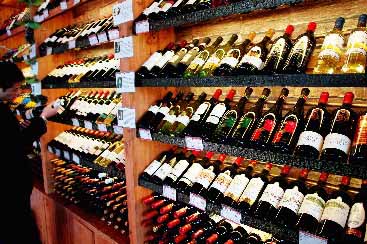
Choices, choices: Beijing wining and dining is poised to grow. Photos: CFP
As the winter season rages on, don't forget one of the best ways to keep warm during the chilly season: Curling up in front of a roaring fire with a thick woolen blanket and a big goblet of hot mulled wine in your hand.
This being China, however, you may have to substitute the wine for a shot of erguotou, but worry not, because the Chinese market for wine (a daily staple of most Westerners' diet) has been skyrocketing along with the rest of the Chinese economy.
Though in the eyes of many independent wine importers, restauranteurs and connoisseurs, attitudes toward wine in China still have a long way to go if they're to match the ethusiaism commonly associated with French tipplers.
"I'd like to see Chinese people drink wine because they actually enjoy it," said Fongyee Walker, founder of Dragon Phoenix Fine Wine Consulting in Beijing. "Red wine is largely still just a status symbol, something people drink in social situations, to preserve face, but not because they actually like the taste."
Walker's wines represent China's only "Master of Wine" candidate, a certification bestowed by London's Institutes of the Masters of Wine in London.
Reasons for how Chinese people select their wines range from standard tropes of grape variety, country of origin and word-of-mouth, to the fact that "they saw it in a Hong Kong gangster movie," according to Tomaz Hladnik, manager of a Enoteca Wine Bar, Lounge, and Boutique in Beijing. "The mafia boss in some movie would always drink Château Lafite, and it became wildly popular after that."
Made-in-France
For all the talk of a booming mainland wine market, France is still inextricably linked to all things wine in China.
"Seventy percent of our wine is French," said Zhou Yan, general manager of the Beijing Assai Import and Export Trading Company. "Merlot is our most popular variety, but only because it's the most expensive and fragrant. The Chinese don't really understand the nuances of wine."
Walker chalks up the dominance of French wine to marketing acumen.
"The French are great at selling this romantic vision of French wine," said Walker, citing the example of Sopexa, the French Ministry of Agriculture's international food and beverage consulting agency.
Walker also gave the example of a local blind taste test of wines from four countries, where an Australian wine came out on top over Chile, China, and France. When the exact same wines were tested again, with full disclosure of which bottle came from where, the French wine was named number one.
"But when it comes down to it, some of the wines [the French] push are really poor quality," Walker lamented. "Some tasting events I've been to had some very shockingly bad, undrinkable examples."
Paulo Ramos, founder of a start-up wine importer in China, Portuguese Wine Company, saw a link between the myth of great French red wine and the country's insistence on its health benefits.
"It's true there are some compounds in red wine which are good for your health," he asserted, "but ethanol is toxic, so it must be drunk in moderation."
Business is booming
By any objective measure, the Chinese wine market is expanding and diversifying rapidly, defying any notion of any potential economic downturn.
According to China's General Administration of Customs, 1.8 billion yuan ($264 million) in wine was imported into China in 2008, an increase of 43 percent since 2007.
Walker estimates 90 percent of imported wine is going to domestic Chinese consumers. "China's joining of the WTO was really the clincher for imports," she said. "But wine is a very tricky product to sell here; most foreign wine companies don't have nearly enough staff who can speak Chinese. Just trying to transliterate the names of exotic grapes, for example, can cause a huge headache."
Serious wineries, however, pride themselves on offering a diverse variety of wines from all over the world.
"We've had some Greek wines, which are old and very difficult to translate to Chinese tastes," said Marc-Antoine Malia, Enoteca's director of sales and marketing.
Geoffrey Weckx, owner of Beijing's W Dine & Wine, acknowledged that most of his clients prefer "supermarket wines," and that he has observed a distinct rift between foreigners and Chinese in their wine tastes.
"Chinese customers generally prefer popular wines from France like Lafite," he mentioned, echoing Hladnik's gangster movie anecdote, "while foreign customers tend to order more diverse wines from different parts of the world."
Customs horror stories
A bottle of wine's journey from a far-flung vineyard to a Beijing dining table is fraught with no small measure of difficulties. Wine can be dauntingly complex to bring to market, and there are often a long chain of middlemen that importers have to deal with.
"We try to present an image as a single unit with the producers to the final buyer," said Zhou. "If you're simply seen as a middleman, the buyer will try to go around you."
Walker spoke of Chinese customs horror stories, waiting for up to months at a time for foreign wine to clear officials.
"I had a friend who was importing really fine Burgundy, and it waited in the Shanghai docks for two months in the height of summer," said Walker.
Malia, with a resigned shrug, mentioned a pervasive culture of kickbacks and bribery.
"It's just part of mentality here," he said. "But I haven't found the bureaucratic hurdles to be any more complicated than in France."
As the Chinese wine market matures and the average Chinese consumer opens his or her palate (and wallet) to the prospects of wine from countries other than France, many foreign wine importers see nothing but opportunity.
"Chinese wine culture is like a young teenager, while the European market is like a man over 60," said Ramos. "I'm always so pleasantly surprised by the number of young people here who want to dedicate their lives to wine."