Grape/Wine Conference Eyes N.Y. Industry


Viticulture 2010 examines industry trends, funding and Riesling, state's signature varietal
|
New York Wine and Grape Foundation president Jim Trezise reported on challenges and progress for the state's grape and wine industry. |
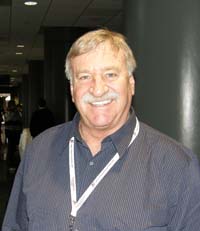
Jim Trezise, president of the New York Wine and Grape Foundation (NYWGF), opened the conference Wednesday, with a review of how far the New York wine and grape industry has come -- and the challenges that the industry still needs to address.
Trezise noted that New York is the third-largest wine and grape producer in the country, but he put that figure in perspective by recognizing that the state still only produces 4% of the country’s wine and 0.2% of global wine production. “More wineries started between 2000 and 2009 in New York than in the preceding 170 years,” Trezise stated. “And we have wineries in 48 of 62 counties, which is good for politics, since more legislators now have wineries in their districts.”
While wineries have seen strong growth, improved wine quality and increased cooperation among wineries, Trezise identified four main challenges that remain:
1. The industry must develop private sector funding mechanisms so that programs previously supported by the state can continue -- including the NYWGF.
2. In these turbulent economic times, a level of economic sustainability for growers must be established.
3. Growers and wineries alike must deal with a highly competitive environment.
4. The New York industry must become more national and less regional in distribution.
Danny Brager of the Nielsen Co. summarized the national overall outlook: There are signs of economic recovery, but some strong headwinds remain. According to Brager, the public mindset remains mired down, with 90% still believing that we are in a recession. Consumer confidence is low; and the job situation has not turned around.
“While wine is not recession-proof, it is recession-tough. Wine does a lot better than other categories,” Brager stated. “I see the glass as half-full: There are definitely some clear wine channel winners.” He identified three areas where wine is doing well: Online sales are up more than 10%; several price segments are doing well, including the $3 to $6 and $9 to $15 price range; and the two fastest growing varietals are Pinot Noir and Riesling.
John Gillespie of Wine Opinions and Wine Market Council in St. Helena, Calif., provided additional perspective on the positive position of the wine industry. Gillespie noted that total table wine consumption has continued to grow, even in a difficult economy. In 1970, a year when many Baby Boomers reached drinking age, the annual rate of consumption was 1.05 gallons of wine per adult; in 2009, the rate was 3.02 gallons per adult.
The percentage of core wine drinkers -- those who have at least one or more glass of wine per week -- have increased in 10 years from 10% to 15.9% of the adult population. Even more encouraging is the fact that among Millennials (ages 21-33) and Generation X (ages 34-45), there are now more core wine drinkers than marginal wine drinkers (those who only occasionally drink wine).
According to Gillespie, trade members who report trends to Wine Opinions see shifts in the sales channel. Tasting room sales are up by 25%, and online sales are also increasing. Wineries are working to broaden their customer base and to increase traffic to retail venues. On the Wine Opinions panel, 41% believe that consumers will not go back to buying expensive wine, even when the economy does recover fully.
Riesling reigns
Gillespie and wine writer Dan Berger spoke at the second plenary session, which focused on Riesling, increasingly recognized as a signature varietal for New York. Gillespie reviewed the process that Wine Opinions went through in conducting a survey in July 2008 to evaluate consumer awareness of sweetness in wine for the newly formed International Riesling Foundation (IRF). The panel of 862 people gave opinions about topics such as the meaning of terms describing sweetness from sweet to dry; their perception of what a Riesling tastes like, and the frequency and seasonality of wine consumption by varietal.
The survey revealed that Riesling could be described using a scale of sweetness descriptors; that consumers knew the range of sweetness of Riesling, but thought the wine was usually sweet; and that work remained to be done to establish Riesling as a varietal.
Berger, from Sonoma, Calif., then described the work he did to develop the four-point Riesling scale based on the results of the Wine Opinions survey. While individuals taste sweetness differently, he and the IRF settled on four levels of sweetness -- dry, medium-dry, semi-sweet, and sweet -- to describe Riesling. Technical guidelines were then established using a ratio of sugar to acid, with pH as an additional factor. (For more on this, see How Sweet's That Riesling?)
The best feature of the guidelines according to Berger is their simplicity; the bad part is that he knows things were left out. “There are different kinds of acid, and the kinds of sugar used also are different,” Berger pointed out. “This scale is voluntary both in use and in application. Is it a perfect scale? No, but it’s the best that we’ve got, and it’s free.” Winemakers who want to use the Riesling scale can find the guidelines on the IRF website drinkriesling.com.
Berger then reviewed several of the Riesling wines that were available for tasting at the conference, and concluded with a positive statement that should make all New York winemakers view the glass as half-full: “New York state makes the best Rieslings in North America.”
Keynote focuses on budget
The Unity Banquet on Thursday featured a keynote speech by Patrick Hooker, New York’s agriculture commissioner. He lauded the grape industry for increasing vineyard acreage from 31,000 acres in 2004 to 37,000 acres, something that he does not see happening in other crops. Challenges are facing the industry, from the impact of climate change to reduction in funding because of the $8.2 billion deficit in the state budget.
“Keep telling us what you need, and how we can be helpful,” Hooker offered, “but it will have to be without a lot of money.” Continued funding for research at Cornell University is a major concern, as well as programs such as those fighting disease in vineyards.
Hooker mentioned the hot topic of wine sales in grocery stores only briefly. “We’re trying to have a respectful discussion on the topic,” Hooker stated. “Gov. Paterson thinks it’s the right thing to do. The question is: How do you do it right, and in a logical way?”
Viticulture 2010 included a range of seminar topics on marketing, grapegrowing and winemaking and featured a trade show with 88 vendors. A total of approximately 550 people attended the conference.Shar