Heard on the grapevine


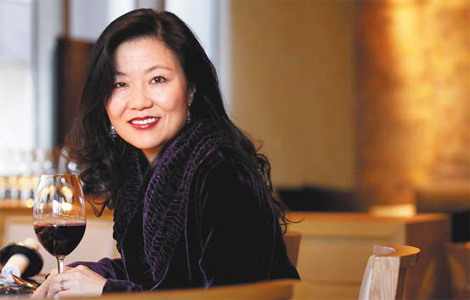
The only Master of Wine of Asian origin, Jeanie Cho Lee, visits China at least twice a year.
Jeannie Cho Lee thinks drinking wine is like meeting interesting people.
"Great wines always change. They all have their own life cycles," she says.
The only Master of Wine in Asia, Lee started buying wines by the case in 1996. She would keep the wines and drink them three years later.
"If you really love wine, it's part of the fun to see how it changes, develops, and compares with three to five years ago," she says. "It's like an interesting friend, whom you meet again and find he's done so much."
In that sense Lee herself can be deemed a bottle of great wine. Born in Seoul, South Korea, Lee has lived around the world, in New York, Boston, London and Kuala Lumpur. She went to Oxford University in the United Kingdom, Smith College in Massachusetts and got a Master's Degree from Harvard University. She has lived in Hong Kong for the past 17 years.
Lee worked in business journalism, but her passion for food and wine led her to obtain the Certificat de Cuisine from Cordon Bleu and the WSET Diploma. In 2008, she became one of world's 279 Masters of Wine, and the only one from Asia.
Although she has been to the mainland many times, her recent visit, to host a wine dinner at the Gallery, Park Hyatt Beijing, on Jan 28, was her first public function in the capital city. Lee paired 10 courses at a grand dinner that evening. Executive chef Jack Aw Yong prepared a surprisingly diversified dinner, with a range of typical North Chinese dishes, such as cold appetizers, sea cucumber, steamed garoupa, wok-fried prawn, Mongolian barbequed lamb saddle, and hand-pulled noodles. The dishes were fabulous, and the wines matched up.
For sea cucumber with foie gras, Lee chose a versatile Maison Joseph Drouhin Beaune Ier Cru Clos de Mouches Red 2007. Mongolian barbequed lamb was paired with Shaw &Smith Shiraz 2006, a fruity wine. Imperial abalone with pine mushroom soup came with Chateau Palmer Alter Ego 2003, a fresh Bordeaux wine with a grippy, savory, tannic finish. Shanxi hand-pulled noodles with stewed pork belly, a tasty winner, was matched with Domaine Thalabert 2005, a smooth and velvety wine with a fresh finish.
"In general North Chinese foods are more intense, and I prefer to use gentle wines, instead of strong wines, which might fight with the food," Lee says.
She says, usually, the older and more mature a wine is, the more it merges. It becomes smoother and softer.
She says she pairs textured food with texture wines. Then, she chooses wine, not according to the foodstuff, but rather according to the taste of the condiment. For instance, is it soy sauce, or chili? Finally, she recommends chilling the wine a little bit to pair with hot food, so as to make it taste fresh.
"For a North Chinese meal it is helpful to have two or three wines, which is consistent with the way we eat," she says.
Interestingly, Lee switched from white to red during the dinner, defying the common rule that red wines, and the best wines, come last.
"In China the more important dishes often come at the beginning," Lee says. "Wine should follow the same rhythm of the food. Let the wine makers follow our ways."
As the only Master of Wine of Asian origin, Lee said she often gives speeches in the United States and the UK as an Asian representative. That fuels her incentive to visit China more often, which she does at least twice a year. She has visited big vineyards in Xinjiang, Gansu, Shanxi and Shandong, and contacted big wine companies here, such as ASC and Summer Gates, to see them for herself.
Lee said she saw "a lot of patriotism" in China's and Japan's wine businesses, where local wines are widely consumed. Korean people, though, mostly drink imported wines.
"Chinese wines are really improving," she said. "However, if you compare them to other wines in the world, they are still not internationally competitive."
She named Qingdao Huadong white wine, Grace Vineyard's Chardonnay and Dragon Seal as some good choices here.
Many Masters of Wine work as wine buyers. Some work for or own wine companies, and some, like Lee, specialize in wine writing. Lee said she spends two to three days a week writing for various publications, such as Wine Spectator, The World of Fine Wine, Revue du Vin, Wine Business International and Decanter.
She said she feels comfortable living in Hong Kong. She said she made sure that her four daughters' first language was Chinese. Their second language is English, third Korean, and fourth, French. She still returns to Korea for major holidays to visit her parents, who have retired and live in Pusan.
Jeannie Cho Lee's Asian Palate, published in 2009, talks about Asian foods, and how to pair them with wine. The innovative book has already won her two major awards in the US and the UK. She said her second book is coming soon.
For now, most of the time, she's working on her website and a mobile application for the pairing of Asian food and wine, which will be in English, Chinese and Korean. Users will get access to 15,000 notes on wine Lee has taken in the past 15 years. She expects that to be ready in May.