Clones attack in grape wars


|
TW’s Paul Tietjen and Pernod Ricard’s David Bullivant discuss one of the new varieties in Mr Tietjen’s vineyard. |
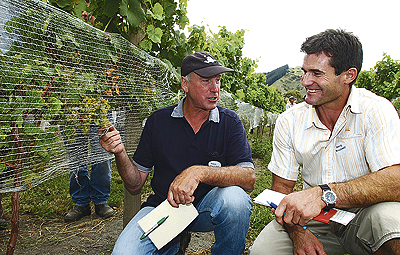
As well as assessing the performance of some varieties in a commercial setting, at Paul and Jenny Tietjen's vineyard in the Golden Slope area of Gisborne, growers looked over the full range of varieties and clones at Riversun viticulture nursery’s source block at Manutuke.
At Tietjen's they viewed malbec, verdelho, carmenere, tempranillo, grüner veltliner and viognier with appropriate canopy management, vine training, and fruit thinning.
Mr Tietjen said some of the new selections required only modest inputs in terms of viticultural practices.
"The Chilean selection of carmenere, for example, has received only a quick green thin after veraison - where vines act to ‘crop thin' themselves to some degree, it certainly saves you time and money in the vineyard."
Riversun managing director Geoff Thorpe said the Tietjens were early adopters of the new varieties and planted in September 2008.
The TW winery was already well regarded as a producer of viognier and malbec, so it was a natural choice to trial newer selections of those varieties, and the balance of their planting programme was varieties new to Gisborne and, in some instances, to New Zealand.
Riversun head viticulturist Nick Hoskins told growers about the viticultural and winemaking characteristics of the new varieties.
"Growers appreciate the opportunity to see and taste fruit on the vine as harvest approaches, particularly when they are able to compare new imports against industry standard clones."
More than 100 new varieties and clones planted alongside a similar number of industry standard clones were seen at Riversun's source block in Manutuke.
Mr Thorpe said the source block was designed to produce wood for grafting vines, rather than fruit for winemaking, so the vines were on their own roots, and canopy management and vine training were different to a standard vineyard.
This year, the first bay in each row was treated to more closely reflect the commercial vineyard environment, so staff could monitor fruit and vine performance.
While growers from other wine growing regions were eager to assess the different clones of sauvignon blanc, pinot noir and syrah, many Gisborne growers were keen to look at new French clones of chardonnay.
Also of interest to local winegrowers were the many clones of pinot gris, and a special Italian selection from the Alto Adige wine region, which produces the pinot grigio style of wine.
Mr Thorpe said 30 or more years ago, clonal selection was all about increasing yields.
"But more recently, germplasm agencies have attempted to select for smaller yields, higher sugars, and better disease tolerance, which we certainly see in the newer selections we have imported," Mr Thorpe said.