Robo Pruner 2 Unveiled in Lodi


Robo Pruner 2 works with more types of vines and trellis systems
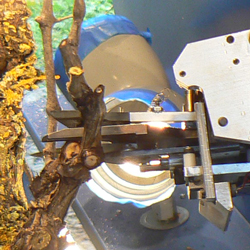 A field demonstration was held in a Lodi vineyard last week of the second phase prototype of the "Intelligent Robotic Vineyard Pruner" being developed by Vision Robotics Corp. of San Diego with backing from several California vineyard industry investors. The first prototype demo was held one year ago in a Clarksburg vineyard. Vision Robotics CEO Derek Morikawa said, "This is a complete new iteration of the product that we designed to handle more mature vines. Last year's prototype was designed to prove that the concept would work in the field." This, and future versions, will provide the ability to prune more types of vines and trellis systems. The goal for the equipment is to prune in the style of hand pruning, but at about half the cost, with a target cost of 17 cents/vine, compared with an average hand pruning cost of 35 cents/vine.
Vision Robotics, founded in 1999, has developed vision-based mapping and navigation systems to create robotic devices for military, health care, agricultural, and cleaning applications. The company's expertise is with stereoscopic vision cameras that work like human eyes to see depth. The vineyard pruner has stereo-vision cameras that take multiple images, scanning the entire vine, and working a full vine length ahead of the pruning shears. An onboard computer uses the multiple overlapping photos to build a 3-dimensional model of the vine, then applies "pruning rules" that were programmed into the software. The pruning rules guide and tell robotic arms, with hydraulic pruning shears, what to cut and what to leave, and where to make cuts for desired lengths and desired densities of buds/vine.
The second prototype unit is more compact in size and lighter in weight, has a better centering system, and is built more ruggedly and weatherproof, with the top and sides enclosed to better protect the cameras and robotic arms. The pruning heads will continue to be refined and scaled smaller, to provide greater "dexterity" to fit into smaller spaces and make cuts that are tougher to access.
Morikawa discussed two less visible changes over the first prototype. One is improvement in the computer operation for modeling the vine to better identify different parts of the vine, such as where a cordon ends and a spur begins, to allow the pruner to work on more complex vines and make more precise cuts. The second improvement was a new design for the pruning shears to provide a sense of "touch." Morikawa explained, "Touch sensors allow the shear to sense up and down and side to side when it touches the vine to enable working the shear into the crotch of a junction, for example, which is important to imitating the style of a human pruner."

Investors include Sutter Home/Trinchero Family Estates, Vino Farms of Lodi, Lange Twins Vineyard Management of Acampo, and Sunview Vineyards in Delano. Ag Industrial Manufacturing (AIM) of Lodi is involved as a design partner. For growers, a major goal is to increase vineyard mechanization due to uncertainty about the future availability and cost of labor. Investors can use some of their investment as a tax deduction, and they have the rights to purchase all the available units for the first three years of production. Morikawa has also visited Australia during the past year and received significant interest in the technology from a few of the country's major winegrowers, particularly Foster's Wine Group.
Other operational goals for the robotic pruner include: day and night operation. pruning at speeds of 8 feet/minute, self-propelled units, and a payback of 2.5 years on equipment purchase. Morikawa believes equipment purchase would be cost-effective for a grower with at least 250 acres of vineyards. However, he expects the technology to be available to growers with smaller acreages by contracting with a vineyard management company that uses robotic pruners. Large growers could run multiple units simultaneously. A self-propelled unit would not require a full-time operator with constant supervision, once the unit was programmed and working down a row. It is envisioned that one vineyard manager could operate and monitor several pruner units simultaneously for a given vineyard block or section.
Morikawa also noted, "This is the first step in what can become a multi-purpose machine." It potentially can be adapted to other practices such as leaf removal and shoot thinning. The onboard cameras and computer could be used for data collection to incorporate into GIS systems, with the cameras used to count clusters during the growing season for crop estimation.
Morikawa expects the third phase prototype unit to be ready before the end of 2010, with more refinements and with additional pruning arms to increase overall pruning speed. In 2011, he expects to produce two or three units for commercial operation that will be available for investor growers.
