Fight over grocery stores’ right to sell wine escalates


|
|
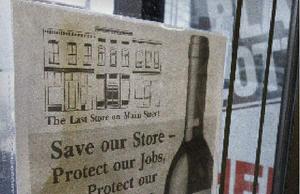
Legislation to put wine on the shelves of New York grocery and convenience stores may have to wait another year — or longer, if liquor store owners have their way.
Gov. David Paterson proposed to end the state’s long-standing ban on the sale of wine in food stores, making it part of his budget plan for the second straight year.
But just as the proposal died for lack of legislative support last year, it appears headed for oblivion again this year. Assembly Speaker Sheldon Silver, D-Manhattan, said Wednesday he didn’t see much support, and without his backing any legislation has little chance of passage.
Senate Deputy Majority Leader Jeff Klein, D-Bronx, said: “In the long term, we destroy mom-and-pop liquor stores through the state.”
Even Wegmans Vice Chairman and General Counsel Paul Speranza, a proponent, said that after all his years of trying on this issue, he’s never confident of passage.
Assemblyman Joseph Morelle, D-Irondequoit, sponsor of the legislation, wasn’t as pessimistic. “There is $250 million in revenue at stake and my belief is that some of these remarks from leadership are being done in the context of budget negotiations,” he said.
The proposal would allow grocers and convenience stores to carry wine in exchange for paying a franchise fee that would be scaled to the size of the retailer. Not only would the measure generate revenue for the state, proponents say it also could lead to the creation of thousands of jobs.
Liquor store owners say it would destroy, not create, thousands of jobs by putting many of them out of business.
Lobbying on both sides has been ramped up this year, which was evident in this week’s unveiling of the campaign “Convenience is Choice. Bring Home the Wine” by state Agriculture Commissioner Patrick Hooker. Grocery stores like Wegmans, which sells wine in other states, have rallied consumers to get behind the legislation.
“We believe our consumers want wine in food stores,” Wegmans CEO Danny Wegman said at a news conference announcing the campaign. “This is free enterprise.”
Organizations opposing the wine provision, including the Last Store on Main Street coalition, have also increased their efforts. Although encouraged by the indications that the legislation is unlikely to pass, Last Store spokesman Michael McKeon said his side isn’t taking anything for granted.
“We’ll keep working hard until the process is done,” he said. “The opposition is very strong and growing, but big-box stores have millions of dollars to spend and will likely unleash more campaigns.”
Then, acknowledging that the fight will be renewed in 2011 if the legislation fails this year, McKeon said: “If Danny Wegman wants to waste his money again next year, he can.”
Can the two sides find common ground on an issue that appeals to many consumers? Morelle said he is pitching a change to the proposal to alleviate the concerns of liquor stores. The change would establish a three-year moratorium on obtaining a new wine-selling license. The only way supermarkets and convenience stores could get a license would be to buy one from an existing liquor store.
Each liquor store under Morelle’s revised plan would have two medallions — one for the store and another to sell. The franchise fee would remain, meaning that grocers would have to pay for that as well as for the license.
Morelle said the pro-wine coalition has yet to support the moratorium idea. “They have some unrealistic ideas about what can be done,” he said.
No matter how the legislation is tweaked, liquor store owners remain adamantly opposed.
“My livelihood is dependent on this store. I hope for the sake of my family and my store it doesn’t pass,” said Matt Strassman, co-owner of Parkway Discount Wine and Liquor in Greece. His father, Jeff Strassman, used his retirement money to purchase the business last April.
James Lepore, owner of Chili Liquor, said he employs 17 people and their jobs would be on the line. “If I become a specialty shop, it will be just me and two other employees left, and that’s a lot of people on the street.” His store is located within a quarter mile of Wegmans, Kmart and Target.
Lepore has been a vocal opponent of the legislation and encourages his customers to understand what it would mean for his business and others like it. A petition sits on the checkout counter, and although he doesn’t ask customers to sign it, he said many ask for more information.
“Ninety percent of people ask about it and out of those almost 100 percent sign it once they’ve talked about it,” Lepore said.
Many wineries have joined the pro-legislation side, saying any increase in sales, no matter how small, would be positive.
“Not only will it benefit my winery but the whole industry, giving us more outlets to sell our products,” said Scott Osborn, president of Fox Run Vineyards on Seneca Lake. “Consumers shop for tonight’s dinner but don’t have time to make that second trip. To me, that’s not a lost sale for a liquor store; that’s a sale that would have never happened.”
John Martini, owner of Anthony Road Winery on Seneca Lake, sells his wines in grocery stores across the country, since 35 states allow it. He said he would love to see his wine on the shelves of New York grocery stores and doesn’t think opposing arguments are valid.
“Existing wine stores have more knowledge of the product and will do just fine,” he said. “The consumer looking for information isn’t necessarily looking for it at a grocery store. It’s my job to make sure the consumer’s aware of product, that they like it and will repurchase it.”
Unlike the 2009 proposal, the Paterson administration is seeking to alleviate the strain it may cause liquor store owners, adding provisions such as extending their hours, giving them the ability to sell certain food items and gift bags and allowing them to open new locations under a medallion system.
Store owners aren’t buying it. “It’s really a slap in the face,” said Strassman. “They talk about letting us have cheese and soda and crackers. But there’s not enough space in the store. And we don’t have the money for coolers.”
The Last Store on Main Street coalition says nearly half of the state’s liquor stores — like Strassman’s — would be forced to close, costing thousands of jobs.
“It shows a lot of greed,” Strassman said. “You fix the budget now, but who’s next? Are they going to go after someone else’s business, someone else’s livelihood?”
New Yorkers for Economic Growth and Open Markets, an organization created to support wine sales in groceries, says the proposal would create 2,000 jobs in wine production, sales and distribution. The state is also proposing to spend $1.2 million on added enforcement to crack down on underage sales if the proposal passes.
As for consumers, some think the idea of purchasing a bottle of wine while grocery shopping is simply convenient. “I love it,” said Rochester resident Heather Feinman. “It’s one less stop to make.”
Others say they would still shop at liquor stores for the expertise and experience.
“I actually like just browsing for wine without the craziness of the grocery store,” said Jen Palumbo of Rochester.