He explores other worlds with his words


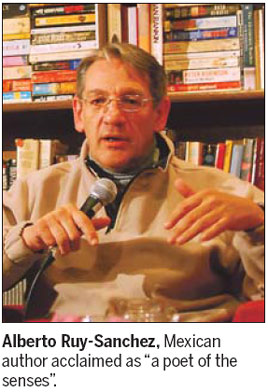 China reminds Alberto Ruy-Sanchez of 1950s Mexico.
"I find the traditional dreams of modernity being realized here," says the Mexican author and cultural vanguard who attended the Bookworm literary festival in Beijing and Chengdu last week.
"China is now part of the international folklore of economic growth."
The writer has been working on the theme of a woman's desire in his novels in the past 20 years. Mexican literary behemoth Octavio Paz has called Ruy-Sanchez "a poet of the senses" ("his language is the 'Touch', the sense that implies all the others").
The narratives are about a woman's journey toward the ultimate sensory experiences, as seen from a man's point of view. His stories are set in the semi-fictional land of Mogador (as the Arabic city of Essaouira on the Atlantic coast of Morocco was known in ancient times).
It is, in fact, a lifelong quest, says the flamboyant and voluble Ruy-Sanchez.
The Mogador series of novels are based on his trying to make sense of his life as a "Mexican macho" spent with a French woman during his Paris years in the 1970s.
"I wondered if my Mexican machismo would be transformed into something other than myself. I was trying to understand life and my place in it through studying a woman's desires."
The Mogador books defy generic classification. They fit into the stream of consciousness novel category as much as they would in the classifications of narrative poetry or aestheticism studies. The text is punctuated by quaint and intricate calligraphy adapted from the Arabic script - images in which layers of meaning are encrypted.
Moved as he is by the mystique of Chinese calligraphy, in his own work, Ruy-Sanchez says, the cursive script - signifying both words and images - have a spiritual dimension. Each book in the Mogador series "is a mythology of how to travel from everydayness to something sacred; it's about the construction of godliness through love".
It's not as if all his writing has to do with abstraction and magic realism.
Ruy-Sanchez does write the odd essay about more immediate issues concerning art, culture and politics, when he feels the public needs a shake-up.
He has spoken out against the trend of multinationals swallowing small publishing houses and criticized the felling of woods where monarch butterflies flying in from Canada in the winter months once nested.
As the editor of the rather lavishly mounted and influential magazine, Artes de Mexico - a periodical in both English and Spanish - Ruy-Sanchez has been producing a serial encyclopedia of Mexican culture. Each edition explores a theme - as incongruous as "the fly" and "the ritual art of photographing dead children". It takes a year and a half to compile each edition, during which time experts with a passion for the subject brainstorm, research and put the articles and images in place.
Ruy-Sanchez co-edits Artes de Mexico with his wife, historian Margarita De Orellana.
Editions have become collectors' items. "We print anywhere between 12,000 to 70,000 copies to be distributed all over the world, and yet we are always getting requests to do reprints," he says.