Giddy Times for Chinese Wines



Janis Miglavs
A vineyard at Huadong-Parry winery, Shandong Province, China.
Open the suede-covered case and there's another box inside, this one made of cork. That second box contains a black silk bag with gold decorations. Alongside is a rolled-up scroll, with the signature of the chairman of the board, telling you in both English and Chinese that the $586 you've just spent has bought you a "miracle."
After all this, the bottle of wine inside the silk bag could only be an anticlimax. The label just says that it's a Merlot from Dynasty, one of China's three giant wine producers. There's no information on the vineyard or its location. There's no vintage date on the bottle. Asked about the pricing, He Rujun, Dynasty's East China general manager, said: "Merlot is so hard to grow in China. Dynasty spent 20 years to successfully grow it. Also, it was personally developed by our chairman and the quantity is limited."
Welcome to the unique world of Chinese wines.
After years of producing millions of bottles of cheap plonk for supermarket shelves, Chinese wine producers are invading the high end—no doubt noticing that increasingly affluent and sophisticated Chinese wine drinkers are turning to French wines. In fact, the Dynasty scroll claims that "this Merlot wine can compare with French Lafite class," even though the predominant grape of Château Lafite Rothschild is Cabernet Sauvignon, not Merlot.
Statistics on Chinese wine production are as famously murky as the origin of the liquid that goes into the bottles. But it's widely agreed that, although hardly a drop of Chinese wine gets exported beyond Hong Kong and Macau, China is about to become one of the world's top 10 wine producers. The London-based International Wine & Spirit Research, which does world-wide market studies on the consumption of alcohol, says China is now the fastest-growing wine market in the world, with consumption of more than one billion bottles forecast for next year. The country already boasts more than 400 wineries, although the Big Three of Dynasty, Great Wall and Changyu account for the vast bulk of the production.
"It's the Wild East of winemaking, where there are no rules," says Lisa Perrotti-Brown, an American who lives in Singapore and gives seminars on Asian wine markets. "In China you can take anything and import it from anywhere and call it Chinese wine," she adds.
The many boutique Chinese vineyards are proving a tourist draw; a California tour packager called China Wine Tours offers trips that include visits to five or six wineries. "The first question someone asks when they see our name is, 'There's wine in China?' " says Marc Curtis, the agency's president. "Wine has a 4,500-year history there."
Several expensive Western restaurants and hotels in Shanghai feature a single Chinese-made wine, by Grace Vineyard. With their wet and humid summers, most areas of China aren't suitable for grape growing, says Judy Leissner, Grace's president and a Hong Kong Chinese married to a German investment banker. Grace's four vineyards are in provinces to the west of Beijing, where the company has found conditions ideal for high-quality vineyards. (Like Dynasty, Grace has managed to grow Merlot and sells it at Grace's retail store in Shanghai, for $28.)
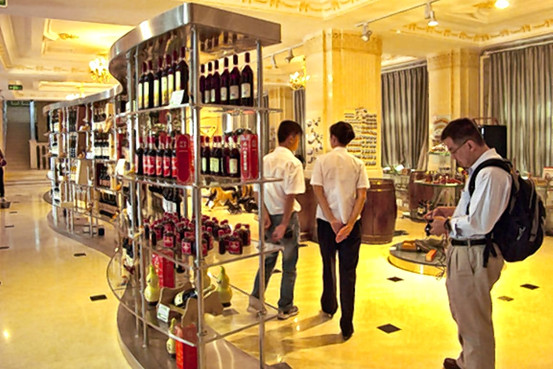
To satisfy Chinese wine drinkers' growing sophistication, the large Shanghai First Food Store on Nanjing Road East walking street now has a separate wine room filled with high-end products from the Big Three displayed alongside French wines. Some wines are clearly aimed at the gift market. Great Wall sells a $72 red wine in an individual wooden case with a glass cover that slides open to reveal the wine, resting on a bed of straw, with the label showing nothing more than a painting of a vineyard. A potential buyer would have to open the case and twist the bottle around to learn that it's a 1998 Cabernet Sauvignon.
If the store is any indication, wine sophistication in China has yet to keep pace with the rise in prices. My interpreter asked the saleslady how that $72 Great Wall Cabernet differed from another Great Wall Cabernet on display costing $7. In the expensive wine, she said, "the liquid is thicker."
Janis Miglavs
Buying souvenirs at Chaeau Changyu, Miyun County, near Beijing.
I visited the office of Dynasty's Mr. He to ask about its products. Dynasty is majority-owned by the government of the city of Tianjin, with a minority stake held by Rémy Martin, the French producer of Cognacs. What about the absence of a vintage date on the $586 Merlot bottle? Mr. He says the wine is from 2003, but that Dynasty omits the vintage to save the cost of printing new labels each year. But soon, he promises, "with the maturity of the Chinese market, we'll have the vintages, the grapes and the winemaking techniques on the label."
"We're in a period of transition," the Dynasty executive said in the interview. That transition will include Dynasty's popular "1992 dry red wine" where, according to Mr. He, the 1992 is a brand name rather than a vintage. "We're getting rid of this," he declares. "We'll call it 92."
It's unlikely that any of these bottles will pop up in an American wine store. But David Henderson, who ran a wine importing business in China before returning to the U.S., has a vineyard and winery in China that produces a wine called Dragon's Hollow solely for sale in the U.S. "Nobody walks into a [U.S.] wine shop and asks, 'Where is the Chinese section?' " he says. "But there are 44,000 licensed Chinese restaurants in America. The potential is huge."