Oakley's disappearing vineyards showcase past, point to future


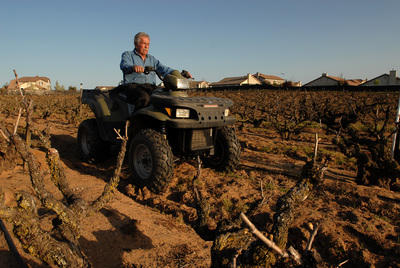
Stan Planchon of Oakley, Calif., drives a tractor through his vineyards Thursday, March 18, 2010 in Oakley Calif.. Not long ago Oakley was a land of orchards, vineyards, and country lanes. Today the trees have mostly succumbed to blight and the lanes have become highway, but many vines remain along with a handful of latter day farmers. Stan Planchon's family has owned his property since 1904. (Dan Rosenstrauch/Staff)
OAKLEY — Alan Lucchesi has spent nearly every day of the past 20 years in the vineyards here.
"Some of the vines I know by heart — they're like kids almost," he said.
Not that long ago, Oakley was a land of orchards, vineyards and country lanes. Today, the trees have mostly succumbed to blight and the lanes have become highway, but many of the vines remain, along with a handful of latter-day farmers.
"We're still here farming," said Lucchesi, who makes his living looking after 500 acres of private and publicly owned Oakley vines. "We're going to go along as far as we can until they push us out."
With its sandy soil, warm days and cool nights, Oakley has been producing award-winning wine grapes since the turn of the 20th century. Lush pictures of Oakley vineyards adorn official buildings and local wine labels, and the city regularly capitalizes on its agricultural heritage in promotional and planning materials.
As residential and commercial pressures intensify in the growing city, however, more farmers are selling their land.
Contra Costa County has lost two-thirds of its vines in the past 100 years, and Lucchesi estimates that 50 percent of Oakley's vineyards have been uprooted since the 1980s.
"Money talks, and these farmers are just going nuts," said Linda Ghilarducci, a Liberty High School teacher who owns 23 acres of vines in town.
Joe Dewart, 71, sold his vineyard to developers in the early 1990s and used the proceeds to buy a local shopping center. He passes the homes that stand on his former land every day and describes the sale as bittersweet.
"The only retirement a farmer has is in the land," he said.
The few remaining farmers seem to hope their children find a more stable profession.
"When my father saw (development) coming, he thought we would go to college," Lucchesi recalled. "They wanted us to do something else because it's hard to make a living farming."
Still, some grape growers have no intention of leaving the area if they can help it.
Determined to be buried among her vines, Ghilarducci is working toward opening a tasting room featuring Sonoma-based Cline Cellars wines, many of which are made with Oakley grapes.
"I used to stomp grapes when I was little. We were considered the Italian hillbillies," she said.
One acre of Oakley grapes yields about $8,000 a year, a third of the going rate in Napa.
"You have to have a love of the land and love of farming, or you wouldn't do it," vineyard owner Rich Pato said.
In recent years, the Agricultural Trust of Contra Costa County has been working with Oakley growers who want help preserving their vineyards. With city leaders, the organization is considering creating for certain vineyards permanent agricultural conservation easements, which would prevent the land from being developed and reward owners with money and tax benefits.
Similar programs exist in Brentwood, Livermore and Pleasanton.
Some locals, uncomfortable with the speed and direction of recent growth, want this city of about 34,000 people to do more to preserve agriculture, which they see as integral to Oakley's identity.
Mindful of the fiscal bottom line, however, officials prefer to leave to growers the question of conservation.
"It costs so much money to preserve that stuff," Councilman Kevin Romick said, later adding, "The city doesn't want to have to do farming."
Farmers, meanwhile, sometimes struggle to find the space to load their grapes onto trucks, and have difficulty navigating the produce through the urbanized streets. "You have to understand traffic patterns," Pato said.
Residents, for their part, complain about the dust and chemical sprays coming off the fields. Some farmers have gone organic as a result.
Longtime vintner Stan Planchon keeps his neighbors happy with the occasional bottle of wine.
"They're city people, but they like having a vineyard in the backyard," he said.
Today, the stocky brown plants dotting the Oakley streets are dormant, but in a month or two they will burst into bloom.
During the fall harvest, laborers will fill the rows and tractors will line the streets, creating a scene that is both bucolic and a nuisance — Oakley's own brand of urban farming.