Water Issues Get Worse for Wine Industry


California's growing shortage means grapegrowers and wineries face more oversight and regulation
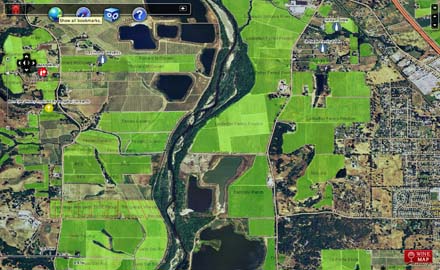
This detail from the Sonoma County Winegrape Commission's interactive Wine Map shows numerous ponds and reservoirs on Russian River vineyards. Will new restrictions jeopardize them?
Napa, Calif. -- “You’re not being paranoid: You’re being watched.”
That was the attention-getting start to a talk about water supply in California by Robert J. Saperstein of Brownstein Hyatt Farber Schreck LLP. Saperstein spoke Friday at the seminar “Best Practices for Owning and Operating a Winery,” held in Napa.
Organized by The Seminar Group, a significant part of the seminar was devoted to water—sourcing, saving water in vineyards and wineries, dealing with authorities and the use of recycled water. It was an appropriate focus as California begins a fourth year of drought. Although this winter’s rains alleviated shortages, they haven’t ended a chronic lack of water that has gotten worse during the past century.
Saperstein was specifically referring to increased state and local oversight and control of water, replacing a formerly laissez faire attitude toward its use in agriculture. “In the past, the state kept its hands off, but that’s no longer true. They’re now watching users closely,” Saperstein warned.
That means that growers who have water features that aren’t permitted, like ponds and drainage ditches, could be subject to criminal investigations and fines.
Google Earth has made it easier for authorities to learn what’s on your property, and government agents including those from fish and game departments can legally enter your land to investigate.
This is all a major change from the past, when the focus was on harnessing and reclaiming water, mostly to take water from the wetter north and Sierra south to the Bay Area, Central Valley and Southern California, noted Mary Lou Cotton, a speaker from Kennedy/Jenks Consultants.
Unfortunately, with California’s population growing from 30 million to 64 million during the past few decades, “We’re now close to functional breakdown,” Saperstein said. “Agriculture is getting 25% of its needs in a good year.”
Where does it go?
California receives about 200 million acre-feet of precipitation per year. Of this total, only half is available for use. Of the 100 million acre-feet available, 48% is for environmental protection, and the remainder is divided between 11% for municipalities and 41% for agriculture.
In addition, energy used in delivering water is also a big issue. Water pumping is the largest power user in the state, and ironically, shortage of cooling water could stall giant solar and other power projects.
Overall, the state is not dealing with the issue in an organized matter, but is simply reacting to specific threats, the speakers said.
All the water is the property of the people, but the right to use it is defined by the law. For growers, part of the problem is that surface water is treated differently from ground water. Riparian rights have highest priority, and surface water is regulated by the state. Percolating groundwater is regulated locally or by the courts, if regulated at all. One great source of uncertainty is dormant riparian water rights based on earlier decisions.
Saperstein described the complexity of the issue and recommends that anyone with interest in water become involved politically locally.
Cotton explained the issues in more detail, discussing the changing water supply and new legislation and court decisions that have impacted water supply. “There are new requirements for conservation, more water reserved for endangered species, cutbacks in projects and mandates for use of recycled water with conditions on its use.
“Water prices are escalating rapidly,” she said. “It’s difficult for agriculture to pay for it.” And well levels are dropping because of the drought.
She noted that you used to be able dig a well at will; now you have to measure its output and report it. “That’s a big change.”
She added that environmentalists want to see water use tightened before building more infrastructure to acquire and transport water. “The goal for wineries and growers is to reduce consumption by 10% by 2020.” Even residential plumbing must be retrofitted to save water, she said.
Robert Chrobak of Kennedy/Jenks Consultants described ways to use less water in making wine. He noted that wineries range from using 1.5 gallons to more than 20 gallons of water to produce a gallon of wine. Careful study of water usage is the key to saving water, he said. A few steps may have far more impact than others, and they should be settled first.
Wineries may find that automated controls and standard operating procedures, though not as dramatic as some steps, could have a major impact.
Wastewater is as important as sourced water, too. If it is to be used for irrigation, it must be processed, can’t degrade natural water sources, and can’t be used if it will touch edible products. However, studies of vineyards irrigated with recycled water have shown no significant effect on plants.
A final talk described the Byzantine water boards in the state. Basically, the state board sets policy and make the rules, while the nine regional boards regulate quality. “The regional boards are the water cops,” said Gary M. Carlton of Kennedy/Jenks Consulting, a former executive director of a regional board and state board member.
He said that members of the state board are open to discussions with those affected, though problems are best handled with organizations like the Wine Institute and California Association of Winegrape Growers, who can develop long-term relationships.
On the other hand, the regional board members aren’t open to “lobbying,” as they act as regulators and even judges. Dealing with staff and going through channels are required.
Cotton summarized the basic issue: “There’s very little ‘new’ water supply in California.” Yet increasing demand means conservation, and use of recycled water will be required—and this will affect everyone, including grapegrowers and wineries.