Which Winegrapes to Grow in Missouri?


Researchers host tastings to evaluate varieties and cultivation practices
|
A hybrid of Seyval Blanc and Chardonnay grapes, Chardonel is serving as the test variety for Marco Li Calzo's experiments with different grapegrowing practices. |
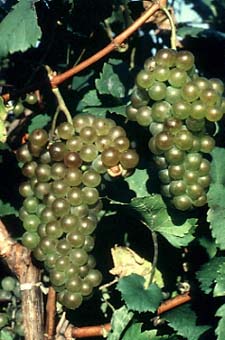
Li Calzi told Wines & Vines, “We would like to give options to established growers and wineries, as well as to the new growers who are just coming into the industry. Five years ago, there were 50 wineries in Missouri; now there are 100. This is a service for the industry, so growers can pick from a bigger selection of varieties for their plantings.”
To gain some insight into the possibilities, Striegler and Li Calzi organized two tastings of eight white and nine red wines from the 2009 harvest. On Feb. 22 and again March 1, two groups of 35 people, from Missouri and some from Kansas -- grapegrowers, winemakers, winery owners and a few people in wine marketing -- came to Columbia to evaluate those wines.
They tasted vinifera and hybrid varietals, as well as some from numbered, as yet un-named grapes. The white varietals included Viognier, Sémillion, Chardonel, Traminette, La Crescent, Valvin Muscat and two varieties still being tested at the New York State Agricultural Experiment Station in Geneva, N.Y. The reds were Cabernet Franc, Chambourcin (from two vineyards), Norton, Corot Noir, Noiret (from two vineyards), Laurot and Prophecy.
Do mechanized methods affect taste?
A second part of the tastings focused specifically on Chardonel that was grown by Eli Bergmeier, the MU viticulture research specialist who is conducting studies of mechanized growing methods compared with manual vineyard operations. A total of 16 Chardonel wines were tasted from the different research blocks to see if the tasters could detect differences in aromas and flavors and, if there were differences, which wines were preferred.
The results? According to Li Calzi, the wine research team at ICCVE gained a lot of data that will take some time to evaluate. “We’ve had great feedback from the participants, and we are definitely planning to hold the tastings again in the next years. We need to have at least three years of data collected for good statistical analysis,” Li Calzi stated. “We are moving forward in learning which are the best grape selections to grow in Missouri’s somewhat difficult climate, and how best to grow them.”
Danene Beedle, marketing director for the Missouri Wine and Grape Board, commented that she could taste the differences among the Chardonel wines and noted, “I liked the machine-picked, hand-thinned variety.” A home winemaker, Jerry Judson, found the white wines to be quite nice, while the red varietals were still too young, and consequently harsher.
Missouri has a long history of growing grapes and making wine that stretches back into the 19th century. In 1900, the state was the United States’ second-largest wine producer, after California, with a total of 2 million gallons of wine. Then came Prohibition, and Missouri farmers stopped growing grapes and switched to other crops.
Wine production revived in the 1970s and 80s, and many growers planted hybrid grape varieties as well as the traditional native American grapes. With the number of wineries in Missouri expanding, other changes in the wine and grape industry also have occurred. The educational programs in viticulture and enology moved from the research station in rural Mountain Grove to the campus of the University of Missouri in Columbia; ICCVE officially opened in 2006.
In addition to the research about mechanization that is being done by Bergmeier, ICCVE director and UM viticulture specialist Striegler is evaluating 70 different varieties at a research plot in Ste. Genevieve.
For more information about ICCVE or growing grapes in Missouri, e-mail Dr. Li Calzi at licalzim@missouri.edu or Dr. Striegler at strieglerk@missouri.edu.