Tiny Bottles a Big Change for Wine Tasting?


Vintners hope tiny tasting bottles will pay big dividends in wine marketing
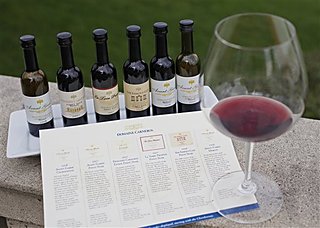
This photo taken Jan. 29, 2010 shows TASTE which is a small six-bottle tasting kit with tasting notes beside a glass of Pinot Noir at the Domaine Carneros winery in Napa, Calif. The small kit helps remove uncertainty about wines for consumers and trade buyers. (AP Photo/Eric Risberg)
Thousands of people visit the Domaine Carneros Winery each year, snapping pictures in front of the 18th-century style chateau and sipping wine on the terrace overlooking a sweep of green vineyards.
Now, the winery hopes to extend the experience with new, sample-sized bottle kits that aim to send the tasting room experience home — you read the tasting notes, you sip, you rekindle those sensory memories. All without ponying up for a full bottle of untried wine — or stripping down for an airport security check.
"You can stay in Iowa or New York or Miami, wherever you are, and you can have this experience come to you," says Eileen Crane, CEO and founding winemaker of Domaine Carneros.
The idea seems simple enough. You try sample sizes of drapes, mouthwash and wallpaper. Why not wine?
But test-driving wine isn't as simple as opening a big bottle and pouring it into a bunch of little ones, says Tim Bucher, CEO and founder of TastingRoom Inc., which launched last year and is making the 50-milliliter samples for Domaine Carneros.
For one thing, wine is sensitive to oxygen. So if a little bit is exposed to a lot of oxygen, which is what would happen if you merely poured wine through a funnel, that will change the character of the wine. Beyond that, each winery has its own method of bottling, such as "sparging," in which bottles are filled with an inert gas before filling to ensure the right conditions.
Bucher's process involves a patent-pending technology called Total Anaerobic Sample Transfer Environment — TASTE — that aims to replicate what the winery does on a miniature scale. Transfers are conducted in a sealed, zero-oxygen chamber, similar to a semiconductor "clean room," and the goal is to come up with something that duplicates the tasting room experience.
"For us it was never about taking wine from a barrel and just putting it into a smaller vessel. That would not capture the real product that wineries are selling," Bucher says.