Julius’s Jerepigo


Now that the application for mineral exploration in the Stellemboschkloof has been exposed for what it always was, a foefie, the political debate in SA wine is turning back to what it always was: land hunger. My thoughts expounded in the Sunday Times on the weekend. An earlier version of the story soon went to top of the pops on the www.winenews.co.za website.
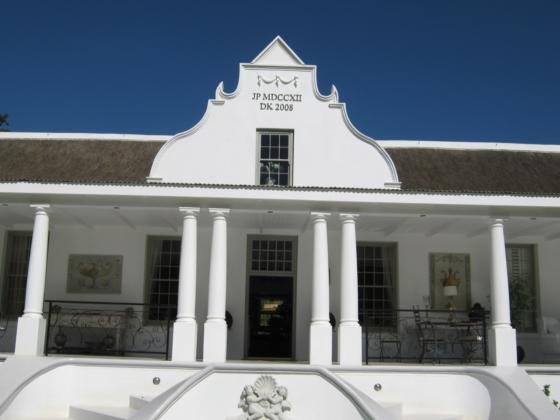
One of the many foreign-owned wine farms in Wellington
Pass the Malema Merlot
Vintage 2010 is shaping up as one SA wine farmers would rather forget. It rained at the wrong time, unseasonal winds decapitated trellised vineyards and made pumpkin patches out of bush vines and then a shadowy government exploration company applied for exploration licenses in the heart of the Winelands, leading to mass hysteria and attacks of the vapors among anoraks and hairy sandals imagining headgears on the Helderberg and Boksburg mine dumps on the Bottelary Hills. But the cherry on the tartufo came from parliament where Thozi Gwanya, director-general of the Department of Rural Development and Land Affairs, revealed plans to grab “all productive land” and transform it into “a national asset” to be leased back to farmers.
Plan B is to leave freehold alone and impose a ceiling on the number or size of farms owned by individuals. Bad news for Paul Cluver, who owns the 3500ha Mountain Kingdom of Wine in Elgin and Saag Jonker, the world’s largest ostrich farmer, which he does on 70 000ha of Karoo dessert while his son Morné grows the grapes for Retief Goosen’s Goose wines. Foreigners, in particular, will come in for scrutiny with Business Day reporting “property rights of foreign owners could face further restrictions.”
Gwanya was expanding on the confused message of his minister Gugile Nkwinti, who earlier this month told parliament foreigners buying land is “a recipe for chaos…. Foreigners are buying land three times more than the government in the country; that is partly why we have to look at the system in SA… It’s inevitable because at some point we will end up not having land as a country.” The honorable minister seeming to put SA is in the same boat as the Maldives. But instead of rising sea levels inundating low-lying land, a tsunami of foreign land purchases is threatening to make the ANC a government in situ and in exile, all at the same time.
Land ownership has been an emotive issue in SA ever since Jan van Riebeeck relocated the strandlopers and the ANC’s nose is thrust in the elegant Riedel sommelier series glass held by a foreign hand on a daily basis. Earlier this month The Times reported government intended to “put the restriction of foreign land ownership in South Africa back on the table.”
Restrictions on foreign ownership of land have been raised in public by ANC politicians for many years with Thabo Mbeki even launching an investigation. As government’s own land distribution program quietly collapses (The Times reports that over 90% of farms bought by the government for restitution or redistribution to victims of apartheid have collapsed, threatening food security and economic growth) the obvious and well-publicized success of foreign-owned wine farms coupled with painfully slow transformation of the SA wine industry, mock the whole policy.
In fact AgriSA, the farmers’ union, says that the department’s Mugabe Manifesto is precisely “a smokescreen to hide the department’s bungled implementation of land reforms.” Meanwhile wine lovers will be hoping that the message from Messrs. Nkwinti and Gwanya are an early April Fool’s jape as some of the finest SA wine, from Almenkerk to Waterkloof, is made by foreigners.