U.K. chef hails sake as 'sexy'


London-based chef and TV presenter Silvena Rowe is best-known in Britain as an expert on eastern Mediterranean cuisine. But in Japan last month, she had her compass set entirely elsewhere — promoting the "sex appeal" of sake to Japan's younger generations.
|
Kanpai!: A glass of sake in hand, Silvena Rowe poses with Western dishes she created using Japanese ingredients. TOMOKO OTAKE PHOTO |
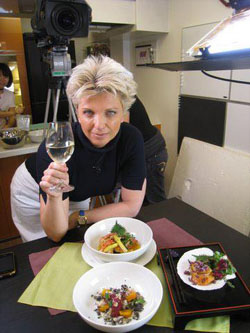
"When you get a good sake with food, it's like a Viagra injection!" she declared.
Rowe was in Japan for a two-week visit in March, the first half sponsored by the Japan Sake Brewers' Association, which represents 2,000-plus domestic sake/shochu producers. It had its origin, however, in her winning a Sake Contributor Award in September 2009 at the International Wine Challenge in London — the largest and most prestigious wine competition in the world, which only added a sake category as recently as 2007. Rowe was recognized for her work matching sake with Western cuisine, according to the association.
During her stay in Japan — her first ever trip to Asia — she visited six kuramoto (brewers) around the country, from the sake-production stronghold of Nada, in Hyogo Prefecture, to Niigata, known as the source of Japan's best rice (from which sake is made). It was during her travels through provincial Japan, though, that Rowe said she came to realize how badly sake was in need of an image revamp.
"I didn't realize what was going on in Japan," she said. "I knew that sake consumption here was declining, but only after I came here did I realize that sake in Japan has got no image. Zero image."
Indeed, that's surely so. Although sake has become much more common and popular overseas in recent years — as have eateries serving sushi, and supermarkets with sushi on their shelves — domestic consumption of the age-old, traditional tipple has been declining steadily. In fact, the decline dates back some 30 years, from 1,675,000 kl quaffed in 1975 to a meager 664,000 kl in 2007, according to National Tax Agency data.
Consequently, as Rowe so elegantly puts it, sake's image nowadays is of "old, smelly men with pipes." Sadly, she adds that "none of the young generation realize how amazing sake is — how subarashii (wonderful) sake is."
|
YOSHIAKI MIURA PHOTO |
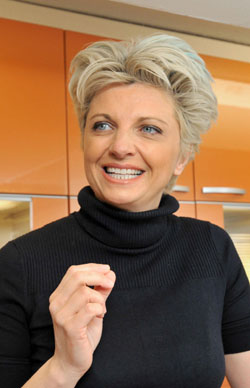
Primarily a nondrinker, she was not at all interested in Japan's traditional drink — or any other alcoholic drinks, for that matter — until about three years ago, when a friend introduced her to sake when they went to a Japanese restaurant in London. Before that, in fact, she said she only recalled tasting sake once, and that was 25 years ago when she first met her husband and he took her to a top Japanese restaurant in London named Santori.
"I remember eating teriyaki steak and having a little sake then," she said dreamily like someone revisiting in their mind a dramatic encounter with their first love at a high school reunion.
"I was thinking, 'That's unusual, I've never had that.' But I was very young. And sake was very expensive. And then two years ago, a girlfriend introduced me to it properly and I fell in love all over again. Something from 25 years ago was rekindled."
Since then, Rowe has been a passionate fan and promoter of sake. Last November, she presented an 11-course dinner for VIP guests at the residence of Shin Ebihara, Japan's current ambassador to the United Kingdom, for which she created dishes comprising Japanese ingredients such as seaweed — but all presented in a Western style. For dessert, she created chocolate truffles using koshu (aged sake) — and the Japanese guests were "blown away," she said.
|
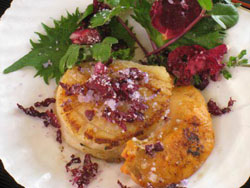
Bon appetit: A dish of sauteed scallops Silvena Rowe prepared using her special "rose-cube salt," which includes rose petals, presents a mouth-watering and beautiful prospect. TOMOKO OTAKE PHOTO |
Rowe believes that a good sake, with its distinctive umami (flavor), can make even mediocre food taste better. But to make the allure of sake understood by Westerners, brewers here need to change the way they serve it, she insists.
"If I had sake, I wouldn't put it in a small cup. I would put it in a big wine glass and serve it like a beautiful white wine," Rowe said with an emphasis on the word "big."
Then she became increasingly excited and quite passionate in her tone of voice — almost to the point of sounding amorous. "Allow it to breathe, put it to your nose, swirl it, give it a good swish! See the color, see the texture, see the coating on the glass!
". . . And only then will you begin to understand it in a Western way.
|
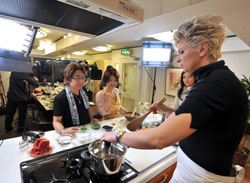
Master class: Silvena Rowe at work during a recent cookery demonstration in Tokyo. YOSHIAKI MIURA PHOTO |
Unfortunately for Rowe, the Fuji TV program — which spent hours filming her as she visited breweries and then the Tsukiji fish market in Tokyo, where she selected ingredients to cook for the show, including scallops, masu (salmonlike Japanese trout) and shrimps — used only five minutes of the footage.
Then, the commentators who appeared on the program — which was aired after she left Japan — weren't impressed with her dishes. But to her chagrin, the dishes that failed to impress were not Rowe's own — they were concocted by the program's staffers from her recipes. Additionally, the studio commentators even scoffed at the idea — in her absence — that sake can be matched with Western cuisine.
In her e-mail to this reporter last week, Rowe expressed disappointment that the TV presenters didn't seem to share her "modernist" approach to sake, saying that, without new approaches like that, sake would remain "a diminishing product even in its homeland."
"While I was in Japan, I visited a large number of restaurants, witnessing firsthand that most Japanese have themselves turned their backs on sake and favor instead imported wines and spirits," she said.
|
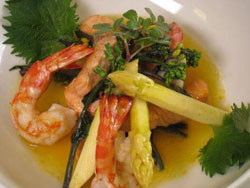
Fine fare: A dish of Silvena Rowe's sauteed masu (trout) with Hollandaise sauce and a garnish of shrimp and white asparagus. SILVENA ROWE PHOTO |
"I'm very well-known in Britain because I'm one of very few women chefs out there — and I'm very well known for bossing men around in the kitchen," she said.
"So I would love to have a show where I have five or six Japanese men and I would be whipping them. 'You do the peeling,' 'You do the shopping,' 'You do the cutting,' you know?
And this would be wonderful, because, look at me, I'm 180 cm tall. That would very entertaining, very funny."