Chinese Wine: Challenges & Opportunities


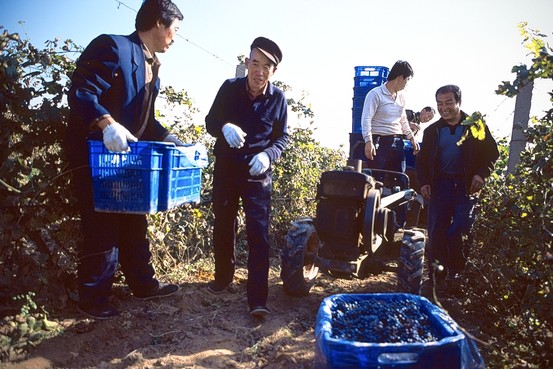
Harvest time at Grace Vineyards.
Wine in China is getting a lot of attention just now. Jancis Robinson is back from Beijing and Shanghai, where she celebrated the release of a Chinese edition of her indispensable Oxford Companion to Wine with wine dinners and tastings. Recent issues of Decanter (April 2010) and the Wall Street Journal (March 20, 2010) feature big stories about Chinese wine. One of my senior thesis students is even doing research on the potential market for Washington State wine in China.
Coffee Grounds and Ashtray
I’ve written about China’s wine market on several occasions. I discussed the challenges facing their industry in “The China Syndrome” in January 2008 and the difficulties of penetrating the Chinese market in October 2009. I even reported a London wine merchant’s forecast that China would eventually overtake France as the world’s greatest wine nation.
Challenges and opportunities: those seem to be the recurring themes.
The challenge is easy to appreciate if you taste Chinese wine. At present this is difficult (unless you travel to China) because import supplies are very limited. The Morrisons supermarket chain apparently carries some Chinese wine in Great Britain. So far I haven’t seen Chinese wine for sale in the U.S., but I think it’s here somewhere so I’ll keep looking. There is obviously a large potential ethnic market (at Asian food stores like Uwajimaya and at the tens of thousands of Chinese restaurants that dot the country) in addition to curious wine enthusiasts like me.
I have tasted two Chinese wines, thanks to a former student who schlepped them back from Beijing for me. The first, tasted with a group of students a year ago, showed the murky past of Chinese wine. It was a 1999 Changyu Cabernet Sauvignon — a recent release mass market product by China’s oldest winemaker. Tasting notes I found on the internet warned about coffee grounds and ashtray with a hint of urinal cake. Right on the money, unfortunately. Drinkable (hard to believe, I know), and weirdly fascinating, but really only interesting as a novelty.
The Grape Vine Supply Chain
The basic problems, as I have pointed out in the past, are the undemanding domestic consumer base and the badly broken supply chain.
Wine is only as good as the grapes that go into it, or so growers tell me, and the grape supply situation in China is difficult. Most of the wine grapes are grown by families that lease about an acre of land from their local agricultural commune. That acre is typically divided into four or five small plots that are planted with different crops so as to minimize risk. One or perhaps two of the plots may be wine grapes in the vineyard regions. So vineyard scale is impossibly small — smaller even than in the south of France.
These small growers insist on calling the shots, which is natural since they are so dependent upon the success of their tiny farms. The wine producers have no control over what these hundreds of thousands of micro-vineyards produce, how they are cropped, and when the grapes are picked. Researchers suggest that the grapes are chosen and grown to maximize quantity not quality and that the grapes are picked as soon as possible to minimize risk of poor weather than could destroy the crop. So small crops of flavorful fully ripe grapes — the winemaker’s dream — that’s not going to happen in a typical Chinese vineyard. One study I found suggested that the grapes sell for as little as $80 a ton.
There is not much incentive for individual growers to sacrifice quantity for quality because their grapes are sold by weight to agents who lump together fruit from dozens or hundreds of individual growers. Good fruit would quickly get mixed with inferior fruit, so why pay more? The local agents often then resell the fruit to regional agents who sell again to the large winemakers. You can just imagine the condition of the fruit by the time it finally gets to the winemaking facility having passed through so many hands. This system is worse than the European cooperatives I have read about (and I didn’t think anything could be worse than that).
China’s Hopeful Future
Recently a group of us tasted the hopeful future of Chinese fine wine, a bottle of 2003 Grace Vineyards Tasya’s Reserve Cabernet Franc. Grace Vineyards is often cited as the most promising winemaker in China and the contrast between this bottle and the Changyu was night and day. The attention to detail in the winemaking was evident and the use of estate grapes (rather than the unreliable supply chain cited above) was apparent, too.
The contrast between the two wines was stunning, mainly because the Changyu was so very bad, of course. The Grace Vineyards Cab Franc was a solid effort but nothing special– a bit light compared to our Washington State Cab Franc wines, for example, with the distinctive “green” taste I associate with wine made from under-ripe Cab Franc grapes.
[Update 3/24/10: A reader suggests that the "green" flavor may be intentional -- he has heard that this flavor is familiar to Chinese consumers and that some Chinese wineries may harvest grapes in a less than fully ripe state in order to achieve it. Interesting and understandable if true. Thanks to Bob Calvert for this insight.]
This points to another challenge and one that will be hard to overcome. China is a pretty difficult place to grow and properly ripen vinifera grapes. The combination of very cold winters and hot and humid summers in the principal grape growing regions makes winegrowing particularly tricky. (The Decanter article does a good job explaining this.) Some reports indicate that white varietals like Riesling can be grown with success, but wine’s first duty in China is to be red and ripening the preferred Bordeaux varietals is a significant long term problem.
Seventy-Two Buck Chuck
The Wall Street Journal article by Stan Sesser included tasting notes by a panel of local experts. The nonvintage Changyu Cabernet Sauvignon they sampled sold for the equivalent of $5.40 and reminded them of dirty sweat socks and cleaning fluid — possibly a step up from the one I tasted.
At the other extreme, a 1998 Cab from Great Wall was apparently really quite good — “deep colored, full bodied, tannic, but with a lot of fruit.” Price? The equivalent of $72. Yikes!
I have to think that Chinese wine will benefit in the long run from all the attention it is receiving at home and abroad. It will be interesting to see how the challenges and opportunities develop over the next few years.