Water Panel Will Impact California Vineyards


Delta Stewardship Council meets to address California's conflicting needs
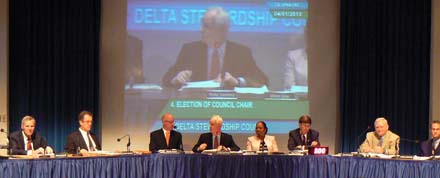
The new Delta Stewardship Council held it first meeting in Sacramento on April 1. Chair Phil Isenberg is seen in center and projected on screen.
Sacramento, Calif. -- The new Delta Stewardship Council (DSC), charged with providing a more reliable water supply for California's multiple needs while simultaneously restoring and enhancing the Sacramento-San Joaquin River Delta, held its first meeting April 1. Its aim: To make progress where other governmental agencies and policies have failed in recent years.
The new agency is a result of the California Legislature's historic and comprehensive special session water legislation package, the Sacramento-San Joaquin Delta Reform Act of 2009 (SB X7 1), signed in November. The DSC is the successor to the California Bay-Delta Authority, and the CALFED Bay-Delta Program. The DSC is an independent state agency, not subject to review by an umbrella state agency, secretary or department head. The council is expected to operate with more independence and authority than previous agencies with similar duties.
Chris Stevens, DSC legal counsel, brought the new seven-member panel up to speed by highlighting key aspects of the 2009 water legislation and the DSC's key duties and responsibilities. The legislation establishes:
• The co-equal goals of providing a more reliable water supply for California and restoring and enhancing the Delta ecosystem.
• In addition to the Delta Stewardship Council, establishes the Sacramento-San Joaquin Delta Conservancy to implement ecosystem restoration activities, and restructures the current Delta Protection Commission.
• A primary focus of the DSC is to prepare, adopt and implement a Delta Plan by Jan. 1, 2012, to guide state and local actions in the Delta. This will include incorporation of other planning efforts in the state, such as the Bay-Delta Conservation Plan. The DSC will serve as an appellate body to determine if a state or local agency's project in the Delta is consistent with the Delta Plan, in the event of a claim that a project is inconsistent with the plan and goals.
• The DSC must also develop an Interim Plan with recommendations for early action.
• The DSC is required to engage with the federal government to coordinate activities in order to be consistent with federal statutes.
Historic changes in the works
The legislation requires, for the first time in California history, that local agencies monitor groundwater levels. It addresses statewide water conservation through management plans by urban and agricultural water suppliers, with the goal of reducing statewide per capita water consumption 20% by 2020.
Most of the seven members appointed to the DSC have backgrounds in water policy or Delta resource issues. In its first action, the DSC elected former Sacramento mayor and former California Assemblyman Phil Isenberg as chair. An attorney with extensive knowledge of state water policy and related legal issues, Isenberg also served as chair of the Delta Vision Task Force, a body created in 2006 through an executive order by Governor Arnold Schwarzenegger, which issued a Delta Vision Plan in 2008.
The DSC includes a member associated with grapegrowing. Randy Fiorini of Turlock, Fiorini Farms and Fiorini Family Vineyards, has served on the board of the Turlock Irrigation District, is a past president and board member of the Association of California Water Agencies and a past president and board member of the California Farm Water Coalition.
Other DSC members include former California Senator Patrick Johnston of Stockton; Sacramento County Supervisor and chair of the Delta Protection Commission Don Nottoli; Richard Roos-Collins of Berkeley, director of legal services for the Natural Heritage Institute, co-chair of the Agricultural Water Management Council and a member of the Bay-Delta Conservation Planning Committee; Gloria Gray of Inglewood, a board member of the Metropolitan Water District of Southern California; and Hank Nordhoff of Del Mar, who has held executive management positions with biotechnology and pharmaceutical companies.
The DSC's first meeting dealt with organizational and housekeeping actions to officially appoint staff, review legal requirements and gear up to hire consultants and enter into contracts to help prepare the Delta Plan. The DSC appointed Joe Grindstaff as interim executive officer, carrying over from the same position he held with the CALFED Bay-Delta Program. Much of the existing CALFED staff will continue on as DSC staff. The council will revisit the executive officer appointment in 90 days to consider others for the position. The DSC also designated Dr. Cliff Dahm as interim Delta lead scientist, continuing his CALFED role and contract term that goes to July 1.
Legislation specifies a Delta Science Program and a 10-member Delta Independent Science Board as successors to the CALFED Science Program and Science Board. The role of the program and board is to provide unbiased scientific information for decision-making, identify research needs, and evaluate and fund research proposals.
Isenberg noted that everyone in the legislative process agreed on the importance of an independent science panel, and he said, "We are required under the legislation to use the 'best available science' in developing the Delta Plan."
He acknowledged that conflicting science -- and lack of good science -- have been issues in decision-making and implementation in the past, and that parties often look for scientific studies to be completed that will support their positions. "I intend to rely on the Independent Science Board to tell us what is the 'best available science,'" Isenberg said.
Litigation has been another logjam to progress, and is viewed as a symptom of dysfunctional management and policy in the Delta. Stevens and Grindstaff acknowledged that water policy, supply and flow rates were being decided by litigation, primarily involving the Endangered Species Act in connection with the effects of water flows on populations of fish species such as salmon and Delta smelt. DSC members and staff expect conflict and controversy as they go forward. One issue will be considering renewed proposals to build new water con veyance systems through or around the Delta, such as the decades-old proposal for a Peripheral Canal, or a more recently proposed underground tunnel alternative.
Central Valley agriculture interests south of the Delta are interested in finding solutions that will make more water available for farming operations. However, many agricultural operations and landowners within the Delta, including the Clarksburg Wine Growers & Vintners Association (CWGVA), are opposed to drawing more water from the Delta estuary system, in part due to concerns about its impact on the ecosystem and water salinity.
Grapegrowers seek protection
A bigger threat is the Peripheral Canal. CWGVA president Tim Waits said, "The Canal's proposed western route option goes right through our district, and with required levees and land disturbance for construction, could be from 1,400 to 2,000-feet wide. We recognize this as a very serious threat to our existence." The group is pursuing legal action to prevent employees from the Department of Water Resources from entering their private properties and vineyards to do surveying work for the canal. In addition, the group plans to oppose an $11 billion state water bond issue planned for the November 2010 ballot (also authorized by the November 2009 legislation), which they fear could fund water diversion infrastructure.
Public comments at the meeting, which was attended by representatives of local and state water agencies, environmental groups, natural resource organizations, and Delta stakeholders, ranged from optimism about the new body and its authority to skepticism about whether the DSC could succeed where others have failed. Some stated that the short two-year timeline to complete a Delta Plan was unrealistic and unachievable.
There is also discontent among some parties over the DSC incorporating the existing CALFED staff and program. Many view as unsuccessful the CALFED program, because it has not improved water supply, and fish populations have continued to decline. The Environmental Defense Fund's A. Spreck Rosekrans told the DSC, "There is criticism that you've been handed something old before you've been able to create something new."
The DSC plans to meet at least twice monthly. See more information on the council, its tasks, and other Delta information, policies and plans is at deltacouncil.ca.gov.