Rejection of expanded wine sales applauded


|
Members of The Last Store on Main Street, a group of small business owners, say they feel confident the fight to keep wine out of grocery stores is won. However, the New York Farm Bureau, representing winegrowers in support of the proposal, says it is not over yet. Photo by AP.
|
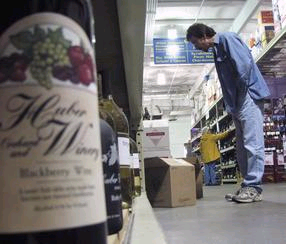
New Yorkers looking forward to purchasing a bottle of Shiraz with their other supermarket sundries are starting to see the glass half empty as final budget negotiations continue.
The new fiscal year began last Thursday without a final state budget in place. Before leaving Albany for the Easter-Passover holiday break, the Senate and Assembly passed their respective budget resolutions, with both houses rejecting Gov. David A. Paterson's 2010-11 Executive Budget proposal to allow the sale of wine in grocery, convenience and drug stores.
But is the proposal truly off the table?
Austin Shafran, a spokesman for the Senate majority conference, said since the Senate rejected the proposal, he has not heard of any relevant movement or actions taken to revive the measure.
Through licensing fees imposed on businesses with gross sales over $1 million annually, the measure was estimated to generate $300 million by 2012. That revenue would be dedicated to Medicaid and other health care program costs.
"Right now the Senate's budget resolution is reflective of the status of the particular issue. The wine in grocery store … revenue action was not included in the Senate's budget resolution because it's an issue a number of members in our conference have concerns with," said Shafran.
The proposal was rejected, he said, because of concerns for the effect it would have on the wine store industry and small businesses' ability to retain jobs.
Sonia Lindell, a spokeswoman for Assembly Speaker Sheldon Silver, said the measure was not included in the Assembly's budget resolution because there wasn't support among the majority members for a variety of reasons. "It's hard to say right now [if the proposal is dead] because nothing is final," she said.
"The Legislature made the decision for all the right reasons," said Mike McKeon, a spokesman for The Last Store on Main Street, a coalition of small business advocates, wine store owners and wholesalers. "The Legislature rejected it because they don't trust the numbers. … The Legislature is rightfully skeptical of the numbers coming up."
McKeon called the $300 million figure "phony" and a "gimmick" and said that the proposal would have put thousands out of work by allowing sales in 19,000 new venues.
"We're not taking anything for granted," he noted. "We don't believe that it's possible that the Legislature will flip on this at this point, but we know things change in a heartbeat in Albany. We're going to keep working hard, making the case over and over again. … But we're more confident than ever."
Julie Suarez, public policy director for the New York Farm Bureau, is still optimistic that New York will join the 35 other states that have expanded wine sales.
"I'm still hopeful that this will happen this year," she said.
However, Suarez said she was not surprised that neither house's budget resolution included the provision. "Politically, it would have been foolish of the Legislature to accept the proposal in either of the one-house budgets. I never expected it to be in the one-house budgets," she said.
"We work for farmers, so as an organization we're used to beating our heads against the wall. It's been an issue that our members have sought for over 30 years, so at some point in time it's my strong belief that this will happen. There's strong support from the public. At some point in time these artificial barricades will fall."
Support from the public, according to a poll conducted in February by the Siena Research Institute, has grown since last year when the governor first proposed expanding wine sales. An estimated 58 percent of New Yorkers were in favor of selling wine in grocery stores in February, as opposed to 46 percent when they were asked the questions in 2009.