Sonoma County grape growers fight early morning frost


KENT PORTER/THE PRESS DEMOCRAT
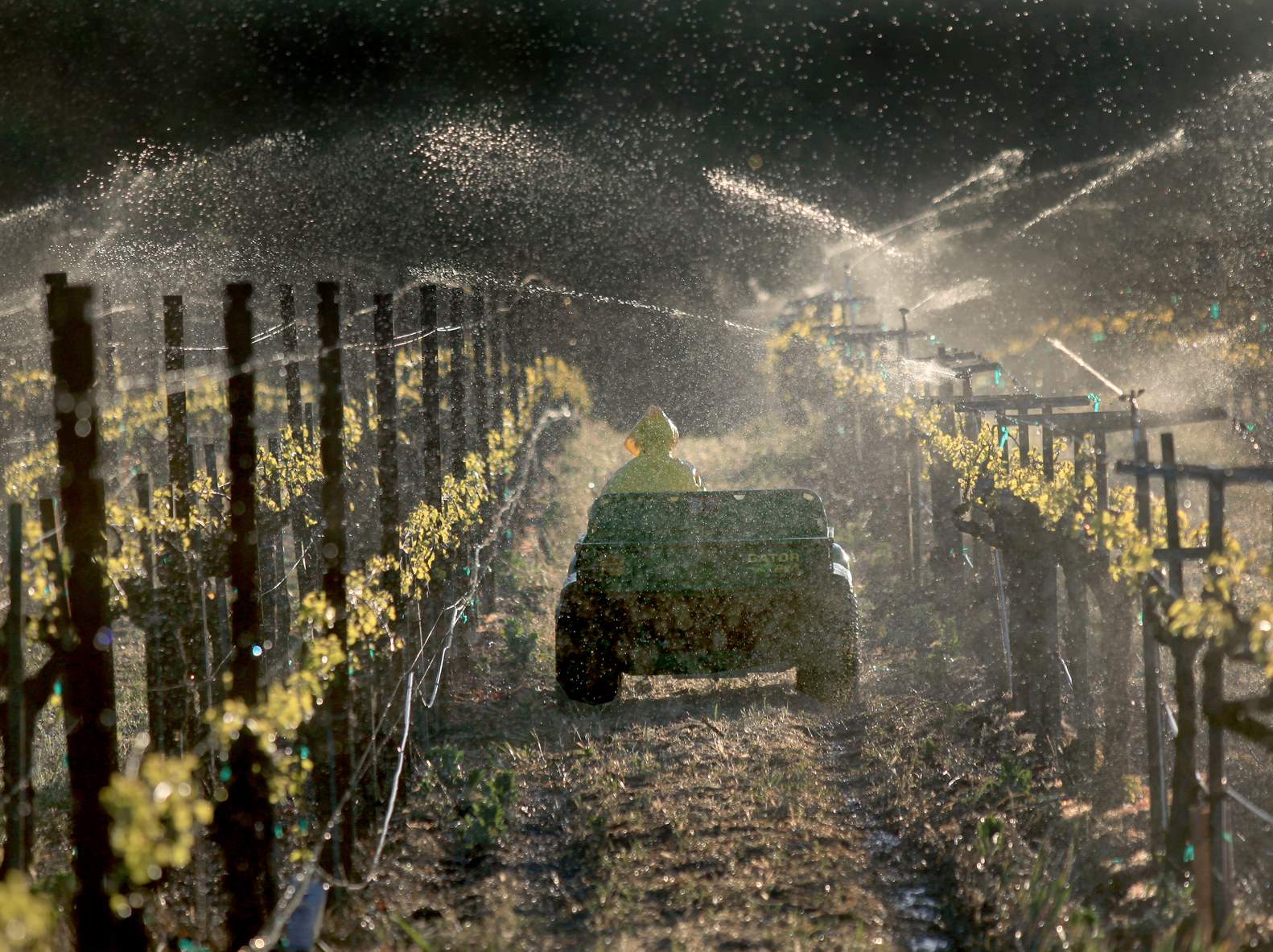
Above, near Forestville, Salvador Camacho checks sprinkler flows as part of frost protection measures used this morning to battle temperatures near freezing.
Grape grower Ned Hill saw a clear sky before dawn Tuesday when he got up after frost alarms rang his telephone at about 2 a.m., the sign to get up and start measuring temperatures, dew points and wind.
Temperatures dipped around freezing in pockets across Sonoma County, sending grape growers to the fields before dawn to run sprinklers and fans on budding grape crops to keep frost at bay.
“We had our first major frost event in quite a while,” Hill said just as the sun was rising over his southern Sonoma Valley fields.
The U.S. Weather Service had issued a frost advisory but forecasters removed the alert at 2:24 a.m. when temperatures didn’t dip as much as expected, said Bob Benjamin, a forecaster with the U.S. Weather Service.
Still, temperatures hovered around freezing in some North Bay interior valleys, Benjamin said.
Some thermometers hit 32 degrees before dawn on Hill’s 400 acres. Hill turned the fans on at 4 a.m. to push warmer air down toward the grapes. A high dew point and winds coming through the Petaluma gap meant he didn’t have to run the sprinklers, he said.
“There was just enough wind to keep the temperatures from bouncing around,” said Hill, who owns La Prenda Vineyards Management.
In Graton, building roofs were frosted but temperatures hit freezing in just a few isolated spots across Steve Dutton’s grape fields.
Dutton ran 40 percent of the fans across his ranch, though he said “it’s not even going to be a hard 32-degree frost here.”
“It’s been a pretty mild season so far,” Dutton said. “We’ve gotten up four or five times but we haven’t had to run much.”
Tuesday’s frost alert was mild in part because the season’s wet weather kept dew points high, said Nick Frey, president of the Sonoma County Winegrape Commission.
“When you have a high dew point the temperature goes down slower,” Frey said.
The rains also mean there’s water enough to draw from area rivers to run sprinklers without threatening flows needed to support threatened fish.
Teams from the state Water Resources Control Board Tuesday monitored flows in tributaries in the Russian River, said Dave Clegern, water board spokesman. The season’s 27.02 inches of rain bolstered river water supplies against the sudden water draws, he said.
“At this point we’ve seen nothing to indicate there’s a problem,” Clegern said.
An unusual number of freezing mornings during the 2008 and 2009 seasons led growers to rely on sprinklers to encase the buds in ice, insulating them against plummeting pre-dawn temperatures. But the water draws caused a sharp drop in the river and its tributaries, killing coho salmon and steelhead.
“We haven’t had the night after night of freezing temperatures this year, and that helps everybody,” Clegern said. “As long as that continues we’ll be fine.”
Frost shouldn’t be a concern for the rest of the week, according to U.S. Weather Service forecasts that put nighttime lows in the low 40s for the rest of the week, Benjamin said.
Daytime highs should start in the mid 60s and rise into the low 70s by Friday.