World Expo 2010 Shanghai: Portugal Pavilion designed by Macau consortium


Alexandra Lages (MDT in Shanghai)
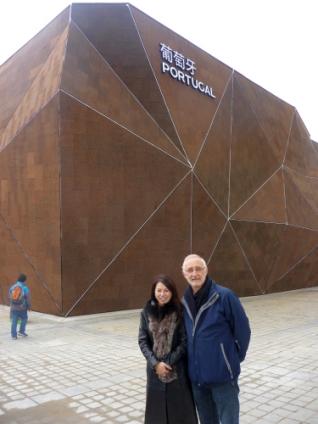 The Portugal Pavilion in the World Expo Shanghai was designed by a consortium from Macau and it will provide Portuguese egg tarts supplied by a local businessman.
Living in Macau for 28 years, architect Carlos Couto is having an experience of a lifetime. The Fisherman’s Wharf and the Landmark are some of his more famous properties in Macau designed by the Portuguese architect.
“It is perhaps one of the most important things in my life. Such a work doesn’t appear every day. These events occur every four years and we have not many opportunities to participate in it,” he told reporters.
For Couto, participation in this particular event has a special meaning. “It is in China, where I live, which is meant to be the world’s largest exhibition ever. In the next years, it will be hard to exceed the dimension of this Expo. It was a unique career opportunity,” he said.
In fact, a locally-based consortium headed by PAL Asiaconsult, who hired Couto, was in charge of the construction of the Portugal Pavilion.
The Portuguese Delegation launched an open international tender for the design and construction of its pavilion, and five Macau companies were invited to bid, with PAL Asiaconsult ultimately being selected for the task.
Carlos Couto explained one very good reason for awarding the job to a Macau-based company. “I need to be here many times and the engineers as well. So it makes more sense to have a company from Macau in charge of the pavilion design and construction,” he added.
The exterior curtain walls and interior attaching veneers of the Portugal Pavilion make use of cork cladding, a Portuguese-sourced, recyclable and environmentally friendly material.
“Portugal is the biggest cork manufacturer. Today, cork is not only used to seal wine bottles, but also used in construction for isolation, flooring and many other usages,” he said.
“Amorim Group is the biggest cork manufacturer in Portugal and in the world and they are one of the main sponsors of the pavilion. That is the reason why the cork is the main element of the Pavilion’s design,” the architect said.
Portuguese egg tarts from Macau
Carlos Couto added new forms to the original design of the Portuguese Pavilion. “It was a parallelepiped lying. We have tried to destroy this way, using these triangular lines to provide it a plastic richness,” he pointed out.
Indoors, the Pavilion will include a bakery with egg tarts provided by a Macau businessman. Mr Cheong already owns 30 stores in Shanghai selling Portuguese egg tarts.
The theme of Portugal’s cork-enveloped pavilion for Shanghai’s Expo 2010 is “Portugal, a Square for the World”. It features the 500 hundred years of relations between Portugal and China, mainly its history and its influence on modern Portugal.
Just like its cork façade, the Portuguese exhibit focuses on renewable energy and environmental themes. The exhibition area is divided into four sections of “moments,” while supporting facility areas include a dining area and wine tasting area.
Entrance halls, digital screens and theme exhibition areas showcase history, culture, economy and daily lives of Portugal. Nearly 3 million visitors are expected to visit the 2,000 square-metre Portuguese pavilion and exhibit during the six-month event that opens officially on Saturday.
Carlos Couto led the design team of “Glitter”, one of the final three design concepts for the Macau Pavilion of the 2010 Shanghai World Expo. When asked to comment on that, he said with a smile on his face: “I just feel sorry for not having had the opportunity to win both projects [Portugal and Macau].”
Organized around the theme “Better City, Better Life”, Shanghai’s Expo 2010 will feature pavilions and exhibits from 200 countries and institutions in the biggest international event hosted by China since the Beijing Olympics in 2008.