Will glut sour vintage?


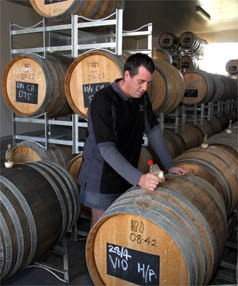
RuralPersonal touch does the trick Will glut sour vintage? Top dairy trainee eyes career Kiwifruit down, returns up Firm reviews systems Rural property sales sluggish Milk production now tailing off Mopping up, moving on Kiwifruit reaction lukewarm Nest triggered salvation It's been another vintage season for Nelson winegrowers but as rural reporter Peter Watson reports, selling it is proving more difficult.
Great wine, but how low do you go to sell it?
That's the dilemma facing Nelson winemakers in what many of them describe as the most brutal trading conditions they've experienced.
A massive oversupply of wine that is flooding export markets still recovering from recession has pushed prices down to often barely profitable levels, leaving only consumers smiling.
Cash-strapped grape growers are feeling the pinch from yield caps and falling prices, while industry observers warn of winery failures and mergers in a cleanout lasting several years.
Nelson Winegrowers Association chairman Mike Brown calls it "a perfect storm", while Kahurangi Estate Winery managing director Greg Day says he's never seen selling margins so small and discounting so rife.
Frustratingly, it follows a season that has produced excellent red and white wines.
After a cold flowering during December naturally reduced crops, sunny settled weather from February to the end of April allowed grapes to fully ripen and be harvested unhindered, largely free of fungal diseases.
Aware of the wine glut, many growers also deliberately thinned their crops to concentrate on quality, with Mr Brown estimating the Nelson crop was down about 10 per cent on the 7740 tonnes produced last year.
"2009 was a great white vintage and a good red vintage, but 2010 is potentially great for both varieties, partly due to the lower cropping and that warm spell that pushed varieties along," Mr Brown said.
There were plenty of "really nice, concentrated, darkly-coloured, deeply-scented red wines, pinot noir mainly".
"That's what the South Island grows well and what the world wants from us."
White varieties were generally flavoursome with higher alcoholic content.
"Because we had such a dry season, they're pretty clean, so the aromatic wines are pure expressions of the variety without any complexing character from botrytis."
Mr Day said it was the best vintage in his 12 years at Kahurangi. "I'm delighted with the results of my riesling and it's been a very good year for reds."
Trevor Bolitho, co-owner of Waimea Estates, one of Nelson's major winemakers, described it as "a real gem of a season".
"We had a fantastic vintage. It went like clockwork. Crop levels were where we wanted them, and we had a very clean crop with good flavours."
Ad Feedback But selling even high-quality wine has been a real struggle, with the domestic market and key export markets like Australia and Britain awash with wine, much of it cheap, bulk-produced sauvignon blanc and of lesser quality. Figures issued earlier this month show wine exports up 32 per cent to 107 million litres for the nine months to March, but the average price per litre down from $9.18 to $7.36.
"It's hard to compete with some of the Marlborough wineries when you can buy a bottle of sauvignon blanc for $5.90 in a supermarket. I find it hard to make the wine for that price," Mr Day said. "We're having to discount our wines just to get some sales to compete."
Rising costs for things such as glass and packaging could not be passed on, as supermarkets were demanding sharper prices.
Kahurangi, which as one of Nelson's larger producers will produce 406,000 litres this year of mainly riesling, sauvignon blanc, pinot noir and chardonnay, was concentrating on selling to restaurants and cafes, where margins were still good, and looking with some success for new export opportunities for its premium brands, he said. It had just secured its biggest single order for more than 4000 cases of pinot noir to Norway after 12 years of leg work.
"That gives us a bit of heart."
While Kahurangi would still make a small profit this year, there would be a lot of wineries that didn't, Mr Day said.
Mr Bolitho said Waimea Estates was also trying to increase its exports and reduce its reliance on domestic sales, where it was competing against supermarkets, which were selling wines for prices "that we couldn't even bottle it at", let alone make a profit.
Costs had already been trimmed as low as they could be, so it was a matter of riding out the turbulence as he remained committed long-term to the industry.
"There's still profitable markets out there; the world's been in a wine glut since the mid-eighties."
He did not regret the decision to pull out of a $34 million deal involving the sale of his family-owned company to American-based St James Company earlier this year.
While the state of the industry might have had an impact on the deal not going ahead, it had not changed the way Waimea Estates operated, he said.
Mr Brown said it was important for wineries to protect their main, premium brands from discounting so they were still intact when markets recovered. "If you have drifted down from selling a $25 wine for $12, it's impossible to climb back again."
For the many smaller winemakers in Nelson, who struggled to compete with deals being offered to supermarkets and liquor stores, it was a case of selling as much as they could at the cellar door to tourists, restaurants and high-end retail outlets, where margins were higher.
"It's a very, very competitive market out there and the better the quality your wine is and the better you communicate that, the better you can stand up to the competition."
He expected a few would exit the local industry over the next few years. Already, D'Urville Vineyard had gone into liquidation but mainly because of property development losses, while the number of vineyards for sale, such as Moutere Hills and Stafford Lane, had increased.
Most at risk were new entrants, often growers, with high levels of debt and less recognisable labels, while some of the smaller lifestyle vineyards without a contract for their grapes were likely to disappear. Others would move on to different crops.
The restructuring was also likely to see some mid-size wineries in Marlborough and Nelson merged or swallowed up by bigger companies seizing the opportunities to buy brands for a reduced price in a depressed market, he said.
It could take about two to three years for the market to "come back into sync" and the glut to be sold before prices slowly recovered.
In the meantime, Nelson growers had more or less imposed a moratorium on new plantings, although some would take the opportunity to "reinvent themselves" by moving to grafted vines or changing their mix of varieties.
They would also be focusing on further developing the challenging American and Asian markets, Mr Brown said.
But while winemakers fret about current market woes, Mr Bolitho sees it more simply.
"We've been in these situations before. We've been in the horticultural industry for 35 years and seen them go up and down. You've got to be sustainable and sustainability is not just about putting less spray on, it's about making a profit to be able to survive next year."
INDUSTRY SNAPSHOT
Nelson has 34 wineries and 62 grapegrowers. Grapes cover 813 hectares. Nelson produced 7740 tonnes last year, about 2.7 per cent of the national crop. Sauvignon blanc makes up 57 per cent of the local crop, followed by pinot noir (14 per cent), chardonnay (12 per cent), pinot gris (9 per cent) and riesling (5 per cent). Source: NZ Winegrowers Association