THE CHAMPAGNE ROUTE - Département de l'Aube


( photography by Ryan Ebner)
I recently travelled to France and met with French Journalist Helene Sourdeau and International photographer Ryan Ebner in Paris to assist me in my travels to the Champagne Route, Département de l'Aube. I was on a mission to seek out some unique boutique champagne houses in the area, and to learn more about the Aube district for my book entitled “Unique Boutique Champagne Houses” which will be launched in 2011.
Champagne History
Champagne has been associated with celebration and luxury for hundreds of years. It has became world-renown because of its association with the anointment of French kings and royalty throughout Europe spread the message of the unique sparkling wine from Champagne and its association with luxury and power.
The Champagne region is the only area in the world that can legally produce and market bottles labeled “Champagne” There are specific laws in place that govern where and how the grapes are grown.
Rules and Regulations Governing Champagne
The Champagne region under the auspices of the Comité Interprofessionnel du Vin de Champagne (CIVC), has developed a comprehensive set of rules and regulations for all champagne produced in the region to protect its economic interests. This includes: codification of the most suitable growing places; the most suitable grape types (primary varieties used Chardonnay, Pinot Noir and Pinot Meunier); and a lengthy set of requirements specifying most aspects of viticulture (pruning, vineyard yield) and requirements specifying aspects of viniculture (the degree of pressing, and the time that wine must remain on its lees before bottling). CIVC also limits the release of Champagne to market (to maintain pricing). Only when a wine meets these requirements may it be labeled Champagne.
Champagne Region
Champagne-Ardenne is one of the 26 regions of France and is situated in the northeast of the country, bordering Belgium in the north and its southern border nestles against Burgundy. Champagne-Ardenne consists of four departments: Aube, Ardennes, Haute-Marne, and Marne. Champagne is only “Champagne” if it originated from the Champagne-Ardenne region. There are around 14,000 winegrowers in the Champagne wine region and more than 320 million bottles are sold a year. This region has 7,500 hectares of vines comprising 22% of the accredited Champagne area.
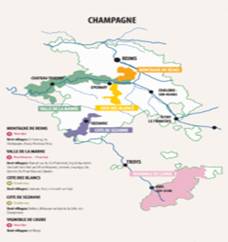
Département de l'Aube
Most people, when they think of the Champagne region, think of the area around Reims, but 126 km south of Reims is the Département de l'Aube. Aube being the lesser known champagne route has smaller, friendlier, family-run boutique champagne houses. Along this Champagne route (The Côte des Bar trail which runs south of Reims, from Bar-sur-Aube down to Bar-sur-Seine and Les Riceys) I found a beautiful countryside with rolling hills, historical villages, magnificent forests, lakes, and rivers.
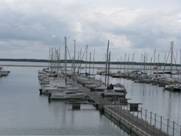
The Route
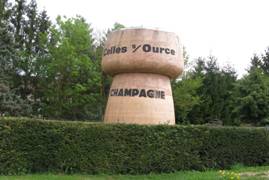
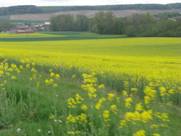
The Champagne vineyards are within five miles of the city centre, south of the town of Troyes and it forms a peak, with Bar-sur-Aube at the top and a line along Bar-sur-Seine and les Riceys at the bottom. The soil here is consistent; however, the climate is closer to Burgundy’s. The main grape variety is Pinot Noir which is 85% of plantings. Production in Aube is 60 million bottles of champagne per year.
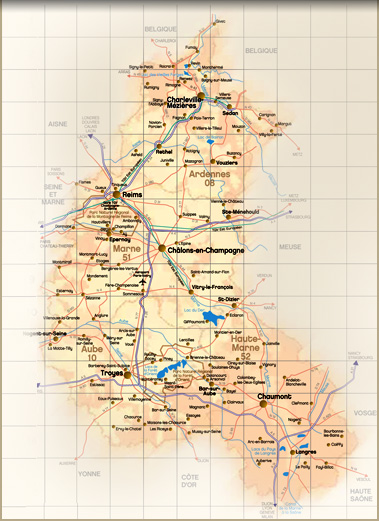
I found visiting these Champagne houses you need to phone ahead and book appointment times for visiting. Most are closed on Sundays, and the month of September due to the harvest. The Côte des Bar’s winegrowers have posted signs on the 220 km route welcoming visitors. This route winds its way between hillsides and valleys, between winegrowing villages and is lined with 29 cellars that have been awarded “Visitors Welcome” certificates (which have been granted to assure the standard of their welcome, quality of their facilities, their expertise and their quality champagnes) by Aube’s 2,589 winegrowers.
Here I found either the winegrowers or members of their family who guided us through the cool vaulted cellars (some dating back to the 12th century) where the bottles are kept and we learned about the Champagne making process and the grape varieties that are used. They also discussed the care and attention they give their vines right up until the moment of harvest (Champagne derives its main characteristics from the soil and the sunshine). They further demonstrate pressing then assembling (the subtlety of all these specific techniques that make champagne a unique wine on an international scale).
Finally, at the end of each tour and demonstration comes that special and memorable moment when Champagne is tasted. We learned to discern champagne’s multiple flavours, vintages, rosés and special vintages. There are so many subtle differences and harmonies to discover from cellar to cellar.
Troyes
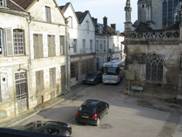
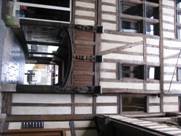
The City of Troyes is actually the outline of a champagne cork – how Ironic! Troyes is the medieval capital of Champagne, and here we explored the finest concentration of beautifully restored 16th-century (medieval and renaissance) half-timbered houses that remain in Europe. It is pleasantly picturesque, and boasts an abundance of architecturally appealing landmarks and notable sites. Stoll along the cobblestone streets we admired the wealth of culture and centuries of history that envelops this region. It was in this city that the medieval champagne trade fairs took place.
There are more than four hundred half-timbered houses that are clustered around narrow alleys and passageways. We came upon “Cat Alley” which is to be rumored the narrowest street in France. Ruelle des chats (Cat Alley) - Local legend has it, that cats once jumped from rooftop to rooftop because the ally is so narrow Troyes is also the departmental capital of the Aube, which produces a quarter of Champagne’s grapes. Troyes has one of the largest Gothic cathedrals in France Basilique St Urbain. It is considered to be one of the best examples of Gothic construction in the Champagne region. It was built from 1262 to 1286 by Pope Urban IV, who was originally from Troyes.
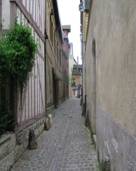
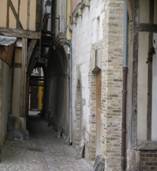 Famous “Cat Alley”
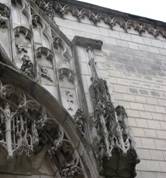
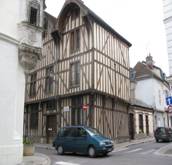
Basilique St Urbain
To be continued: Village of Essoyes, in the champagne fields, four champagne houses we visited, Local food specialties, and preferred hotels
Village of Essoyes & In The Champagne Fields
Champagne-Ardenne Region (Aube) PART 3 OF 3
Village of Essoyes
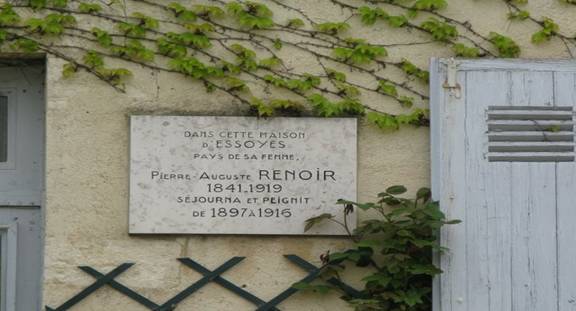
The Village of Essoyes, which is located 45 km south of Troyes and 15 km from Bar-sur-Seine (on the Champagne Route). This village has fewer than 700 inhabitants. We found Essoyes is situated in a beautiful valley, surrounded by lots of trees and the tributary of the Seine flowing through, It is best known as home of the artist Pierre-Auguste Renoir. Many of his paintings were inspired by the picturesque landscape. His roadside villa is currently run by his family. In the backyard of his garden, is his former workshop. This is now a museum and summer home for young resident-artists who are working on a Renoir scholarship. Renoir himself rests in the local cemetery.
Memorial Plaque
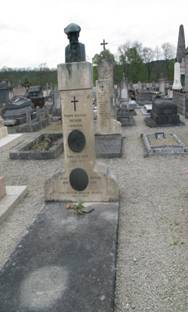
Burial Site of Pierre-Auguste Renoir
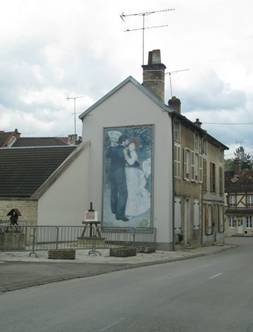
Scattered throughout the Village of Essoyes we found some of his paintings
In the Fields: Bud Break In Champagne-Ardenne (Aube)
A new cycle is under way – we witnessed that the vines are budding vigorously. This past winter has been long and cold, and the spring has been very short this year. The current weather is more summer-related, and the sudden growth of the vegetation is exceptional - local growers believe unprecedented!
To date, there has been no frost this year and it looks like it will hold off – the traditional wait is May 11, 12 or 13 (days renowned for potential frost - Saints de Glace).
The buds look like brilliant green butterflies on the vines. The clusters are beginning to appear and the campaign of protection against mildew will be commencing soon…..a new cycle is under way…
Photography by Ryan Ebner
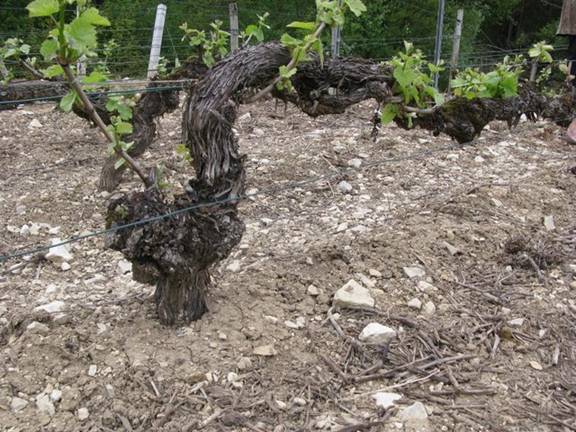
There are three varieties which are utilized in the production of Champagne, and are planted in Aube. Chardonnay and Pinot Noir are considered the most significant varietals in terms of producing quality wine; Pinot Meunier provides a unique set of characteristics that, when grown in optimal areas, and masterfully vilified and blended, endow Champagne with exceptional character. These three varieties are found in the Champagne-Ardenne (Aube) Region.
PINOT MEUNIER
Growing cycle: Buds later than chardonnay and pinot noir; matures early
Attributes: Because of late bud-break, it is less prone to spring frost
Sensitive to: Powdery mildew and botrytis
Characteristics: Fruit, earthiness, roundness
CHARDONNAY:
Growing cycle: Buds earlier than pinot noir or pinot meunier, but ripens later
Attributes: Relatively hardy and resistant to cold temperatures
Sensitive to: Spring frosts (due to early bud-break), powdery mildew and botrytis
Characteristics: Finesse, acidity and length
PINOT NOIR
Growing cycle: Buds later than chardonnay and before pinot meunier. Pinot noir ripens earlier than the other two varieties.
Attributes: High pulp-to-skin ratio, yielding abundant juice. Most planted varietal in Premier and Grand Cru vineyards. Early ripening lends its suitability to vineyards sites that face south/southwest
Sensitive to: Powdery mildew, odium, and gray rot
Characteristics: Weight, structure and depth of flavor, more aromatic fruitiness