'A tale that still speaks to us today'


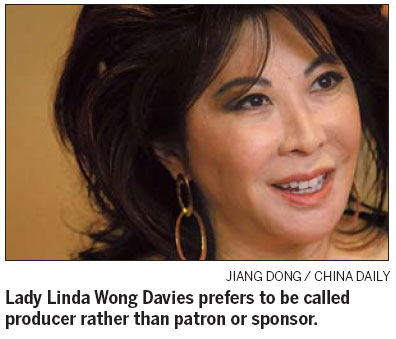
The idea of interpreting a Baroque opera through the eyes of a Chinese contemporary artist came from Lady Linda Wong Davies, chairperson of the KT Wong Foundation.
The same night the 450-year-old ancestral temple arrived at Poly Theater, Lady Wong stayed until 3 am to discuss technical details of the show.
She prefers to be called producer rather than patron or sponsor. She says while some people prefer being just sponsor, leaving the artistic and technical details to the show's creators, she enjoys being involved in the whole process.
"Chinese filmmakers have established a position for themselves in the world, so why not the theater artists," Lady Wong says during an interview with China Daily the next morning at Swissotel.
"That's also one reason I was inspired to commission a Chinese contemporary artist to do this Chinese version of Baroque opera. If Ang Lee can direct Jane Austen's Sense and Sensibility, why can't Zhang Huan interpret Handel's Semele."
Wong's grandfather was born in China and the family moved to Indonesia where her father Dato Wong Kee Tat was born in 1926. The family then moved to Malaysia where she was raised surrounded by music and art.
"Like most typical Chinese parents, my parents forced me to learn the piano when I was around 6. Almost every evening, the family held parties where we listened to Mozart and Strauss. We supported many local culture and arts events," she says. However, there was no pressure on her to become a soloist and she was encouraged to learn economics, culture and history in the United States.
But the family's commitment to the arts left such a deep impression on her that three years after her father died, in 2007, she established the KT Wong Foundation to extend his vision to build bridges between China and the rest of the world through innovative cross-culture collaboration and to enhance mutual cooperation.
"The biggest challenge is to find the right project to interest audiences outside China and provoke more thought and a better understanding of China's culture. For example, Chinese opera is wonderful but quite frankly, it is not really understood in the West and is something that is totally exotic," she says.
"But China has a diverse culture, especially the dynamic contemporary arts, so you really have much to choose from, but first of all, you must find the right partners and the right talents to realize the right project."
In this sense, the opera Semele is, by far, the foundation's most challenging and ambitious project. Three years ago in Shanghai, Lady Wong, a big fan of Baroque music and of Handel, watched a performance of Handel's Messiah and saw the positive response of the audience.
Ever since she has felt that Semele offered the best operatic answer to her vision of bringing great Baroque music to China.
"I don't know what Handel would have thought about a Chinese version of Semele. But it is a tale that still speaks to us today," she says.
"China is a country hardly bereft of a rich tradition of errant gods and goddesses drawn from its own pantheon of deities."
Wanting a contemporary Chinese artist to realize her concept, she settled on the controversial visual artist Zhang Huan. "The reason I picked him is that I read from his works that he was searching for a deeper meaning of life and (I sensed) a deep spirituality in him. He also has a series of works called Gods and Demons, which made me think this man has something interesting to offer to the Greek myths of Semele," she says.
Zhang did not disappoint her. All the nine shows in Brussels were sold out and became the talk of the town.
"Zhang certainly is not afraid of being controversial. When the production comes to Beijing, he hopes that people will respond well to it, but it's okay if somebody dislikes it. This is what we want to do to challenge you to talk and think," Lady Wong says, adding that the show has been invited to run in Toronto, Canada, in 2012.