[60thAnni] Long way to go before globalization of Korean cuisine
By 2010-10-31 10:15:35


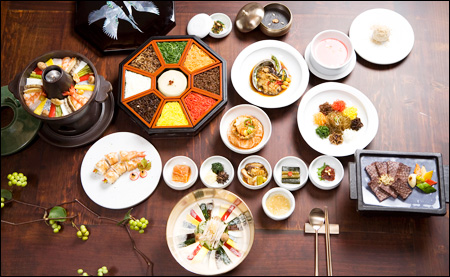 Hansik offers rich tastes with an array of side dishes. But it has yet to gain a firm root in the global markets. / Korea Times file |
Overseas Korean restaurant owners not that optimistic about hansik’s success abroad
Corresponding with its 60th anniversary, The Korea Times visited Korean restaurants in the United States and Canada in order to cover the Seoul administration’s initiative of trying to globalize Korean food, or hansik. The Korea Press Foundation sponsored the project. ― ED.
 NEW YORK ― Korea’s cultural industries have chalked up a major success in the global scene over the first decade of the new millennium as showcased by the term ``hallyu,’’ in such segments as soap operas, movies and music.
Seoul tried to duplicate the success in the food industry during the past few years under the stewardship of President Lee Myung-bak, who reiterated the potential of Korean cuisine, or ``hansik.’’
Toward that end, the nation has channeled a substantial amount of taxpayers’ money into the project, but there seemingly remains a long way to go for hansik to take a firm root abroad in a manner comparable to food from Japan, China or Mexico.
``Most hansik restaurants in the United States and Canada struggle to stay afloat. They are typically small-sized and their major customers are still Koreans, not locals,’’ said Luis Yoo who manages Niagara’s Young Garden in southern Canada.
``For most foreigners, Korean restaurants are not the best place to wine and dine as they do not know much about hansik. We need to employ various strategies in order to change this situation.’’
King Sejong project
King Sejong of the Choseon Dynasty (1392-1910) is famous for having standardized weights and measures, which historians think is one of the most crucial prerequisites for the full-swing development of any country.
Along the same line, many restaurant operators in North America claim that Korea needs to fix standards for the names of its food in a way friendly to English-speaking customers, such as Japan’s sushi and sashimi.
In the face of such criticism, the Ministry of Food, Agriculture, Forestry and Fisheries (MOFAFF) came up with standards last year based on the revised Romanization by the Korean government.
However, the outcry shows no signs of subsiding as a manager at a New York-based restaurant contends ― the standards are not good for marketing. He picked an example of kimchi jjigae, or the pot stew made with Korea’s top stable side dish kimchi.
``It is very eccentric to put two consonants in succession in the food titles. Pizza and spaghetti would be sole exceptions. In my view, people tend to get bad impressions from bizarre names like kimchi jjigae,’’ said the manager who asked not to be named.
``How about kimchi soup or kimchi stew? It is easy to understand and remember. As many people already know kimchi here, such titles would be perfect for the food. For some reason, however, the Seoul administration sticks to jjigae and does not listen to the grassroots uproar.’’
He added that the country needs a King Sejong project under which it generates standardized titles for Korean food, which can be easily remembered and loved by offshore gourmands.
Side dishes
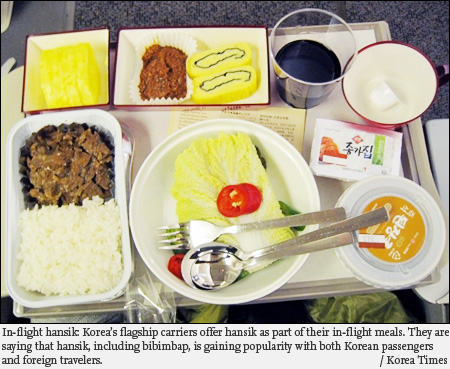
Another issue is side dishes. Koreans have several side dishes before the main cooking comes to the fore, but the time-honored tradition works as a stumbling block in globalizing hansik.
A flurry of tiny bowls of beans, finely sliced potatoes, two kinds of kimchi, on and on crowd the table, which some claim are too heavy as an appetizer.
``A majority of Korean restaurants offer quite a few side dishes in advance so that customers eat many of them before the main dish is served,’’ said Choi Yon-suk, the owner of Woo Chon in Manhattan.
``In other words, they start to have the main dish only when they are half full. Understandably, they are not crazy about the main dish and chances are that they do not return. We need to do something to change this.’’
Another downside is that they make hansik look like low-priced, second-string food, which attracts customers with quantity rather than quality.
Yet, restaurants have a dilemma ― many of their clients have become quite accustomed to the side dishes. Accordingly, they are feared to migrate to other alternatives like Chinese food without them.
Simply put, side dishes balk at attracting new customers but going without them may end up losing existing clients.
``Some big fans of Korean food are those guys who want to have as many side dishes as possible free of charge. Korean restaurant managers think they have to risk losing them if they decide to dispense with side dishes,’’ said Ahn Sang-mee, owner of Ottawa-based restaurant SooRa ― the king’s table in Korean.
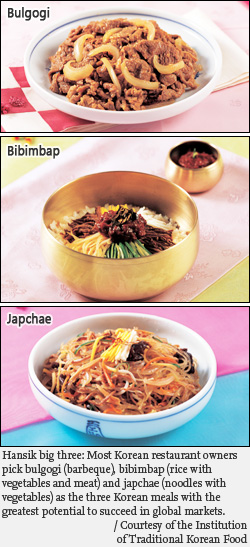
There are a couple of ways to avoid the side dish dilemma ― some levy charges for them and others attempt to develop and market menus, which don’t need side dishes at all, such as bibimbap or japchae.
The former is a bowl of rice topped with vegetables and meat, and the latter refers to a mixture of noodles and vegetables. They are famous Korean meals.
But both strategies seemingly have yet to gain substantive results, though.
Mindset ― Lack of entrepreneurship
Observers point out that many of Korean restaurant owners overseas lack entrepreneurship ― they try to make easy money by attracting compatriots, instead of drawing foreigners by competing nearby Western rivals.
``To avoid start-up glitches, overseas hansik restaurants target Korean residents and one-off tourists. Then, they will not collapse in the short run but they will not rack up success over the long haul, either,’’ said Rhee Kun-hee who runs Han Sung Oak at Falls Church, Virginia.
``Accordingly, foreigners have few chances to taste our food. Hansik has sufficient potential to captivate the taste buds of epicureans outside Korea, but we failed to make them sit at the hansik table.’’
Rhee argued that Koreans need to nurture entrepreneurship via fostering a mindset that hansik restaurants are not small-sized businesses.
To do so, he added that the Seoul administration may play a crucial role through subsidizing new entrepreneurs or providing consulting services to globalize hansik across the world.
From koreatimes.co.kr