Chinese Vintners Accused of Selling Fake Wines
By 2011-1-11 11:42:21


It looks as if China's food and beverage makers may be getting a bit too creative again. This time they apparently were making wine without grapes.
Six winemakers were arrested and at least three large-volume wineries were shut down this week after being accused by local Chinese authorities of adulterating their wines and using counterfeit labels from best-selling brands.
The official action came after an investigation by Chinese national television CCTV asserted that a nationwide con was being inflicted upon China's rapidly growing community of wine aficionados.
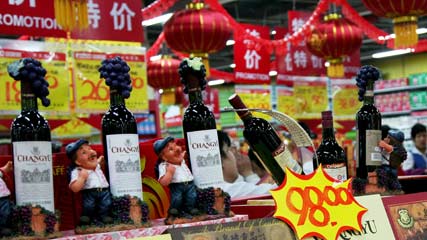 Some of the product contained as little as 5 percent fermented grape juice, and the balance was reportedly filtered water, sugar, activation chemicals and artificial grape flavoring and coloring agents.
One of the three wineries used nothing but water and chemicals, according to Chinese media, and thousands of bottles were sold for as little as $1.50 each. Beijing television reported that the company -- Jiahua -- sold about 2.4 million bottles of faux wine this year.
This is at least the second major food and beverage scandal out of China in 2010. Earlier this year, AOL News reported that several Chinese executives were indicted for conspiring to export mislabeled honey into the U.S.
The wine in question came from Changli County, in Hebei Province, where 80 percent of the tillable land is devoted to growing cabernet sauvignon grapes, one of the world's most recognized red varietals. Changli is called China's Bordeaux region and is the largest of the country's four winemaking districts.
More than 5,000 cases of wine were seized, and authorities are tracing shipping papers to see
where the questionable wine was shipped.
"We are highly concerned about this behavior. To ensure safety measures, we have already started to remove the suspected wines from the shelves," Zhang Tao, spokesman for Walmart supermarkets in Beijing and other cities, told leading Chinese newspapers.
Authorities also seized printing plates and thousands of labels for 19 superior high-priced brands, including Great Wall Wine and Dynasty and Dragon Haven, that may have been forged.
The crackdown comes a month ahead of China's lunar New Year, the peak season for domestic wine sales, according to the China Times, which reported that nearly 30 other wineries were being shut down.
Television in Taiwan says that a good percentage of the wine produced by some of the wineries involved is exported worldwide, with ports in Australia, Mexico, California and Washington state among the favorite destinations.
A press officer with U.S. Immigration and Customs Enforcement told AOL News on Wednesday she knew of no alerts or import warnings on Chinese wine in the Seattle region, but added that she couldn't speak for the rest of ICE operations.
The Chinese have savored alcoholic beverages for thousand of years, mostly high-alcohol-content beverages such as whiskey and other spirits made from rice and grain.
"Although China has a 6,000-year history in grape growing, and a 4,000-year history in winemaking, it was not until this century that Chinese wine was recognized in the West," Stephen Reiss, an international wine authority and author, wrote on his website.
The sophistication of Chinese wine drinkers is increasing, but there are only a few highly drinkable examples on store shelves, according to a couple of experts who lived and drank in the country.
Early this year, Stan Sesser reviewed six wines in his article for The Wall Street Journal. "All but one of the wines were actually drinkable, a couple even enjoyable," Sesser wrote. He described a $5.40 bottle of cabernet, which came from the same region as the suspect wineries, as having "an aroma that evoked dirty sweat socks and cleaning fluid and a foul chemical taste."
At the top of his list was a $72 bottle of Great Wall Cabernet, which he reported "could have held its own with Cabernets from other countries."
Six winemakers were arrested and at least three large-volume wineries were shut down this week after being accused by local Chinese authorities of adulterating their wines and using counterfeit labels from best-selling brands.
The official action came after an investigation by Chinese national television CCTV asserted that a nationwide con was being inflicted upon China's rapidly growing community of wine aficionados.
AFP / Getty Images
Bottles of adulterated wine, produced in now shut-down wineries that were using famous brand names, are shown on sale at a wine fair in Shijiazhuang, China.
One of the three wineries used nothing but water and chemicals, according to Chinese media, and thousands of bottles were sold for as little as $1.50 each. Beijing television reported that the company -- Jiahua -- sold about 2.4 million bottles of faux wine this year.
This is at least the second major food and beverage scandal out of China in 2010. Earlier this year, AOL News reported that several Chinese executives were indicted for conspiring to export mislabeled honey into the U.S.
The wine in question came from Changli County, in Hebei Province, where 80 percent of the tillable land is devoted to growing cabernet sauvignon grapes, one of the world's most recognized red varietals. Changli is called China's Bordeaux region and is the largest of the country's four winemaking districts.
More than 5,000 cases of wine were seized, and authorities are tracing shipping papers to see
where the questionable wine was shipped.
"We are highly concerned about this behavior. To ensure safety measures, we have already started to remove the suspected wines from the shelves," Zhang Tao, spokesman for Walmart supermarkets in Beijing and other cities, told leading Chinese newspapers.
Authorities also seized printing plates and thousands of labels for 19 superior high-priced brands, including Great Wall Wine and Dynasty and Dragon Haven, that may have been forged.
The crackdown comes a month ahead of China's lunar New Year, the peak season for domestic wine sales, according to the China Times, which reported that nearly 30 other wineries were being shut down.
Television in Taiwan says that a good percentage of the wine produced by some of the wineries involved is exported worldwide, with ports in Australia, Mexico, California and Washington state among the favorite destinations.
A press officer with U.S. Immigration and Customs Enforcement told AOL News on Wednesday she knew of no alerts or import warnings on Chinese wine in the Seattle region, but added that she couldn't speak for the rest of ICE operations.
The Chinese have savored alcoholic beverages for thousand of years, mostly high-alcohol-content beverages such as whiskey and other spirits made from rice and grain.
"Although China has a 6,000-year history in grape growing, and a 4,000-year history in winemaking, it was not until this century that Chinese wine was recognized in the West," Stephen Reiss, an international wine authority and author, wrote on his website.
Early this year, Stan Sesser reviewed six wines in his article for The Wall Street Journal. "All but one of the wines were actually drinkable, a couple even enjoyable," Sesser wrote. He described a $5.40 bottle of cabernet, which came from the same region as the suspect wineries, as having "an aroma that evoked dirty sweat socks and cleaning fluid and a foul chemical taste."
At the top of his list was a $72 bottle of Great Wall Cabernet, which he reported "could have held its own with Cabernets from other countries."
From aolnews.com