Quaffing deeper as drinkers splash out on wine


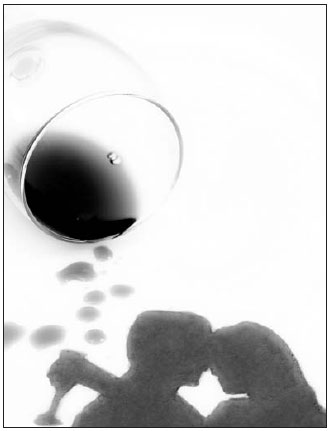
A bottle of wine conjures up images of romance and luxury. Yang Ge \ for China Daily
BEIJING - When the poet Li Bai wrote his celebrated work Drinking Alone by Moonlight in the eighth century, the Chinese were already well acquainted with the pleasures of the cup.
Scholars are still debating whether it was actually grape wine or China's traditional baijiu spirit that moved the "Immortal of Poetry" to write about enjoying "a cup of wine under the flowering trees".
But the poet - who was also dubbed the "Immortal of Wine" - clearly knew why he was drinking, when he added, "I must make merry before the spring is spent."
 His motives seem a far cry from well-heeled Beijing urbanites, who can be seen in restaurants trying to decide between rum-raisin ice-cream to go with their Chilean late harvest Sauvignon Blanc or cookies 'n' cream.
Despite the tradition, wine drinkers were a rare breed in China just three decades ago after ordinary Chinese were exposed to Western wines when the country opened to the outside world in 1978.
"In China, drivers of wine consumption growth are different from those we see in more established wine markets," said Jenny Li, a Chinese wine market analyst for UK-based Wine Intelligence, a strategy consultancy serving the global wine industry.
A grasp of Chinese drinkers' beliefs, tastes and concepts is essential for those who want to penetrate the market and target consumers, Li said.
Red before bed
Wu Jianhua, head of the Shanghai Drinks Association (SDA), pointed to a preference for red wine with its auspicious color as an example of how those traditional beliefs can be advantageous in marketing a product.
"The concept that the color red signifies good luck and happiness has helped the sales of red wines, and they are served on dinner tables at more and more wedding ceremonies, even in the countryside," said Wu.
About 90 percent of the wine shelf space in China's supermarkets is allocated to red wines, says Wu, citing a survey by his association in Shanghai.
The data is roughly in line with a survey by Hong Kong-based Vinexpo, organizer of one of the world's largest wine and spirits conferences, which found that 88 percent of Chinese drinkers prefer red wines.
The growing thirst for wine in China also stems from a strong belief that wine is much healthier than baijiu and even has cosmetic benefits.
Li said increasing numbers of middle-aged Chinese have developed a daily drinking habit for health benefits.
"They are often heard preaching that a glass of red before bed not only aids a sound night's sleep, but is good for general health. Women drinkers also talk about the additional benefit of being great for the skin," said Li.
Experts caution that there is no conclusive scientific evidence of wine's benefits and point to the "French paradox" as a major factor in the widely held view in China that regular consumption of red wine is healthy.
The paradox refers to the relatively low incidence of coronary atherosclerosis in France compared with other Western countries, despite the generally high intake of saturated fat in the French diet.
The belief has also led more Chinese to choose wine as a gift for relatives and friends, and wine even takes the place of baijiu on official dinner tables as some local governments prohibit the white spirit on official occasions.
Wu also blames the different drinking cultures of baijiu and wine for the belief that wine is healthier.
"If Chinese people drink baijiu, they tend to drink excessively in a tradition where men drink baijiu with friends to show personal loyalty, brotherhood or generosity. The more you drink together, the closer the friendship," said Wu.
"So Chinese people often identify baijiu as harmful, but when people drink wine, they don't easily drink excessively in large part due to the general ambience associated with wine."
White light
Despite the perceived health benefits and auspicious symbolism of red wine, many Chinese still find it unpalatable and tend to mix it with soda or sweet juice to soften the taste.
Various surveys show most Chinese drinkers like wines that are light, not too alcoholic, not acidic, and without heavy tannins, Wu said.
This presents a dilemma to China's wine drinkers, who generally adapt more easily to the lighter, fresher taste of white wines, while preferring reds for their health qualities and symbolism.
"Mastering the Chinese palate, which favors soft tannins, and also their belief that red wines are healthier and more sophisticated, is seen as the key for wines to win in China's wine market," Wu said.
However, this challenge for wineries is gradually fading. Vinexpo forecasts white varieties will account for about 42 percent of consumption by 2013 as more Chinese drinkers become exposed to them.
Wu suggests winemakers craft their products to create an aroma and flavor profile that suits Chinese tastes and cuisine, as about 85 percent of wine and spirits drunk in China are enjoyed over a meal.
However, more educated Chinese appreciate good wine. "It's a question of education, just like a foreigner wouldn't appreciate a really top quality Chinese tea at first taste," Wu said.
He identifies increasing cultural and business exchanges as a driving force in educating Chinese to appreciate wines.
Wine drinking can be seen in many Western movies or TV shows, and more people are experiencing wine at dinners with foreign business counterparts, said Wu.
Status symbol
The "sea turtles"- young Chinese who return home after studying abroad - have also played an important role in spreading wine culture, Wu said.
Tian Ming, a 26-year-old software engineer working for a Beijing-based bank after graduating from a university in Melbourne, likes to drink wine when partying with friends, but not because of its health benefits.
"A bottle of wine with a beautiful girl - romance, luxury - these are all thoughts that come to me. Wine is a really good way to start an evening," Tian said.
Tian's girlfriend, Liu Xinxin, agrees. "Wine is about ambience, fashion and sophistication, not like Chinese liquor, which is for people who can drink lots of alcohol."
In China, wine has become a symbol of a desirable urban lifestyle, which shows sophistication, vitality and high social status, Wu said.
A survey conducted by Vinexpo showed 72 percent of Chinese women wine drinkers said wine was "elegant" or "the reflection of a lifestyle" while also acknowledging its health benefits.
China's wine consumption increased from 564.26 million bottles (423.2 million liters) in 2004 to 899.68 million bottles in 2008, but the market is still in its infancy with a per capita consumption of 0.4 liters a year.
This is in sharp contrast to 50 liters for the French, 25 liters for Australians and 15 liters for Americans, according to research by global management consultants AT Kearney last year.
However, with the rising appreciation of wine and the combining forces of urbanization and globalization, Vinexpo predicts wine consumption in China will soar by 32 percent to 1.26 billion bottles by 2013, or about one bottle a year per person of drinking age.
Wu said China's rising number of affluent young increasingly prefer more expensive imported wines, which are often perceived as more sophisticated than domestic wines.
Most Chinese wineries put rough descriptions such as "dry red" on their labels - unlike the common practice abroad of informing buyers of the specific varieties, such as Cabernet Sauvignon, Merlot or Shiraz - because most consumers have near-zero wine knowledge, he said.
Imported wines only accounted for 11.8 percent of China's consumption in 2008, with France being the largest overseas supplier. But the market share for foreign wines could hit 15.8 percent by 2013, Vinexpo predicts.
The forecast is supported by figures showing that while Chinese purchases of homegrown wine increased 67 percent from 2004 to 2008, consumption of imported brands quadrupled over the same period.
"In China wine plays a complex role in people's lives, so winemakers should have a long-term strategy for producing and marketing wine to target the right people," said Wu.