All the tea in China


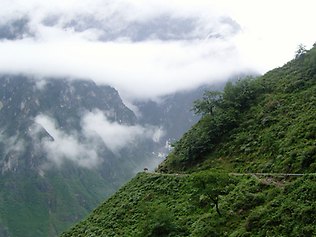
The mountainous beauty of Yunnan province. Source: AP
ROW after row of neat bushes line undulating hills. It could be Tuscany, except for the hats.
The conical straw headgear of the workers is a constant reminder that this is Asia. More specifically, we are in Xishuangbanna district, Yunnan province, at the start of a 1000-year-old trade route that once linked southern China to Tibet, and beyond.
Sometimes called the Southern Silk Road, the trail was more commonly known as the Tea Horse Road. From the 7th century until just 60 years ago, Chinese merchants transported the large leaves of the pu'erh tea varietal so Tibetans could make a delicious hot drink to keep themselves warm on the roof of the world. Tibetan traders would bring a commodity of which the Chinese were even more in need: strong horses to fight off the marauding barbarians on their northern border.
The entire route stretched over 5000km and included difficult mountainous terrain, thousands of metres high. Over a week, with six other travellers, I trace the most clement section of this one-time trade highway, the part that runs through Yunnan, from the subtropical south near the Burmese border to the province's snowy northwest frontier with Tibet. Our guide to this varied trail is Jeff Fuchs, a Canadian mountaineer who has spent the past decade researching the Tea Horse Road, collecting testimonies from those who remember a time before paved roads rendered it obsolete.
With his wiry, overgrown hair, high-altitude tan and bristly chin, Fuchs is every inch the explorer; except as I watch him survey the green hills I realise it isn't the unknown that inspires him. Tea is his obsession. "It's amazing," he says, fondling one of the bushes. "The locals can tell which side of the hill a bush grew on just by inspecting the leaves."
We leave Menghai, one of the few places in Xishuangbanna large enough to be considered a town, and pass along a main road bordered intermittently with small blue-tiled outbuildings. These are "factories" where the pu'erh is sorted before being sent on to real factories elsewhere, where it is packaged, ready for the world's thirsty masses.
Eventually we arrive at a dirt track. Here we change over to a steam-powered tractor and tug uphill through manicured tea bushes to the thatched brick houses of Nongyang village, where we are offered suancha, or pickled tea, and shown how to make it. Our host gently boils the leaves, packs them into bamboo and buries them in the garden to ferment for up to two years. She then unearths a one-year-old bamboo package and scrapes out the contents for us to nibble. This sour snack is an acquired taste.
About 50km northeast of Nongyang are the tea forests of Nannuoshan. This area was one of the first places in the world to cultivate tea, and its antiquity shows. Instead of orderly rows planted to meet the needs of a booming modern market, the tea is wild. For centuries, the people who live here have picked the buds and leaves, but the trees are left to grow in whichever formation nature chooses. Hunched, gnarled and covered with a patchy grey-green bark, they appear like a huddle of wizened men. "You do not go into these forests alone," says Fuchs. "The locals are fiercely protective of these trees. They're liquid gold."
Fuchs enlists the help of a villager, Ming Pei. We walk quietly through the forest.
Our silence is broken only when Ming tells us how the tea is harvested. All the leaves are handpicked by women, she explains. During harvest season, they begin early in the morning and finish late at night. It's tiring work, not least because only the top 5cm of leaves are picked, so pickers must scramble up ladders to reach the treetops.
Ming falls quiet as we approach the king tree. This 800-year-old tree is just 6m high but its wide trunk and interwoven branches command respect. It is fenced off, probably for good reason, as Fuchs looks like a child in a sweet shop.
"My mouth is itching for tea," he says, as he hurries us on to Banpo, Ming's village, a further half-hour's walk into the forest. We know we have arrived when we spot a clump of wooden houses sprouting from the earth. The women of the village are waiting for us, cups in hand, dressed in the traditional costume of the Aini minority: black tunics and hats stitched with feathers, pompoms and silver baubles. While they cook dinner, we sit outside on tree trunk stalls with the men to prepare the tea.
Leaves are roasted on an open fire, then soaked in water, before the golden liquid is poured into our simple ceramic cups. The fire gives the brew a smoky flavour, but you can still taste the tang of just-picked leaves.
Most of the tea harvest is left to ferment into the musty taste that consumers normally associate with pu'erh. It's then sold on to China's wealthy for 10 times what the pickers are paid. This style of tea is treated like a fine wine; connoisseurs carefully note vintages. But for the people who grow it, fresh is best.
Seven cups of the raw, unfermented stuff and I am buzzing. We are ushered into one of the families' simple homes for a dinner of chicken, potatoes and winter melon. After the meal we continue sitting on low stalls on the wooden beam floor.
I am suddenly thankful for the cha skipping around my veins as the hospitable Aini ladle us shot after shot of potent rice wine. "Don't worry," I am told. "Tea has a counterbalancing effect."
The next day I feel a distinct lack of counterbalance, but persuade myself this has more to do with altitude than overindulgence. The province of Yunnan is one giant slope, rising from 76m in the southeast to nearly 7000m in the northwest. We now move on to the walled town of Dali, which stands in the middle, at about 2200m.
Dali marks the start of the tea road proper. It was the trail's first trading post and its citizens, the Bai people, are known as shrewd merchants. They converted their profits into elegant stone buildings, still on view in the old town. With its willow-lined, pedestrianised streets and views of the Green Mountains, it is a picturesque place to wander. But thanks to the local backpacker population, another leaf now predominates. On every corner, hawkers peddle "smokey-smokey".
Away from the main streets, cobbled alleyways offer a more authentic flavour.
Walking south from the north gate, we squeeze down the first alley on the right. Women in headscarfs are selling goods to the locals: giant incense sticks to offer at temples, paper money to burn at funerals. A van tries to turn into the alley and knocks over a rattan cage, sending the chickens squawking to freedom.
We duck through a low open doorway and enter a half-covered market, where dried chillies, fruit and live fish in buckets compete for space. But Fuchs is still restless. He seems intent on leading us to his favourite teahouse. We don't have time for a ceremony but while Fuchs stocks up for later, we admire the building's typical Bai architecture, with its black-and-white tile paintings and the marble screens for which Dali is famous. In a previous incarnation, it was a guesthouse for travelling merchants. Guesthouses once stood all along the trail. But when the communists came to power and built highways, trade dried up and the guesthouses shut.
Today, though, some are reopening to the newest wave of travellers: those who journey for pleasure instead of business.
Later that day we make our way from Dali to a renovated guest house in Shaxi, where hints of bygone days remain: the courtyard where the horses were kept; the narrow, steep stairs up to the rooms; and windowsill pews that doubled as the merchant's bed and a security box in which to place his goods. More a village than a town, Shaxi is a collection of wooden courtyard homes, with exquisitely carved screens.
From the central square, it is a minute's walk to the countryside. It is a rural idyll: locals carrying baskets from fields across a stone bridge; the sweet smell of straw mingling with the incense burning in nearby shrines.
The only sound is the chug of a lone tractor.
Shaxi is a forgotten place. It's hard to believe it was once a trading post as important as Dali.
Luckily, someone in town still remembers. Ouyang Shengxian was born in 1941 to a family of muleteers.
In his 100-year-old courtyard home he shows us his father's saddle and recalls, with a toothless smile, how the streets were once lined with mules tied outside guesthouses. "The town's entire economy was the caravan trade," says Ouyang.
"When the trail died out, we had to rely on farming."
The only clue that the tea horse trail once brought faraway visitors here are the street names, such as North Tibetan Alley.
At our final stop on the trail, we start to breathe in the Tibetan influence. At 3200m, Zhongdian sits among snow-slicked mountains. The architecture, too, is Tibetan: two-floored chalets, gargantuan in size, serve as houses. Fuchs has made his home in the loft of one of these.
He invites us up for tea and shares some tips: "The fourth infusion is best, the leaves have had a chance to open up. You can tell if a tea is good by sniffing the cup afterwards; no smell means poor quality."
Zhongdian was never an important market town like Dali or Shaxi. It was a last outpost before traders took on the daunting next stage of the Tea Horse Road, the Himalayan highway to Tibet. Here they would upgrade to hardy mules and even hardier muleteers: Tibetan lados.
Caravans gathered at nearby Napahai lake, where monks from Songzanlin monastery came to bless them.
When we visit Napahai, cows tinkle past and rare black cranes fly overhead. On the surrounding hills prayer flags flutter in the wind. This is where, just more than two years ago, the tough part of Fuchs's journey began.
From here, he journeyed for eight months to Lhasa, negotiating 78 peaks over 3000m and took down the stories of people he met who still remember life on the old trail. But I am no lado. I am happy to go back to Zhongdian for a nice cup of tea.