Bait and Switch?


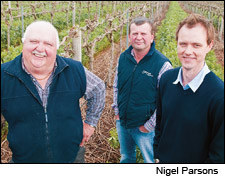
Ed Schild, Michael Schild and winemaker Scott Hazeldine stand in one of their Barossa vineyards.
Faced with strong demand for a highly-rated wine, an Australian winery has simply created more of it. Wine Spectator has learned through an investigation that Schild Estate, a family-owned winery in the Barossa Valley whose 2008 Shiraz placed in Wine Spectator’s Top 10 Wines of the Year in 2010, found itself running low on supply and decided to purchase, blend and bottle additional wine under the same label. While technically legal, the decision raises questions about the winery’s integrity and philosophical issues of what defines a wine’s identity.
Schild Estate produced about 45,600 gallons of 2008 Shiraz from their 400 acres of estate vineyards, bottling it in three batches of 6,000 cases each in November 2009, March 2010 and November 2010. About 5,000 cases were sent to the U.S., where the wine retailed for about $20.
Wine Spectator rated the wine 94 points (outstanding on our 100-point scale) in the Dec. 15, 2010, issue, and then ranked it No. 7 in our Top 100 Wines of the year, published in the Dec. 31, 2010, issue.
Demand for the wine increased dramatically. Tipped off by an Australian source, Wine Spectator recently learned that the winery responded by buying and blending an additional 5,000 cases of 2008 Shiraz, bottling it under the same label.
"We found ourselves in the situation where we are running shorter than expected on domestic stocks of ’08 Shiraz," Schild winemaker Scott Hazeldine told Wine Spectator when asked about the new bottling. "In order to get us through to a stage when the 2009 will be ready for bottling, I have been asked to put together an additional blend for sale in Australia." The 2009 is scheduled for bottling later this month, to be released in Australia in June.
"The last sourcing was from a local grower, and it has been matched as closely as possible to the original blend," general manager Casey Mohr told Wine Spectator. "The sourcing of a second blend was not taken lightly by the team." Hazeldine stressed that wine was not intended for export to North America, but confirmed that the blend was "over and above the original."
Wine Spectator has been able to blind-taste wines from two of the original bottlings and found them consistent in quality and character. However, we have not yet been able to review the new blend from the latest bottling. Schild promised to send samples through its U.S. importer.
Consumers may have difficulty discerning the differences simply by reading the official label. Wine Spectator learned that the labels for the original wine and subsequent bottlings all identify the wine as Schild Estate Shiraz Barossa 2008 and list the American importer, making no distinction among the various bottlings. However, after reporters contacted Schild for clarification, the winery offered to affix an extra label to the recent bottlings, identifying them as a second blend.
"This will enable discerning consumers to note that this is a different blend," Mohr said, adding that the winery put itself into a difficult position by reallocating stocks originally meant for the Australian market to meet U.S. demand.
There is an additional way to tell if it's an old or new bottling. A code engraved on the bottle indicates the bottling date. The newest batch carries codes that begin with BBSL1 (Barossa Bottling Services 2011). The original bottlings all carry codes that begin with BBSL0.
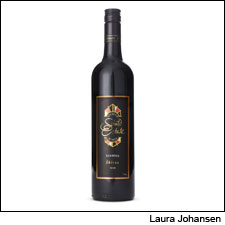
A bottle of the original Schild Estate Shiraz Barossa 2008.
Bottling different blends under the same label is perfectly legal under Australian wine law, so long as the label accurately describes the type and origin of the wines. This is common practice for low-priced commodity wines, but a rare occurrence for wines that have received high praise from critics or won awards. No winery has been prosecuted for this in Australia.
This is partly because of how difficult it is to prove that the wines are not the same, according to Steve Guy, responsible for compliance at the industry organization Wine Australia. "For instance, if one blend had won a trophy at a wine show and then a totally different batch altogether were presented under that brand, carrying the same award, this could be considered to be deceptive," said Guy. It would be up to a separate government commission that monitors trade practices to deal with it.
The additional bottlings came to light because Michael Twelftree, owner of Two Hands Wines in Barossa, also bottles his wines at Barossa Bottling Services. Two Hands winemaker Matt Wenk noticed additional runs under way for Schild Shiraz 2008 late last fall. “We find it incredibly disappointing that a company would take advantage of their position in the Top 100 in this way," said Twelftree.
Apprised of the circumstances of the second bottling, Brian Croser, dean of Australian winemakers and a longtime industry leader, noted that the Australian Wine and Brandy Corporation Act (which created the group that promotes and oversees the industry) has a catch-all clause about "false and misleading conduct” that could lead to prosecution. “The practice as described is immoral and would be viewed as such by the vast majority of the Australian wine community,” said Croser.
Tyson Stelzer contributed to this report from Australia.