Gathering in the grapes


COLIN SMITH
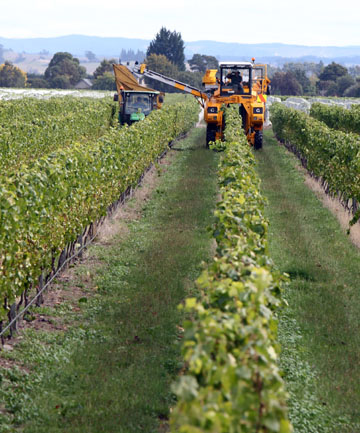
FRUITFUL: A mechanical harvester picks this season's pinot noir grapes at Waimea Estates. Relevant offers
A good growing season has meant an early start to the grape harvest, writes Peter Watson.
The annual grape harvest has got off to an early start with Nelson winemakers praying for settled weather to bring in what they say is shaping as a high-quality vintage.
Among the first to start were two of the region's biggest producers, Seifried Estate, which last week began to handpick chardonnay and pinot noir for its sparkling wines, and Waimea Estates, which began machine harvesting its sauvignon blanc and picking some pinot noir.
Waimea general manager Ben Bolitho said the good growing conditions meant the harvest was running about two weeks ahead of normal, with fruit quality looking excellent and only a little botrytis.
After a good flowering and fruit set, "we've had a perfect summer, and the rain around Christmas came at a time when it didn't bring disease and gave the vines that extra boost".
As a result, some varieties had required heavy thinning to bring the yields down to sensible and sustainable levels and to improve quality by concentrating flavours, he said.
Both its pinot noir and pinot gris, which now made up 20 per cent each of its vineyard plantings, had been thinned by up to 20 per cent, so they would crop at between six and seven tonnes per hectare, while the just under 3ha of reisling it had left had needed only a little bit of shoot thinning.
"Our pinot noir is hanging around 22 brix and is looking really good."
However, sauvignon blanc required almost no work after rain at the end of flowering knocked the top off the crop, which would hit the targeted yield of between nine and 11 tonnes per hectare, Mr Bolitho said.
Mindful that market conditions remained tough and that the national harvest was likely to be higher than last year, Waimea had been very careful about how much sauvignon it produced this year, he said.
With half of the Bolitho family's plantings of 140ha in the variety, it didn't want to be caught out.
"Once you have wine, particularly sauvignon, bottled in the warehouse, you need to move it in a timely fashion, otherwise it becomes just about unsaleable two years down the track."
Overall, the winery would produce about 2000 tonnes of wine this year, well up on the 1300 tonnes it produced last year, but still short of its 2009 crop, he said. That was likely to be reflected around the region.
Ad Feedback "We had a tiny vintage last year due to the climatic conditions, but there were also a number of vineyards that were mothballed last year and weren't harvested, so that will come through this year as a big increase in production when, in fact, it's not a big increase in yield."
Once harvest was in full swing, the winery would employ 15 people working two shifts. Five others were on vineyard duties along with crews of between 25 and 30 people brought in to handpick pinot noir and some pinot gris and aromatics, he said. All of its table sauvignon would be machine harvested.
Mr Bolitho said Waimea's focus was on its export markets, which were ticking along well.
Meanwhile, the domestic market was "a writeoff" which had forced the company to withdraw some of its product lines and do some deep discounting in order to quit stock. "Literally, it is packaging and excise recovery."
Market prospects to a large extent depended on how big the Marlborough harvest was, but with grape prices generally on a par or lower than last year, he didn't expect much improvement in bulk wine prices.
"There's really going to have to be a couple of years of short supply before it starts to show."
Nelson Winegrowers Association chairman Mike Brown was a little more upbeat, saying the latest economic modelling showed sales were tracking along at a level which suggested a national harvest of 310,000 tonnes could be sold. This follows earlier warnings from industry leaders that such a big crop would be disastrous and could force many wineries and growers, particularly smaller operators and those with high debt, out of business.
Mr Brown said he expected a Nelson crop closer to the 7740 tonnes harvested in 2009 than the 5963 tonnes produced last year, with most growers thinning crops, including chardonnay and pinot gris, to reduce yields.
"It should be a good year as long as growers have managed their crop loadings accordingly.
"I think this year will be great for whites again and it will just be a matter of how yields for pinot noir have been managed which will determine their quality."
He said the only dampener would be if there was a lot of rain during harvest, recalling that several wet weeks at the end of the 2008 season had blighted that vintage for many growers.
The recent hailstorm which swept through Mahana was a reminder how reliant winemakers were on the weather, Woollaston Estates vineyard manager Julian Coakley said. Fortunately, damage had been limited to some minor leaf shredding, with the grapes protected by the canopy and bird netting.
Woollaston would this year harvest close to 300 tonnes of grapes from about 50ha, which was up a little on last year largely as a result of more vineyards coming into production, he said. Staff had just finished a final thinning to get rid of late ripening fruit.
"The grapes are all nice and clean and there are already some good flavours coming through."
Picking for their sparkling wine would start this week, with the main harvest getting under way next week, he said.